Foundational models have become an important part of modern artificial intelligence. Instead of building a completely separate AI model for every task, developers can use a broadly trained model as a starting point and adapt it for different applications.
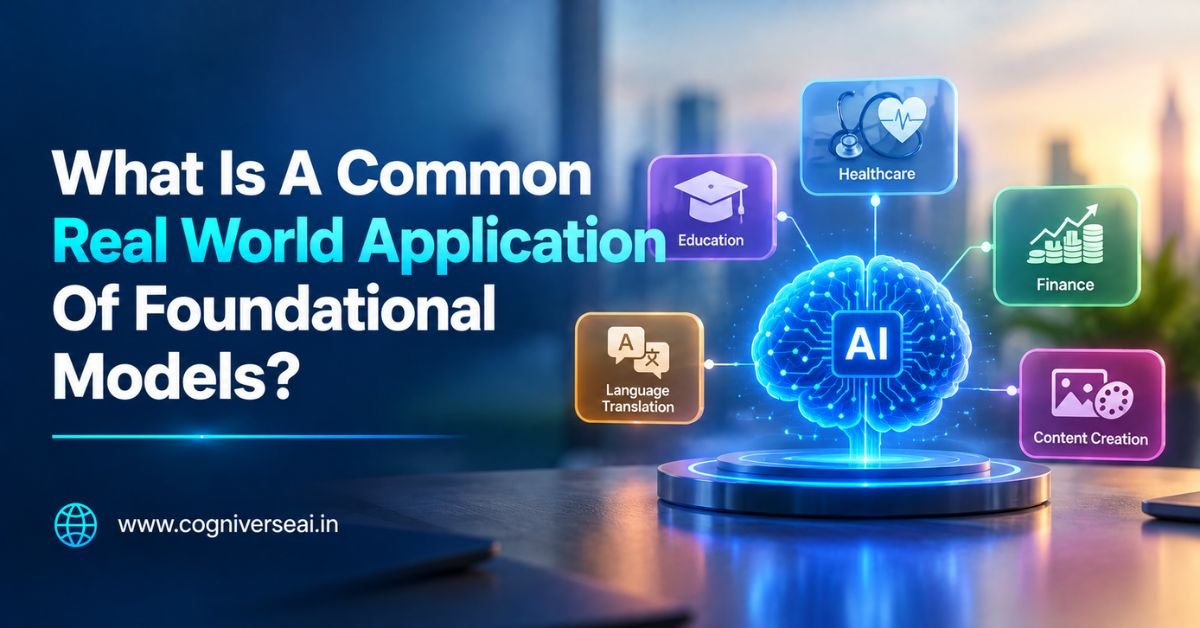
So, what is a common real world application of foundational models? One of the most common applications is natural language processing, especially chatbots and virtual assistants. Foundation models can power systems that answer questions, summarize information, generate content, translate text, assist with coding, and interact with users through natural language. They are also used in computer vision, healthcare, robotics, software development, and other fields. Stanford’s Center for Research on Foundation Models describes these models as systems trained on broad data that can be adapted to many downstream tasks.
The important idea is not just that foundation models can do many things. Their major advantage is that one broadly trained model can become the foundation for many specialized AI applications.
What Are Foundational Models?
A foundation model is an AI model trained on broad data at large scale and designed so that it can be adapted for a wide range of tasks.
Traditional machine learning often involves creating a model for a specific purpose. For example, one model might classify spam emails while another predicts whether a transaction could be fraudulent.
Foundation models follow a different approach. A general model is trained first, often using large amounts of unlabeled data and self-supervised learning. Developers can then adapt that model to specific tasks through methods such as prompting, fine-tuning, retrieval, or other techniques. IBM describes foundation models as broadly trained models that can be adapted for different applications, while Stanford emphasizes their broad training and ability to support many downstream tasks.
Also read: What Is A Common Realworld Application Of Foundational Models?
Why Are They Called Foundation Models?
They are called “foundation” models because they provide a base on which other AI applications can be built.
Think about a foundation under a building. The foundation is not the complete building, but it supports everything constructed above it.
A foundation model works in a similar way.
The model provides general capabilities, while the application adds the information, instructions, data, tools, and rules required for a particular use case.
For example, a company could use a language foundation model as the base for a customer-service assistant. The company could then connect that model to its product documentation, return policies, support database, and internal workflows.
The result is a specialized application built on top of a more general model.
What Is a Common Real-World Application of Foundational Models?
A very common real-world application of foundational models is AI-powered chatbots and virtual assistants.
Large language models can serve as the foundation for applications that communicate with users in natural language. These systems can answer questions, summarize documents, generate responses, translate text, classify messages, and help users find information. IBM identifies natural language processing as a major foundation-model application, with language models supporting tasks such as question answering, summarization, transcription, translation, and text generation.
For example, a company may build a customer-support chatbot using a general-purpose language model.
The foundation model provides broad language abilities.
The company then adds its own information and rules.
The chatbot can then answer questions such as:
“How long does shipping take?”
“What is your return policy?”
“How can I change my delivery address?”
The model handles the language interaction, while the application provides the business-specific information.
How Do Foundation Models Power Chatbots?
A chatbot needs more than the ability to generate sentences. It needs to understand a user’s question, identify relevant information, and produce a useful response.
A foundation model can provide much of the language capability required for these tasks.
Consider a customer asking:
“My order arrived damaged. What should I do?”
A basic language model can understand the request and generate a helpful response structure. But a reliable business chatbot may also need access to the company’s actual return and replacement policies.
A complete system might therefore work like this:
Customer question → Foundation model → Relevant company information → Generated response
This is an important point. The foundation model is not necessarily the entire application. It is often the general-purpose intelligence layer within a larger system.
Why Are Chatbots Such a Common Application?
Chatbots are a natural fit for foundation models because language models are designed to work with human language.
Many businesses already receive large numbers of questions through:
- Websites
- Mobile apps
- Messaging platforms
- Customer-support systems
A foundation model can help turn these conversations into a more automated and flexible experience.
Instead of creating a separate AI model for every possible customer question, a company can use one broadly capable model and provide the appropriate business context.
This can support many related tasks without requiring a completely different model for each one.
Content Creation Is Another Major Application
Foundation models are also widely used for content generation.
Depending on the model and modality, AI systems can create:
- Articles
- Product descriptions
- Emails
- Marketing copy
- Images
- Code
- Audio
- Other forms of digital content
IBM notes that generative AI applications can create text, images, code, video, music, and other content, with foundation models often serving as the underlying basis.
Example: Product Descriptions
Imagine an online store with thousands of products.
The business could provide structured product information such as:
- Product name
- Material
- Size
- Features
- Intended customer
- Usage instructions
A foundation model could then generate a first draft of a product description.
A human editor could review the output for accuracy and brand style.
The important benefit is not that the AI eliminates all human work. It can reduce repetitive drafting work and help employees start with a usable first version.
Document Summarization
Another practical application is summarizing large amounts of text.
Businesses and individuals often have more information than they have time to read.
Foundation models can be used to create shorter versions of:
- Meeting notes
- Reports
- Research papers
- Customer feedback
- Business documents
- Emails
- Policies
- Transcripts
For example, a company could provide a long meeting transcript and ask an AI assistant to identify the main decisions, assigned tasks, deadlines, and unresolved questions.
This is useful because the foundation model can handle the general language task while the surrounding application determines which documents or information the user is allowed to access.
Software Development
Foundation models are also used in software development and code generation.
A developer can use an AI application to:
- Generate code
- Explain existing code
- Write tests
- Suggest fixes
- Create documentation
- Convert code between languages
- Produce repetitive boilerplate
For example, a developer could describe a function in plain English and ask an AI coding assistant to generate a starting implementation.
The developer still needs to review and test the output.
The foundation model provides the general ability to work with programming languages and natural language, while the coding application adds tools and workflows designed for software development.
IBM lists software code generation among the real-world use cases for foundation models.
Translation and Multilingual Applications
Foundation models can also support translation and multilingual communication.
A company working across several countries could use an AI system to help translate product information, customer questions, internal communications, or marketing material.
For example, a customer-support application might receive a question in one language and generate a response in another.
However, human review remains important for legal documents, highly technical material, and situations where cultural or linguistic details can change the meaning.
The model can provide useful assistance, but accuracy should still be checked when the consequences of an incorrect translation are significant.
Computer Vision and Image Applications
Foundation models are not limited to language.
Some are designed for visual information and can support applications such as:
- Image classification
- Object detection
- Image understanding
- Visual search
- Image generation
- Image description
IBM identifies computer vision as another important area for foundation-model applications.
Example: Visual Product Search
Imagine an online shopping platform that lets users upload a photograph of a product they like.
A vision-based AI system could analyze the image and identify characteristics such as the type of object, color, shape, or visual style.
The shopping application could then search its catalog for similar products.
The foundation model provides the visual understanding, while the business application connects that capability to the company’s product database.
Healthcare Applications
Foundation models are also being developed for healthcare and biomedical applications.
Potential uses include:
- Medical document processing
- Clinical information support
- Medical image analysis
- Biomedical research
- Drug discovery
- Information retrieval
Stanford’s research identifies healthcare as an important application area but also points out that domains such as healthcare require special consideration of privacy, fairness, evaluation, and other social and technical issues.
This is an important distinction.
A general foundation model should not automatically be treated as a reliable medical decision-maker.
Healthcare applications need appropriate validation, domain-specific information, privacy protections, and professional oversight.
Education and Learning Support
Foundation models can also support education.
For example, an AI learning assistant can help students:
- Understand difficult concepts
- Generate practice questions
- Summarize study materials
- Review written work
- Explain mistakes
- Create study plans
Imagine a student who does not understand a science concept.
The student could ask an AI assistant to explain the topic in simpler language, provide a real-world analogy, and then create five practice questions.
The same foundation model can support different students with different requests because it is not limited to one fixed task.
However, educational AI works best when it supports learning rather than encouraging students to simply copy answers.
Customer Service and Enterprise Support
Customer service is one of the most practical business applications of foundation models.
Companies can use them to support:
- Frequently asked questions
- Customer message classification
- Response drafting
- Conversation summaries
- Internal knowledge assistants
- Employee support
For example, an employee might ask:
“What is our policy for replacing a damaged product?”
Instead of searching through hundreds of internal documents, an enterprise AI assistant could retrieve the relevant policy and summarize it.
This type of system combines the language capabilities of a foundation model with a company’s trusted internal information.
IBM describes customer care, enterprise knowledge assistants, document processing, software development, and workflow automation among important enterprise generative AI use cases.
How Do Businesses Adapt Foundation Models?
A foundation model is usually adapted to a specific application rather than used completely on its own.
Several approaches are common.
Prompting
The simplest approach is to provide the model with clear instructions and relevant information in the prompt.
For example:
“You are a customer-support assistant. Use the following return policy to answer the customer’s question.”
The model does not need to be retrained for every individual question.
Fine-Tuning
Fine-tuning involves additional training on task-specific data.
This can help a model become better suited to a particular domain or behavior.
Retrieval-Augmented Generation
With retrieval-augmented generation, the application retrieves relevant information from an external source and gives it to the model as context.
This is useful when the answer needs to rely on company documents or information that changes frequently.
Tool and API Integration
A foundation model can also be connected to external systems.
For example, a customer-service assistant could use:
Foundation model + customer database + order system + support platform
The model handles the language interaction while external systems provide current data or carry out actions.
Why Are Foundation Models Valuable in the Real World?
One major advantage is reuse.
Before foundation models became widespread, organizations often needed to create task-specific models for individual problems.
A foundation model can provide a shared starting point for multiple applications.
IBM explains that foundation models can reduce the effort involved in developing separate AI systems by allowing broadly trained models to be adapted for different tasks.
This can provide several practical benefits.
Faster AI Development
Developers can start with an existing pretrained model rather than building everything from zero.
Multiple Applications From One Model
The same foundation model can potentially support writing, summarization, classification, translation, question answering, and other tasks.
Easier Experimentation
Teams can test new AI ideas without necessarily training a new large model for every experiment.
Less Dependence on Task-Specific Training
A broadly trained model may already contain useful capabilities that can be adapted to a new task.
These benefits are a major reason foundation models have become an important approach to building AI applications.
What Are the Limitations of Foundation Models?
Foundation models are powerful, but they also introduce important risks and limitations.
Incorrect Outputs
A model can produce an answer that sounds convincing but is factually wrong.
Bias
Patterns present in training data can contribute to biased or harmful outputs.
Privacy Concerns
Applications must carefully manage sensitive information, especially when models are connected to business or personal data.
Security Risks
AI systems can be attacked or manipulated, particularly when models have access to external tools or private information.
High Computing Requirements
Large models can require significant computing resources for both training and large-scale deployment.
Shared Weaknesses
A particularly important risk is that the same foundation model can be reused across many applications. Stanford notes that defects or limitations in a foundation model can therefore be inherited by downstream applications that rely on it.
This makes evaluation of the underlying model especially important.
Is a Foundation Model the Same as a Generative AI Application?
No.
The two terms are related, but they describe different things.
A foundation model is the broadly trained model that provides general capabilities.
A generative AI application is a product or system built using a model, plus additional components that make it useful for a specific purpose.
A simple example is:
Foundation model + company documents + instructions + user interface = customer-support AI application
The model is the foundation, not the entire building.
This distinction is useful when understanding how AI products are developed.
Foundation Models vs. Traditional Machine Learning Models
Traditional machine learning models are often trained for a specific task.
For example:
Customer data → Prediction model → Likely to churn / Not likely to churn
A foundation-model approach is broader:
Large-scale training → General model → Adaptation → Many possible applications
This does not mean traditional machine learning is obsolete.
Task-specific models can still be more appropriate when a problem is narrow, data is structured, speed matters, or specialized performance is required.
The value of foundation models is their flexibility and ability to support many tasks from a shared base.
Real-World Examples in One View
| Application | Example Use |
|---|---|
| Chatbots | Answer customer questions |
| Virtual assistants | Help users complete everyday tasks |
| Content creation | Draft articles, emails, and product descriptions |
| Summarization | Turn long documents into key points |
| Translation | Support multilingual communication |
| Coding | Generate and explain software code |
| Computer vision | Analyze and describe images |
| Healthcare | Support research and information processing |
| Education | Explain concepts and create study material |
| Enterprise AI | Search knowledge and assist employees |
These examples show why the term foundation is important. The same broad technology can support many different applications when adapted appropriately.
How to Identify a Foundation-Model Application?
A simple way to identify one is to ask:
“Is this application using a broadly trained model that has been adapted or connected to other information for a specific task?”
If the answer is yes, it may be using a foundation-model approach.
For example, a customer-service chatbot may use a general language model and connect it to company documents.
A visual shopping tool may use a vision foundation model and connect it to a product catalog.
A coding assistant may use a language model trained on code and connect it to a developer’s software environment.
The important feature is the combination of general capabilities and task-specific adaptation.
Why Chatbots Are a Good Example to Remember?
If you need one simple answer for a quiz or basic AI question, remember:
Chatbots and virtual assistants are common real-world applications of foundation models.
A language foundation model can provide the ability to understand and generate text, while the surrounding application adds instructions, information, tools, and business rules.
That makes chatbots an easy example of how a general-purpose foundation model can become a useful real-world AI product.
Also read: Unique Speech Topics for Students
Conclusion
So, what is a common real world application of foundational models? One of the most common and easy-to-understand applications is AI-powered chatbots and virtual assistants. These systems use language foundation models to understand questions, generate responses, summarize information, translate text, and assist users with many different tasks. Foundation models can also support content creation, software development, computer vision, healthcare, education, search, and enterprise applications.
The main advantage of foundation models is their ability to act as a reusable base. Instead of training a completely new AI model for every individual task, developers can adapt an existing broadly trained model through prompting, fine-tuning, retrieval, and tool integration. This makes it possible to build many specialized applications from a common foundation.
However, a foundation model does not automatically make an application reliable. Developers still need accurate data, careful testing, security controls, privacy protections, and human oversight. The easiest way to remember the concept is: a foundation model provides general AI capabilities, while a real-world application adapts those capabilities to solve a specific problem.
Frequently Asked Questions (FAQ)
1. What is a common real world application of foundational models?
Chatbots and virtual assistants are common applications, along with content generation, summarization, translation, coding, and other AI-powered tasks.
2. How are foundation models used in real-world applications?
Developers adapt foundation models with prompts, fine-tuning, external data, retrieval systems, and tools to solve specific business or user problems.
3. Are chatbots based on foundation models?
Many modern AI chatbots use large language foundation models as their underlying technology for understanding and generating natural-language responses.
4. Can foundation models be used outside language?
Yes. Foundation models can support computer vision, image generation, speech, healthcare, robotics, scientific research, and multimodal AI applications.
5. Why are foundation models useful?
Foundation models are useful because one broadly trained model can be adapted for many different tasks, reducing the need to build every AI system entirely from scratch
1 thought on “What Is A Common Real World Application Of Foundational Models?”