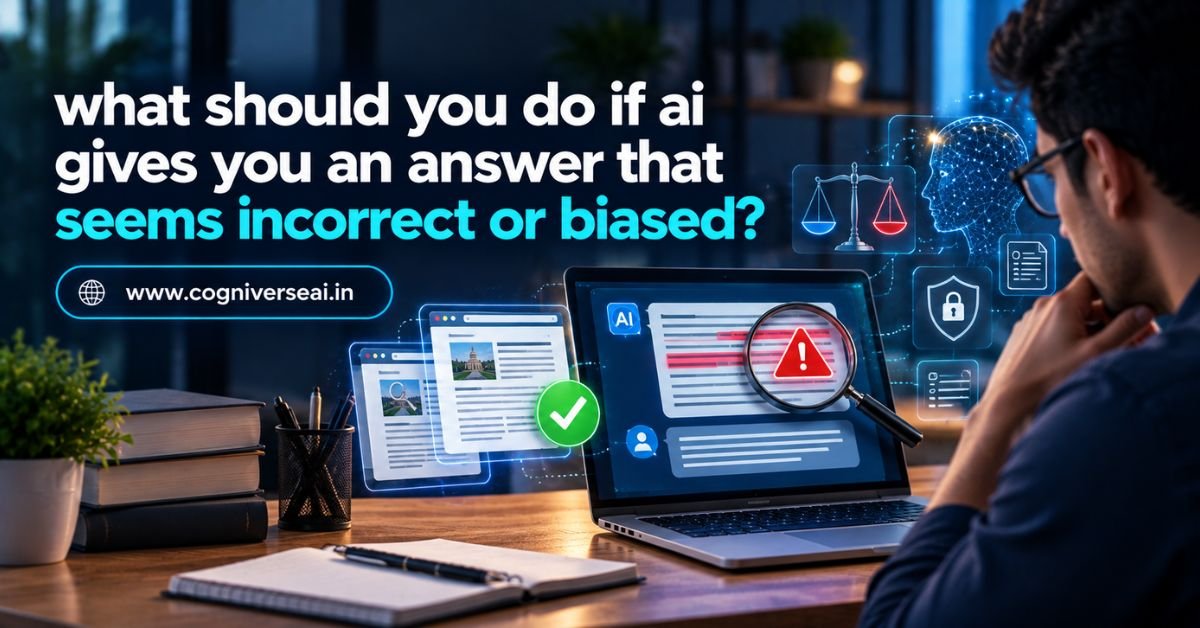
Artificial intelligence can answer questions, explain complex ideas, summarize information, translate languages, and help with many everyday tasks. But AI systems are not perfect. They can sometimes provide incorrect facts, leave out important context, misunderstand a question, or produce an answer that appears biased toward one viewpoint.
So, what should you do if AI gives you an answer that seems incorrect or biased? The best approach is to pause, question the answer, ask the AI to explain or reconsider it, verify important claims using reliable independent sources, and use human judgment before accepting or sharing the information.
This matters because an AI response can sound clear and confident even when it contains mistakes. OpenAI notes that ChatGPT can produce incorrect or misleading outputs, including incorrect facts, fabricated references, overconfident answers to difficult questions, and biased or oversimplified responses. It recommends critically assessing responses and verifying important information with reliable sources.
Learning how to respond to questionable AI answers is therefore an important part of AI literacy and responsible AI use.
Why Can AI Give an Incorrect or Biased Answer?
Before deciding what to do, it helps to understand why the problem can happen.
AI models learn patterns from large amounts of data. They do not automatically know whether every statement they generate is true. A language model can produce a response that is statistically likely to fit the conversation while still being factually wrong.
NIST refers to one important form of this problem as confabulation. This is when a generative AI system generates and confidently presents false or incorrect content. NIST notes that these errors can become especially serious in areas where people may rely on AI outputs to make important decisions.
Bias can also appear in AI outputs. UNESCO explains that AI systems can reproduce or amplify existing biases and emphasizes fairness, transparency, human oversight, and non-discrimination as important principles for AI ethics.
An answer may also seem biased because the question itself is complex, the available information is contested, or the AI presents only one perspective when several relevant viewpoints exist.
First, Do Not Accept the Answer Automatically
The first step is simple: do not treat an AI response as automatically true.
Look at the answer critically.
Ask yourself:
- Does the claim make sense?
- Is anything missing?
- Does the answer seem too certain?
- Does it contain dates, numbers, studies, or quotations that should be checked?
- Is the question controversial or open to different interpretations?
- Does the answer clearly separate facts from opinions?
This is especially important when the information could affect your health, finances, education, work, legal situation, safety, or reputation.
The more important the decision, the more carefully the information should be checked.
Also read: What Risk Is Posed By Internet Of Things Devices?
Ask the AI to Reconsider Its Answer
A useful next step is to ask the AI another question.
You can say:
“Can you check this answer for factual errors?”
Or:
“What evidence supports this claim?”
You can also ask:
“Are there other reasonable viewpoints on this issue?”
Or:
“Which parts of your answer are uncertain?”
This does not guarantee that the second answer will be correct. An AI system can repeat an error or produce a different incorrect answer.
However, asking it to identify assumptions, uncertainty, evidence, or alternative interpretations can help you inspect the response more carefully.
Ask for Sources, Then Check Them Yourself
If the answer includes important factual claims, ask for supporting sources.
For example:
“What are the original sources for these statistics?”
“Can you provide the official source for this requirement?”
“Where did this definition come from?”
But do not assume that a citation supplied by AI is automatically genuine or relevant.
OpenAI specifically warns that models can sometimes fabricate citations, references, studies, or quotations.
That means you should open the source yourself and check whether:
- The source actually exists
- The source says what the AI claims
- The publication date is appropriate
- The information is still current
- The source is authoritative for the subject
A genuine source can still be misunderstood by AI, so reading the relevant material yourself is valuable.
Verify Important Information Using Independent Sources
One of the strongest responses to a questionable AI answer is independent verification.
Instead of asking another AI system whether the first AI was correct, look for reliable original information.
Useful sources can include:
- Government websites
- Official organizations
- Universities
- Professional associations
- Original research papers
- Official product documentation
- Court or regulatory documents
- Reputable news organizations for current events
The source should match the subject.
For example, if you are checking a tax rule, an official government source is generally more useful than a random blog. If you are checking software behavior, the developer’s documentation is often the appropriate place to look.
This simple habit can prevent an AI error from becoming your error.
Check Whether the Answer Is Out of Date
Some AI answers may be wrong simply because information has changed.
Policies, software features, prices, regulations, scientific findings, company information, and public information can change over time.
Ask:
“What date does this information apply to?”
Then look for a recent and authoritative source.
OpenAI notes that without appropriate search or other tools, model responses may not incorporate events or information beyond the model’s available knowledge.
This is why current information should be checked when the date matters.
Look for Signs of Bias
An answer does not need to contain an obvious false statement to be biased.
Bias can appear through:
- One-sided wording
- Missing relevant perspectives
- Selective examples
- Unbalanced evidence
- Loaded descriptions
- Generalizations about groups
- Treating opinions as established facts
- Giving equal weight to claims that do not have equal evidence
UNESCO’s AI ethics framework highlights fairness, non-discrimination, transparency, accountability, and human oversight as important principles for AI systems.
If an answer seems biased, ask the AI to separate the information into categories such as:
Established facts
Evidence
Areas of uncertainty
Different viewpoints
Claims that require further verification
This can make the structure of the answer easier to evaluate.
Distinguish Facts From Opinions
Sometimes an AI answer seems biased because it mixes factual statements with interpretation.
For example:
Fact: A company released a new product on a specific date.
Opinion: The product is the best option available.
The first statement may be independently verified. The second is an evaluation that depends on criteria and evidence.
A useful prompt is:
“Separate the factual claims from opinions or interpretations in your answer.”
This encourages clearer reasoning.
You should still verify important facts independently, but separating the two categories makes questionable claims easier to notice.
Compare More Than One Reliable Perspective
Some subjects are genuinely complex.
There may be legitimate disagreement about causes, effects, methods, or policy choices.
In such cases, asking the AI for one definitive answer can oversimplify the issue.
Instead, ask:
“What are the main evidence-based viewpoints on this issue?”
Then check the underlying sources.
The goal is not to assume every viewpoint has equal support. It is to understand where there is genuine disagreement and where strong evidence points in one direction.
This is especially useful for scientific, historical, social, ethical, and policy-related questions.
Be More Careful With High-Risk Topics
Not every wrong AI answer has the same consequences.
A mistaken recommendation for a movie is inconvenient.
A mistaken medical, financial, legal, or safety answer can have much more serious consequences.
NIST notes that false AI-generated content can lead people to act on incorrect information and says these risks deserve particular attention in consequential applications such as healthcare.
For high-risk topics, use AI as a tool for understanding or organizing information, not as the final authority.
For example, AI might help explain a medical term in simple language, but diagnosis and treatment decisions should involve appropriate healthcare professionals and trusted medical information.
The same principle applies to legal and financial matters.
Give the AI Better Context
Sometimes an answer seems wrong because the question was too broad or ambiguous.
For example:
“Is this legal?”
does not provide enough information for a reliable answer.
A better question might explain the country, type of situation, relevant dates, and other necessary facts.
More context does not guarantee correctness, but it can reduce ambiguity and make the response more useful.
You can also ask the AI what information it needs before answering:
“What details would you need to answer this accurately?”
This is often more useful than repeatedly asking the same question.
Ask the AI to Show Uncertainty
AI systems can sometimes sound more confident than the evidence supports.
A useful prompt is:
“How confident are you, and what part of the answer is most uncertain?”
You can also ask:
“What assumptions are you making?”
This helps reveal where the answer depends on incomplete information.
However, remember that an AI-generated confidence statement is not the same thing as a statistical guarantee. A model can be confident and still be wrong. OpenAI specifically points out that confidence is not the same as reliability.
Do Not Repeat the Same Question as Your Only Verification Method
If an AI gives a questionable answer, asking:
“Are you sure?”
may produce another confident answer without actually resolving the problem.
A stronger approach is to change the verification method.
Instead of:
“Are you sure?”
try:
“Give me the evidence for this claim.”
Or:
“Find the primary source.”
Or:
“List what could make this answer wrong.”
Or:
“Compare this claim with official information.”
The goal is to introduce evidence and independent checking, not simply more confidence.
Be Careful When AI Confirms What You Already Believe
People naturally prefer information that agrees with what they already think.
AI can make this problem easier to overlook because it may produce a polished explanation that appears to support a user’s existing view.
This is why critical thinking matters.
When a topic is important, ask:
“What evidence would challenge this conclusion?”
“What important information might I be missing?”
“What is the strongest argument against this answer?”
These questions can help reduce confirmation bias and encourage a more balanced review.
Do Not Share a Questionable AI Answer Immediately
If an AI gives you an answer that seems incorrect or biased, avoid copying and sharing it immediately.
Take a moment to verify it first.
This is especially important for information that could affect other people.
For example, a false claim copied from an AI response could spread through:
- Social media
- School assignments
- Business reports
- Emails
- Presentations
- Online articles
- Customer communications
A short verification step can prevent a small error from becoming a much larger one.
What Should Students Do With Incorrect AI Answers?
Students can use the situation as a learning opportunity.
Instead of simply asking AI for another answer, they can:
- Identify the questionable claim.
- Find a trusted educational source.
- Compare the two answers.
- Determine what was wrong or missing.
- Correct the explanation.
- Keep the reliable source for future reference.
This approach strengthens research and critical-thinking skills.
AI should support learning, not replace the process of checking and understanding information.
What Should Businesses Do When AI Gives Biased or Incorrect Output?
Organizations need stronger controls when AI is being used in professional workflows.
A business may use several layers of protection:
Human Review
Important AI-generated content can be reviewed before publication or action.
Approved Sources
The system can be connected to trusted internal or external information.
Evaluation
Organizations can test AI systems with realistic examples and measure how often they fail.
Monitoring
Teams can review outputs over time to detect recurring problems.
Clear Accountability
Employees should know who is responsible when an AI-supported process produces an important decision or communication.
UNESCO’s framework emphasizes that AI systems should not displace ultimate human responsibility and accountability.
A Simple Five-Step Method
When you receive an AI answer that looks wrong or biased, use this simple process:
1. Pause
Do not immediately accept or share the answer.
2. Question
Ask the AI to explain its reasoning, assumptions, uncertainty, or evidence.
3. Verify
Check important claims using reliable independent sources.
4. Compare
Look at the original evidence and relevant perspectives.
5. Decide
Use human judgment to determine whether the answer is reliable enough for your purpose.
For low-risk tasks, this process may take only a minute.
For important decisions, it may require much more careful research.
A Practical Example
Suppose an AI gives you an answer about a new government rule.
The response sounds confident and includes a specific date and requirement.
Instead of copying the answer, you could:
First: ask the AI to identify the source.
Second: open the official government website.
Third: confirm that the rule exists.
Fourth: check whether the date and requirements match.
Fifth: check whether the information applies to your specific situation.
If the official information differs from the AI response, follow the authoritative source and treat the AI answer as incorrect.
This example shows an important principle: AI can help you find and understand information, but the most appropriate authoritative source should guide important decisions.
When Should You Trust an AI Answer?
The better question is not whether you should “trust AI” completely.
Instead, ask:
How much verification does this answer need?
A low-risk creative task may need little factual checking.
A basic educational explanation may need some review.
A high-impact claim may require strong evidence and human expertise.
The amount of verification should match the potential consequences of being wrong.
This is a more useful way to think about AI reliability than treating every response as either completely trustworthy or completely useless.
AI Literacy Means Knowing When to Question the Output
AI literacy is not simply knowing how to use prompts.
It also means understanding limitations and knowing when an answer needs further checking.
A strong AI user can recognize that:
- Fluent language does not guarantee truth.
- Confidence does not guarantee accuracy.
- A citation should be checked.
- Important information may need current sources.
- Bias can appear through omission or framing.
- Human judgment still matters.
UNESCO’s AI ethics guidance includes AI literacy and public understanding as important parts of responsible AI use.
This makes critical evaluation an important practical AI skill.
Also read: How to Avoid Sleepiness While Studying?
Conclusion
So, what should you do if AI gives you an answer that seems incorrect or biased? Do not accept or share it immediately. Question the response, ask the AI to identify its assumptions and evidence, verify important claims using reliable independent sources, compare relevant information, and use human judgment before acting on the result.
AI systems can produce useful answers, but they can also generate false information, overconfident statements, incomplete explanations, or biased content. NIST identifies these risks in generative AI, while UNESCO emphasizes human oversight, fairness, transparency, accountability, and AI literacy.
The most important habit is simple: treat AI output as information to evaluate, not as an automatic source of truth.
When the information is low-risk, a quick check may be enough. When the information could affect health, money, education, legal matters, safety, or other important decisions, stronger verification and qualified human expertise are appropriate.
Used this way, AI can be a powerful assistant without becoming a substitute for critical thinking.
Frequently Asked Questions (FAQ)
1. What should I do if an AI answer seems wrong?
Question the answer, ask for evidence, and verify the important claims using reliable independent sources before accepting or sharing them.
2. How can I tell if an AI answer is biased?
Look for one-sided wording, missing perspectives, unsupported assumptions, selective evidence, or opinions presented as established facts.
3. Can I trust AI-generated sources and citations?
Not automatically. AI can sometimes provide incorrect or fabricated citations, so open the source and check that it supports the claim.
4. Should I use AI for important decisions?
AI can help organize or explain information, but important decisions should use reliable evidence and appropriate human expertise, especially in high-risk areas.
5. Why can AI sound confident when it is wrong?
Generative AI can produce fluent responses that fit learned patterns without guaranteeing factual accuracy. Confidence in the wording does not guarantee that the information is correct.