Natural language models have changed the way people interact with computers. Instead of learning complicated commands or software instructions, users can communicate with AI using ordinary language. Tools such as ChatGPT can respond to questions, explain ideas, summarize information, translate text, rewrite content, brainstorm, and help with many other language-based tasks.
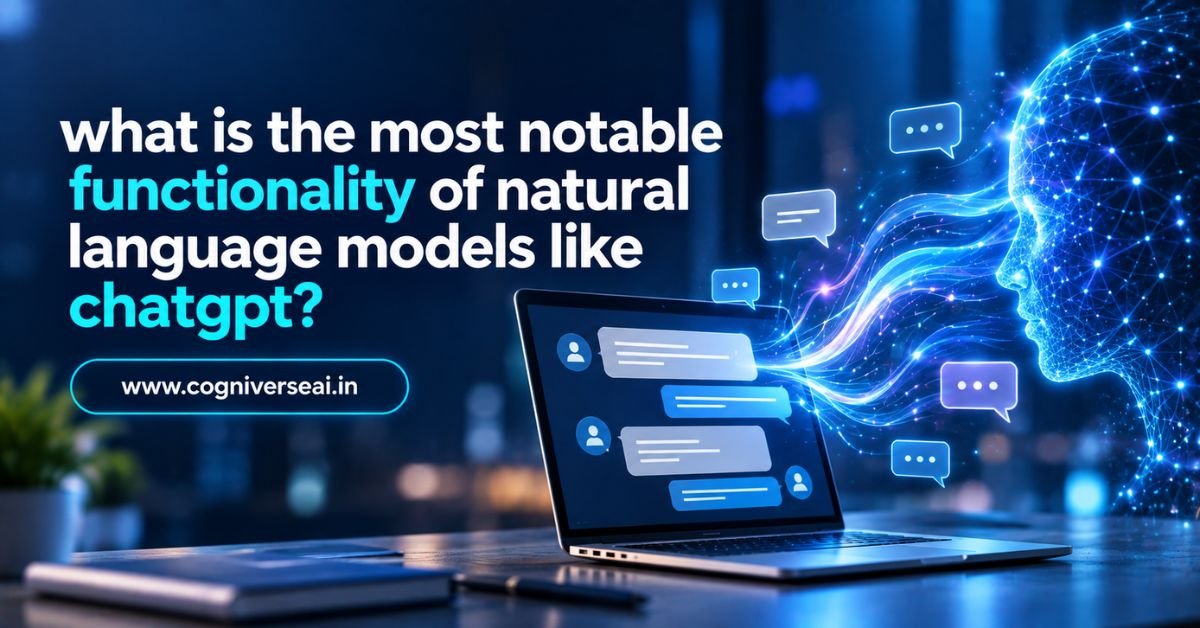
So, what is the most notable functionality of natural language models like ChatGPT? The clearest answer is their ability to understand natural-language instructions and generate human-like text responses that fit the context of a conversation.
This ability makes natural language models useful for far more than simple question answering. They can help people write, learn, research, organize information, solve problems, and communicate. OpenAI describes ChatGPT as a conversational AI assistant that understands natural language and can help with tasks such as answering questions, explaining concepts, drafting, rewriting, summarizing, translating, and generating creative ideas.
At the same time, natural language models have limitations. Their responses can sometimes be incorrect or misleading, so important information should be reviewed and verified rather than accepted simply because it sounds confident.
What Are Natural Language Models?
Natural language models are AI systems designed to work with human language.
They can process written language and, depending on the model and application, may also work with other forms of information. Modern language models learn patterns from large amounts of data and use those patterns to generate responses to instructions or questions.
At a simple level, a language model receives an input and predicts a useful continuation or response based on what it has learned.
For example:
User: Explain photosynthesis in simple English.
AI: Photosynthesis is the process plants use to make food using sunlight, water, and carbon dioxide.
The response may look simple, but producing a useful answer requires the model to process the meaning and context of the user’s request and generate language that fits it.
OpenAI explains that its text-generation models are trained to understand natural and formal language and can be used for tasks such as content generation, summarization, conversation, creative writing, and more.
Also read: Which AI Focuses On Classifying Or Identifying Content That Is Based On Preexisting Data?
What Is the Most Notable Functionality of Natural Language Models Like ChatGPT?
The most notable functionality is natural-language understanding combined with natural-language generation.
A useful way to think about this is:
You communicate with the AI in normal language, and the AI responds in language that is structured to fit your request.
This makes interaction much more accessible.
Instead of learning a specific programming language or rigid command syntax, a user can write something like:
“Explain this topic for a 10-year-old.”
The model can then adapt its response to the instruction.
This ability to follow instructions and maintain conversational context is one of the main reasons tools like ChatGPT are easy to use. OpenAI’s current ChatGPT documentation notes that it can understand natural language, follow complex instructions, remember previous turns within a conversation, and adapt responses to context.
Understanding Human Language
Before a language model can produce a useful response, it needs to interpret the user’s input.
This does not mean that the model understands language in exactly the same way a human brain does. Instead, it uses patterns learned during training to process the words, relationships, and context in an input.
Consider these two requests:
“Write an email about the meeting.”
“Write a short, polite email to my manager explaining that I cannot attend tomorrow’s meeting.”
The second request contains more context.
A capable language model can use the added information to produce a more appropriate response.
This ability to work with natural instructions is one of the most important features of modern language models.
Generating Human-Like Responses
After interpreting an instruction, a language model generates a response.
The output can take many forms:
- A direct answer
- An explanation
- A summary
- A list
- A draft
- A translation
- A conversation
- A creative piece
- Computer code
- Structured information
OpenAI’s documentation explains that text-generation models can produce many kinds of outputs, including prose, code, mathematical expressions, and structured formats.
This flexibility is what makes natural language models different from many older software systems that were designed for one narrow task.
Why Conversational Interaction Matters?
The conversational nature of models like ChatGPT is especially important.
A user does not always know exactly how to phrase a question the first time. They can ask a follow-up question, correct the AI, provide more context, or request a different explanation.
For example:
User: Explain machine learning.
AI: Gives a basic explanation.
User: Make it simpler.
AI: Gives a simpler explanation.
User: Give me a real-world example.
AI: Provides an example.
This back-and-forth interaction makes AI feel more like a conversation than a traditional search or software interface.
OpenAI’s current ChatGPT documentation specifically describes follow-up questions and maintaining context within a chat as part of the experience.
Natural Language Models Can Summarize Information
Another major use is summarization.
People often have to deal with long documents, reports, articles, meeting notes, research papers, and other written material.
A natural language model can help create a shorter version that focuses on important information.
For example, a user could provide a long report and ask:
“Summarize this in five key points.”
The model may produce a concise overview.
This can save time, but users should still check important summaries against the original source. A summary can leave out details or misunderstand an important point.
The ability to summarize is part of the broader language-processing capability that makes these models useful for knowledge work.
Helping With Writing and Rewriting
Writing assistance is another highly visible use of natural language models.
A user can ask the AI to:
- Draft an email
- Improve grammar
- Rewrite a paragraph
- Make text shorter
- Change the tone
- Create an outline
- Brainstorm ideas
- Explain difficult wording
For example, a person may have a rough message that sounds too informal for a professional setting. The AI can help rewrite it in a clearer and more professional tone.
This does not mean the AI automatically knows exactly what the user wants. Better instructions and useful context generally help produce more suitable results.
Translation and Multilingual Communication
Natural language models can also support multilingual communication.
Modern language models can work across many languages, although performance can vary by language and task. OpenAI states that its models can understand and generate text in a wide range of languages and can handle multilingual inputs and outputs.
This creates useful applications for:
- Translation
- Language learning
- International communication
- Localization
- Multilingual customer support
- Cross-language research
For example, a business could use an AI model to create a first draft of a translated message and then have a human review it for accuracy and cultural appropriateness.
Answering Questions
Question answering is one of the most familiar uses of language models.
People can ask questions about:
- Science
- History
- Technology
- Education
- Writing
- Programming
- Business concepts
- Everyday topics
The important difference between a language model and a traditional database is that the model generates an answer from the information and patterns available to it rather than simply returning a fixed stored sentence.
However, this flexibility also creates a risk.
A model can produce a fluent answer even when some of its claims are wrong.
OpenAI explicitly warns that ChatGPT responses can sometimes be incorrect or misleading.
That is why natural-language ability should not be confused with guaranteed factual accuracy.
Why AI Responses Can Sound So Human?
One reason these systems attract attention is their ability to produce fluent, natural-sounding text.
Language models are trained on large amounts of human-generated information and learn patterns involving words, phrases, structure, and context.
OpenAI explains that its models learn relationships within large amounts of information and use those learned patterns to predict and generate responses.
This allows the output to have features people associate with ordinary writing:
- Sentence structure
- Context
- Coherent paragraphs
- Appropriate vocabulary
- Different tones
- Question-and-answer patterns
However, sounding human does not mean being human.
A model does not automatically possess human experiences, personal beliefs, or a guaranteed understanding of the truth behind every statement it produces.
Natural Language Models Can Adapt Their Responses
Another important functionality is adaptation.
The same model can respond differently depending on the user’s instructions.
For example, a user could ask for an explanation:
“Explain neural networks.”
Then ask:
“Explain it like I am a beginner.”
Then:
“Give me a technical explanation.”
The underlying topic remains the same, but the expected audience and style change.
This ability to adapt language makes natural language models useful across different types of users.
A student, teacher, developer, business employee, researcher, or writer can interact with the same type of system while asking for different forms of output.
Natural Language Models and Context
Context is critical to useful conversation.
Consider this exchange:
User: I am writing a blog about machine learning.
AI: Provides relevant assistance.
User: Make the introduction shorter.
The second instruction depends on the context established in the first message.
A conversational language model can use earlier messages in the chat to interpret the follow-up.
This makes it possible to work on larger tasks step by step instead of repeating the entire request every time.
OpenAI’s current description of ChatGPT notes that it can follow complex instructions, remember previous turns in a conversation, and adapt its responses to context.
Natural Language Models Are Useful for Learning
Language models can also act as learning assistants.
A student might use one to:
- Explain a difficult concept
- Create practice questions
- Give examples
- Compare two ideas
- Review a paragraph
- Generate a study outline
- Practice a language
The ability to ask follow-up questions can make learning more interactive.
For example, a student can ask:
“What is photosynthesis?”
Then:
“Why does sunlight matter?”
Then:
“Give me a real-life example.”
Then:
“Create five multiple-choice questions.”
This type of interaction can help learners explore a topic from different angles.
The quality of learning still depends on how the tool is used. Students should not assume that every generated answer is correct, especially for important academic information.
Natural Language Models in Business
Businesses use language models for many language-heavy tasks.
Examples include:
Customer Support
AI can help draft responses to common customer questions.
Marketing
Marketers can use AI for brainstorming, first drafts, campaign ideas, and variations in messaging.
Documentation
Companies can summarize or reorganize internal information.
Research
AI can help organize and explain large amounts of text, especially when used alongside reliable sources and appropriate verification.
Software Development
Language models can generate or explain code and help developers work through programming problems.
OpenAI’s current description of ChatGPT includes writing, coding, brainstorming, studying, planning, data analysis, image work, and other tasks, showing how broad the practical use of conversational AI has become.
The Difference Between Language Understanding and True Understanding
It is useful to avoid a common misunderstanding.
When people say that a language model “understands” language, they usually mean that the model can process language effectively enough to respond to it.
This is not necessarily the same as human understanding.
A person understands a sentence through lived experience, physical perception, memory, intentions, social knowledge, and many other factors.
A language model works through learned patterns and computation.
This difference matters because a model may generate a convincing answer while missing an important real-world detail.
Why Verification Still Matters
The ability to generate fluent language can sometimes make mistakes difficult to notice.
This creates an important rule:
A natural-sounding answer is not automatically a verified answer.
For low-risk tasks, a mistake may only require a correction.
For high-stakes subjects, such as medical, legal, financial, or safety information, users should rely on appropriate authoritative sources and qualified professionals rather than treating a language model as the final authority.
AI can assist with understanding information, but responsibility for important decisions should remain with people and the appropriate sources.
What Natural Language Models Cannot Guarantee?
It is just as important to understand the limits of these systems.
Natural language models cannot guarantee that every response will be:
- Factually correct
- Complete
- Current
- Unbiased
- Appropriate for every situation
- Supported by a reliable source
OpenAI’s guidance on responsible AI use notes that language models may produce incorrect information and that users should apply care when using their outputs.
This is why responsible use involves checking important information rather than blindly accepting generated content.
How to Get Better Results From Natural Language Models?
Users can often improve results by giving clearer instructions.
State the Goal
Tell the model exactly what you want.
Give Context
Explain the audience, purpose, background, and important requirements.
Specify the Format
Ask for a paragraph, table, email, checklist, summary, or another format.
Provide Examples
When appropriate, show the style or structure you want.
Review the Result
Check important facts, figures, sources, and claims.
Prompting is essentially the way users communicate instructions to language models. OpenAI’s documentation describes prompts as inputs used to tell a model what task to perform and notes that instructions and examples can guide the output.
Why This Functionality Is So Important?
The ability to interact with computers using ordinary language changes who can access advanced digital tools.
A person does not need to know programming to ask an AI system to explain code.
A student does not need to understand machine learning algorithms to ask for a simple explanation.
A business employee does not need to be an experienced writer to request help drafting a professional email.
This lowers the communication barrier between people and software.
Natural language becomes the interface.
That is one of the most important reasons language models have attracted such widespread interest.
The Future of Natural Language Models
Natural language models are likely to become part of more digital workflows.
The interaction may move beyond simple chat and include combinations of text, images, voice, files, software tools, and structured data.
Current ChatGPT capabilities already include features such as file analysis, image understanding, voice interaction, web search, data analysis, and other tools depending on the user’s plan and settings.
This means the most important functionality may increasingly be understood not simply as “text generation,” but as using natural language to communicate goals to an AI system that can then help perform a wide range of tasks.
Even as these systems become more capable, human review and judgment will remain important where accuracy, privacy, safety, or important decisions are involved.
Also read: Why Kids Should Have Less Homework?
Conclusion
So, what is the most notable functionality of natural language models like ChatGPT? The clearest answer is their ability to understand natural-language instructions and generate human-like responses that fit the user’s request and conversational context.
This core capability supports many practical uses, including question answering, writing, rewriting, summarization, translation, education, brainstorming, coding assistance, customer support, and business communication.
The biggest change is the interface. People can communicate with powerful AI systems using ordinary language rather than needing specialized commands or programming knowledge.
However, fluent language should not be confused with guaranteed truth. Natural language models can make mistakes, omit important information, or produce misleading content. Users should therefore verify important information and keep human judgment involved in high-impact situations.
The key idea is simple: natural language models make computers easier to communicate with by allowing people to express tasks and questions in everyday language and receive useful generated responses in return.
Frequently Asked Questions (FAQ)
1. What is the most notable functionality of ChatGPT?
Its most notable functionality is understanding natural-language instructions and generating context-aware, human-like text responses.
2. What can natural language models do?
They can answer questions, write and rewrite text, summarize information, translate languages, brainstorm ideas, explain concepts, and assist with code.
3. Are natural language model responses always correct?
No. These models can produce incorrect or misleading information, so important facts should be checked against reliable sources.
4. Why are natural language models easy to use?
They allow users to communicate with AI using ordinary language instead of requiring specialized commands or programming knowledge.
5. How does ChatGPT use context?
Within a conversation, ChatGPT can use earlier messages to understand follow-up questions and adapt its response to the ongoing context.