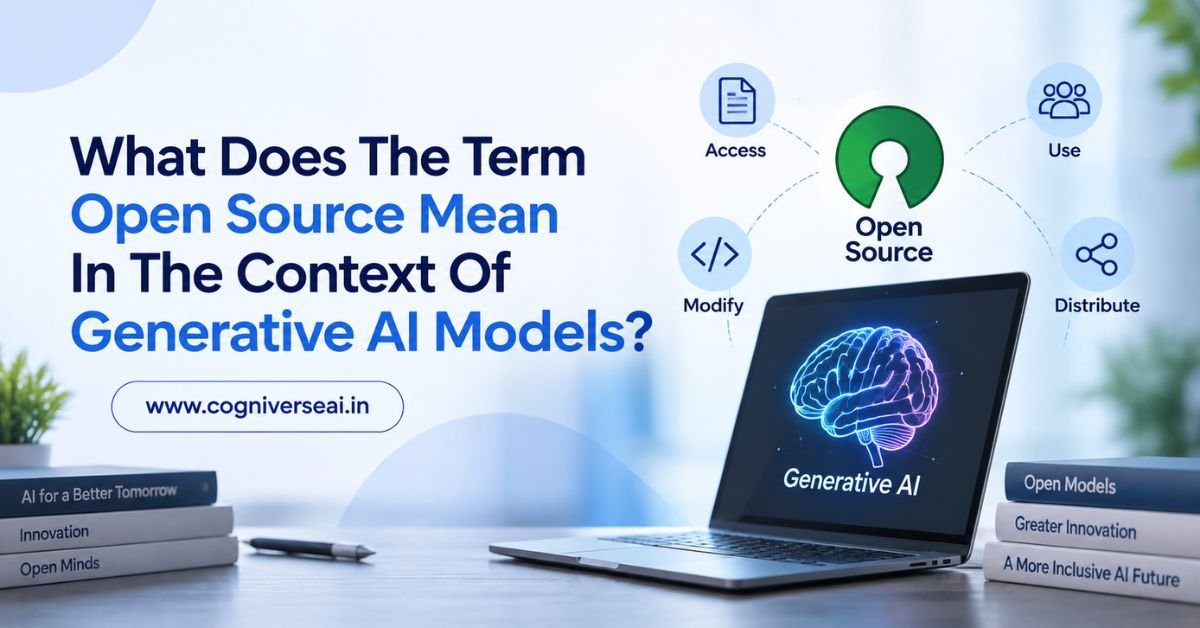
Generative AI models can create text, images, code, audio, and other types of content. But not every AI model is available in the same way. Some models are controlled entirely by the company that develops them, while others make important parts of their technology available for people to inspect, use, modify, or build upon.
So, what does the term open source mean in the context of generative AI models?
In simple terms, an open source generative AI model is a model whose relevant source materials are made available under terms that allow others to access, use, study, modify, and often redistribute them. However, the exact meaning of “open source” can vary depending on what the developer releases and what license applies.
This distinction is important because an AI model may publish its model weights without releasing its complete source code, training data, or training process. Calling such a model “open source” can therefore be misleading if the relevant components are not actually available under an open-source license.
Understanding what is and is not open helps users make better decisions about AI models, especially when privacy, customization, cost, transparency, and commercial use matter.
What Does Open Source Mean in Generative AI?
In traditional software, open source generally means that the source code is available under a license that gives users specific freedoms to use, study, modify, and share the software.
Generative AI is more complicated because an AI model is not just a piece of source code.
A complete AI system can involve several components, including:
- Source code
- Model architecture
- Model weights
- Training data
- Training methods
- Documentation
- Evaluation tools
- Inference software
When someone says a generative AI model is “open source,” it is important to ask which parts are actually available and under what license.
For example, a developer might release model weights that allow users to download and run a model locally. But if the training data and training code are unavailable, users cannot fully reproduce how the model was created.
That is why open weights, open source, and open data should not automatically be treated as the same thing.
Also read: Which Level Of AI Refers To Machines That Can Perform Any Intellectual Task That A Human Can?
What Are Open Weight AI Models?
One of the most important terms to understand is open weights.
Model weights are the numerical parameters learned during training. They contain much of the information that determines how the trained model behaves.
If a company releases the weights, developers may be able to download the model and run it using compatible software.
This can provide significant freedom compared with an AI model that can only be accessed through a company’s online API.
However, releasing weights alone does not necessarily mean that the entire AI system is open source.
Open Source vs Open Weights
Consider this simple comparison:
Open source AI: Relevant source materials are released under an open-source license that provides appropriate freedoms.
Open weights AI: The trained model weights are publicly available, but other parts of the system may remain closed or have restrictive licensing.
This distinction matters when evaluating what you are legally and technically allowed to do with a model.
Why Do Developers Use Open Source AI Models?
Open models can be useful for developers, researchers, businesses, educators, and hobbyists.
One major benefit is greater control.
If the model can be downloaded and run locally, developers may have more control over how it is deployed and integrated into their applications.
For example, a company might want to connect an AI model to an internal application without sending every piece of data to an external AI service.
Open models can also make experimentation easier. Developers can study available components, adapt models to specific use cases, and build additional tools around them, subject to the model’s license.
Key Advantages of Open Source Generative AI
More Customization
An openly available model can give developers more opportunities to customize their AI system.
Depending on what is released, developers may be able to fine-tune the model for a specific task or adapt it to a particular type of data.
For example, a business could customize a language model for internal document classification or a specialized customer-support workflow.
Greater Deployment Control
When model weights and supporting software are available, organizations may have the option to run the model on their own infrastructure.
This can provide greater control over deployment, hardware, access, and system configuration.
However, running a large AI model locally can require significant computing resources.
Research and Learning
Open models can be valuable educational resources.
Students and researchers can experiment with model architectures, inference methods, fine-tuning, evaluation, and other parts of the AI development process.
This can provide a deeper understanding than simply sending prompts to a hosted AI service.
Community Development
Open AI projects can attract developers who create tools, improvements, integrations, documentation, and other resources around the model.
This can help create an ecosystem that extends beyond the original development team.
Potential Cost Savings
Running an open model does not automatically mean it is free.
Users may avoid some API charges, but they can still have expenses for:
- GPUs
- Cloud computing
- Storage
- Electricity
- Maintenance
- Engineering
- Deployment
Therefore, “open source” should not be confused with “zero cost.”
What Are the Limitations of Open Source AI?
Open models also come with challenges.
Licensing Restrictions
Not every publicly available model uses a traditional open-source license.
Some models have licenses with additional conditions or restrictions. These conditions may affect commercial use, redistribution, modification, or other activities.
Always check the specific license before using a model for an important project.
Hardware Requirements
Running a large model yourself can require powerful hardware.
A model may be freely downloadable, but operating it efficiently can still be expensive.
Smaller models are generally easier to run on consumer hardware, while larger models may require substantial GPU memory or cloud infrastructure.
Technical Knowledge
Self-hosting an AI model can require knowledge of:
- Python
- Machine learning frameworks
- GPUs
- Model formats
- APIs
- Deployment
- System administration
A hosted AI service can be much easier for someone who does not want to manage infrastructure.
Support May Vary
Commercial AI services often provide official documentation, support systems, and managed infrastructure.
Community-supported open projects may depend more heavily on documentation, forums, developers, and community contributions.
The quality of support varies from project to project.
Does Open Source Mean Anyone Can Use the AI for Anything?
Not necessarily.
This is one of the most common misunderstandings.
The rights you have depend on the license attached to the model and its components.
Some licenses allow broad commercial and non-commercial use. Others impose specific conditions.
For example, a license may require users to preserve certain notices or comply with particular restrictions.
Therefore, before deploying an AI model in a commercial product, do not rely only on the words “open source” in a model description.
Read the actual license and understand what it permits.
Why Is the License Important?
A license defines the permissions and obligations associated with using a model or its code.
Two models can both be publicly downloadable but provide very different legal rights.
When evaluating an AI model, check:
- What components are released?
- What license applies to each component?
- Is commercial use allowed?
- Can the model be modified?
- Can modified versions be redistributed?
- Are there attribution requirements?
- Are there restrictions on certain uses?
These questions are especially important for businesses and developers building products around third-party models.
What Parts of a Generative AI Model Can Be Open?
Generative AI is made up of multiple layers, and different projects may open different parts.
Source Code
The source code explains how software is created and how different components work.
Model Weights
Weights are learned parameters produced through training. Releasing them allows users to run a trained model in suitable environments.
Model Architecture
Architecture describes how the model is structured, including the types and arrangement of its components.
Training Code
Training code can show how a model was trained, including the algorithms, optimization process, and configuration.
Training Data
Training data consists of information used to train the model.
This is one of the hardest components to make fully available because datasets can contain copyrighted material, personal information, licensed content, proprietary information, or other restricted material.
As a result, an AI project may be relatively open in some areas while remaining closed in others.
Can Open Source AI Be Run Locally?
In many cases, yes, if the necessary model files, software, and hardware requirements are available.
Local AI means that inference happens on a user’s own computer or on infrastructure controlled by the user rather than entirely through a remote AI provider.
For example, a developer could download an eligible language model and use compatible software to generate text on a local machine.
The exact requirements depend on the model.
A smaller model may run on a powerful consumer computer, while a very large model may require multiple GPUs or specialized infrastructure.
Local deployment can offer benefits such as greater control over data and reduced dependence on an external API, but it also transfers responsibility for security, updates, performance, and maintenance to the user.
Open Source AI and Privacy
Privacy is another reason organizations may consider open or locally deployable AI models.
If sensitive information is processed locally, it may be possible to avoid sending that information to an external AI service.
For example, an organization handling confidential internal documents might prefer a deployment model where those documents remain within its controlled infrastructure.
However, using an open model does not automatically guarantee privacy.
A local AI system can still expose sensitive information through poor access controls, insecure storage, logs, applications, or other parts of the deployment.
Privacy depends on the complete system, not simply whether the model is open.
Open Source AI and Transparency
Open models can provide more visibility into certain aspects of an AI system.
If source code, weights, documentation, or evaluation information are available, researchers can inspect those materials and study how the system works.
But openness does not automatically make a model completely transparent.
For example, if the full training dataset is unavailable, it may be difficult to determine exactly what information influenced the model during training.
Similarly, having access to model weights does not make the model’s internal decision process easy for humans to understand.
Therefore, open access and explainability are related but different concepts.
Examples of Open Source Generative AI Uses
Open generative AI can be used in many practical situations.
Education
Students can experiment with language models, study AI concepts, and learn how models are deployed.
Software Development
Developers can integrate locally available models into coding tools, document-processing systems, and other applications.
Business Applications
Companies can adapt models for internal search, classification, summarization, content workflows, or customer-support systems.
Research
Researchers can investigate model behavior, evaluate performance, experiment with fine-tuning, and compare different approaches.
Personal Projects
Hobbyists can run models locally and experiment with text generation, image generation, coding assistance, or other AI applications.
The suitability of a model depends on its capabilities, license, hardware requirements, and the specific use case.
How to Choose an Open Generative AI Model?
If you are considering an open model, do not choose it based only on popularity or benchmark scores.
Use a simple checklist.
Check the License
Understand exactly what you are permitted to do.
Check What Is Actually Open
Determine whether the project provides weights, source code, training information, data, documentation, or only selected components.
Check Hardware Requirements
Find out how much memory and computing power the model needs.
Test Its Performance
A model that performs well on general benchmarks may not be the best model for your particular task.
Test it using realistic examples from your intended use case.
Check Maintenance and Community Activity
Look at documentation, updates, issue tracking, and available tools.
An active ecosystem can make deployment and troubleshooting easier.
Consider Security
Review how the model will be deployed and how data, user access, model files, and generated content will be protected.
Is Open Source AI Better Than Closed AI?
There is no universal winner.
Open models can offer control, customization, local deployment, and flexibility.
Closed AI services can offer ease of use, managed infrastructure, integrated tools, and professional support.
The better option depends on what you need.
A small business that wants to add AI quickly may prefer a hosted service. A developer who needs deep customization or local processing may prefer an openly available model.
The decision should be based on the actual requirements rather than the label “open source.”
Open Source AI vs Closed AI
The difference can be summarized simply:
| Feature | Open or Openly Available AI | Closed AI |
|---|---|---|
| Model access | May be downloadable | Usually provider-controlled |
| Customization | Often greater | Usually more limited |
| Local deployment | Often possible | Often unavailable |
| Infrastructure | User may manage it | Provider usually manages it |
| License | Varies | Controlled by provider terms |
| Transparency | Can provide more visibility | Usually less internal access |
| Ease of use | May require technical setup | Often easier |
The exact differences vary from one model and provider to another.
Why the Term Open Source Can Be Confusing?
Generative AI has made the word “open” more complicated because an AI model consists of more than source code.
A project may release:
- Weights but not training data
- Code but not weights
- Documentation but not complete training information
- A model under a custom license
- Some components under open licenses and others under different terms
This is why responsible users should look beyond marketing labels.
The most useful question is not simply “Is this AI open source?”
Instead, ask:
“Which parts are available, under which license, and what am I allowed to do with them?”
That question provides a much clearer picture.
Also read: Impromptu Speech Topics for Kids
Conclusion
So, what does the term open source mean in the context of generative AI models?
It generally means that important parts of an AI system are made available under terms that give users the ability to access, study, use, modify, or share those components. However, generative AI has several components, so the term needs to be examined carefully.
A model with publicly available weights is not necessarily the same as a fully open-source AI system. Source code, model weights, training data, training methods, documentation, and licenses can all differ between projects.
Open generative AI can provide valuable benefits such as customization, local deployment, research opportunities, greater control, and community development. At the same time, users must consider licensing, hardware costs, security, privacy, maintenance, and technical requirements.
The best way to evaluate an AI model is to look beyond the label and understand exactly what has been released and what the license allows. This helps developers, businesses, students, and researchers choose AI tools that genuinely fit their needs.
Frequently Asked Questions (FAQ)
1. What does open source mean for generative AI?
It means relevant AI components are made available under terms that allow users certain freedoms to access, use, study, modify, or share them.
2. Is an open weights model always open source?
No. Open weights mean the trained model parameters are available, but the source code, training data, or other components may remain unavailable.
3. Can open source AI models be used commercially?
It depends on the model’s license. Always check the specific license to understand whether commercial use and redistribution are permitted.
4. Can I run an open AI model on my own computer?
Yes, many openly available models can be run locally, but the required hardware and software depend on the model’s size and design.
5. What is the main benefit of open source AI?
It can give developers greater control, customization, transparency, and flexibility compared with AI systems that are only available through a provider.
1 thought on “What Does The Term Open Source Mean In The Context Of Generative AI Models?”