
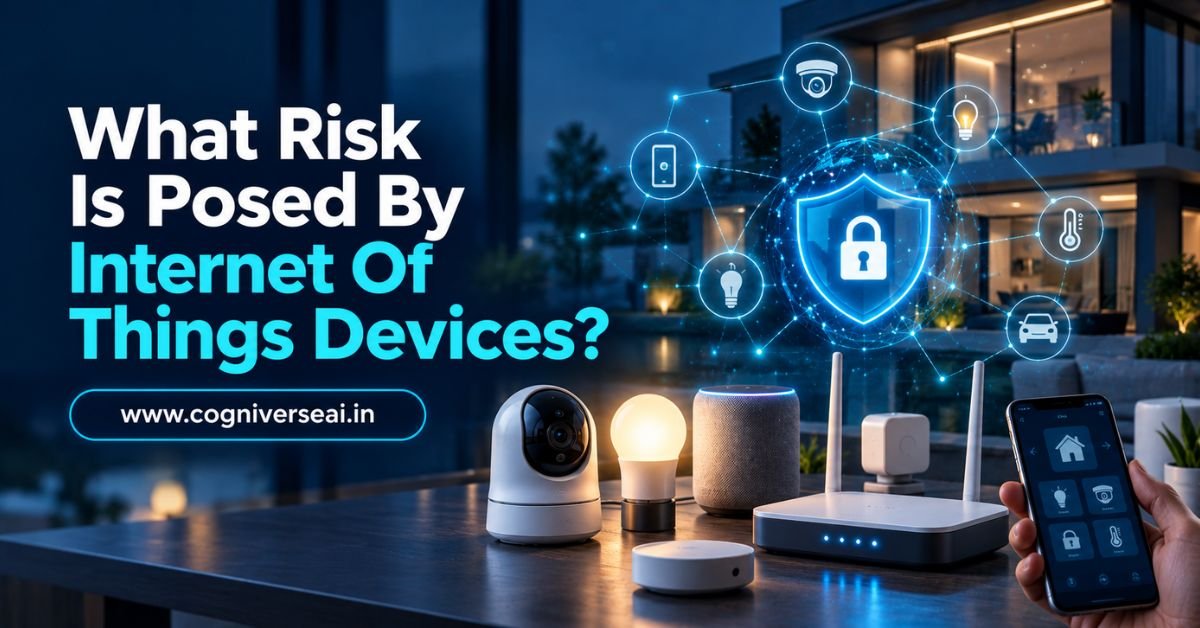
The Internet of Things, or IoT, connects everyday physical devices to the internet so they can collect, exchange, and sometimes act on data. Smart cameras, watches, speakers, thermostats, security systems, medical devices, vehicles, industrial sensors, and connected appliances are common examples.
These devices can make life and business operations more convenient, but they also create new risks because they are connected to networks and often collect information about people, places, and activities.
So, what risk is posed by internet of things devices? The most important risk is cybersecurity and privacy exposure. If an IoT device is poorly secured, attackers may be able to gain unauthorized access, steal data, monitor users, disrupt services, or use the compromised device to attack other systems. Depending on the device, an attack can also create physical safety risks.
NIST’s updated 2026 guidance on IoT products explains that many IoT products may lack cybersecurity capabilities that customers can use to reduce risks and that manufacturers play an important role in making products more secure throughout their lifecycle.
Understanding these risks is important because IoT devices are not just ordinary gadgets. They connect the digital world to the physical world.
What Is the Internet of Things?
The Internet of Things refers to physical objects that contain technologies such as sensors, software, processing capabilities, and network connections that allow them to communicate with other systems.
Examples include:
- Smart TVs
- Fitness trackers
- Smart watches
- Home security cameras
- Smart door locks
- Connected speakers
- Smart thermostats
- Internet-connected appliances
- Industrial sensors
- Connected vehicles
- Medical monitoring devices
An IoT device may collect information, send it to another system, receive instructions, or perform an action automatically.
For example, a smart security camera may record video, send it to a cloud service, and allow the owner to view the footage from a smartphone.
This connectivity creates useful features, but every connected device also creates another point that may need to be secured.
Also read: What Is The Most Notable Functionality Of Natural Language Models Like ChatGPT?
What Is the Main Risk Posed by IoT Devices?
The main risk is that an insecure connected device can become an entry point for unauthorized access to data, networks, services, or physical systems.
A device does not need to be obviously important to create a security problem.
For example, an attacker might target a poorly secured smart camera instead of directly attacking a company’s main server. If that camera is connected to a wider network, it may provide a path toward other systems.
NIST has noted that compromised IoT devices can create cybersecurity risks for their users and can also be used as part of attacks against other systems.
This makes IoT security a network issue as well as a device issue.
Weak Passwords and Poor Authentication
One common IoT security problem is weak authentication.
Some devices may be installed with default credentials, reused passwords, weak access controls, or poor account management.
If an attacker obtains valid login information, they may be able to access the device without needing to exploit a complicated technical vulnerability.
For consumers, this could mean unauthorized access to a camera, smart lock, or home network device.
For businesses, compromised credentials could give attackers access to equipment or systems that are connected to larger internal networks.
Strong, unique passwords and appropriate multi-factor authentication can reduce some of these risks where supported.
Outdated Software and Missing Security Updates
IoT devices depend on software and firmware. Like computers and smartphones, that software can contain security vulnerabilities.
If a manufacturer releases a security update and the device is not updated, a known weakness may remain available to attackers.
This creates an important question when buying an IoT product:
How long will the manufacturer provide security updates?
NIST’s 2026 revision of its foundational IoT guidance specifically broadens attention to post-market activities, including cybersecurity maintenance, customer communications, support, and end-of-life considerations.
This is important because a device can become a security concern long after it was first purchased.
Privacy Risks From IoT Devices
Another major risk is loss of privacy.
Many IoT devices collect data about users and their environments.
Depending on the product, this can include:
- Location information
- Movement patterns
- Voice recordings
- Video footage
- Health-related information
- Usage habits
- Home activity
- Device interactions
For example, a smart speaker may process voice commands, while a fitness device may collect information about physical activity.
The privacy risk is not only that someone could steal the data. It is also important to understand what data is collected, why it is collected, where it is stored, who can access it, and how long it is retained.
NIST has highlighted that IoT devices can create cybersecurity and privacy risks that differ from those associated with traditional information technology because of their connection to the physical world and their wide variety of uses.
Unauthorized Monitoring and Surveillance
Connected cameras, microphones, location-enabled devices, and other sensors can create especially sensitive privacy concerns.
If an attacker compromises a smart camera, for example, the problem may go beyond stolen files. The attacker could potentially gain access to live or recorded visual information.
This makes device security particularly important for products used in homes, workplaces, schools, healthcare environments, and other private settings.
Users should understand which sensors a device contains and what permissions the associated application requires.
IoT Devices Can Become Part of Botnets
A compromised IoT device may also be used as part of a botnet.
A botnet is a collection of compromised devices controlled by an attacker.
Instead of attacking with one computer, an attacker can use many compromised devices together.
IoT devices can be attractive targets because organizations and individuals may overlook them after installation.
NIST’s IoT guidance specifically discusses the risk of device compromises and attacks carried out using compromised IoT devices.
A compromised smart device might therefore become part of a much larger attack, even if its owner never notices anything unusual.
IoT Creates Risks for Entire Networks
An IoT device can also introduce risk to other systems on the same network.
Consider a business with:
- Employee computers
- Network printers
- Security cameras
- Smart access systems
- Sensors
- Cloud-connected devices
If one poorly secured device is compromised, an attacker may attempt to use that foothold to move toward other systems.
This is why organizations should not treat IoT devices as isolated gadgets.
Network segmentation, access controls, device inventories, monitoring, and appropriate security policies can help limit the impact of a compromised device.
Physical Safety Risks
IoT security is different from ordinary data security because some connected devices can affect the physical world.
For example, an IoT system may control or influence:
- Door locks
- Industrial machinery
- Building systems
- Vehicles
- Medical equipment
- Heating and cooling systems
If such a device is compromised or behaves incorrectly, the consequences may extend beyond data loss.
NIST describes IoT as a diverse group of technologies that interact with the physical world, which is one reason its cybersecurity and privacy risks can differ from those of traditional IT systems.
This means safety should be considered alongside cybersecurity when connected devices can directly or indirectly affect physical processes.
Risks in Smart Homes
Smart-home devices can improve convenience, but they can also increase the number of connected devices that need protection.
Imagine a home with:
- Smart cameras
- Smart locks
- Smart speakers
- Smart lights
- Connected appliances
- A smart thermostat
Each product may have its own application, account, software, update process, and security settings.
A weak device can create a weak point in the wider home environment.
A simple example is a smart camera with poor password security. Even if the homeowner’s laptop is well protected, the camera may still create a separate attack path.
This is why smart-home security should include every connected device, not just the main computer or phone.
Risks in Healthcare IoT
IoT is also used in healthcare.
Connected medical and health-monitoring technologies can collect valuable information and support healthcare services, but they may also handle sensitive data or interact with clinical environments.
Security failures may therefore create two different types of concern:
Privacy risk: unauthorized access to health information.
Operational or safety risk: disruption of a device or system that people rely on.
The appropriate level of protection depends on the device, its function, its data, and how it connects to other systems.
Organizations using connected healthcare technologies need appropriate security, access control, updates, monitoring, and risk-management processes.
Risks in Businesses and Industrial Environments
Businesses often use IoT in warehouses, factories, logistics operations, buildings, agriculture, energy systems, and supply chains.
Sensors can monitor temperature, equipment condition, inventory, movement, and production processes.
This can improve efficiency, but a compromised industrial IoT device may disrupt operations or expose sensitive information.
The risk can increase when older equipment is connected to newer networks without adequate security controls.
For organizations, understanding exactly which IoT products are connected to the network is an important first step.
NIST’s updated guidance emphasizes that manufacturers should consider cybersecurity throughout the product lifecycle and provide customers with information and capabilities needed to manage security after purchase.
Why IoT Security Can Be Difficult?
IoT security has several practical challenges.
Large Numbers of Devices
Organizations can have hundreds or thousands of connected devices.
Keeping track of them all can be difficult.
Different Manufacturers
Each device may have different security features, update methods, and management systems.
Limited Device Resources
Some IoT products have limited computing power, storage, or battery life, which can affect the security mechanisms they can support.
Long Device Lifespans
Some devices may remain in use for years.
A product that was secure when purchased may face new threats later.
Poor Visibility
An organization may not always know exactly which connected devices are operating on its network.
These challenges make IoT security a long-term management issue rather than a one-time setup task.
How IoT Devices Can Be Secured
Security should begin before a device is purchased.
Choose Products With Security Features
Look for products that provide secure authentication, software updates, access controls, encryption where appropriate, and clear security information.
Change Default Credentials
Never leave easily guessable or manufacturer-default passwords in place when a device allows them to be changed.
Keep Software Updated
Install security updates and firmware patches when they are available.
Disable Unnecessary Features
If a device does not need a particular network service, remote-access feature, or permission, consider disabling it when possible.
Use Network Segmentation
Businesses can separate IoT devices from sensitive systems so that one compromised device has less opportunity to affect other parts of the network.
Monitor Connected Devices
Unexpected network activity or device behavior can be a sign that further investigation is needed.
NIST’s 2026 IoT guidance encourages manufacturers to build products with cybersecurity capabilities that reduce the burden on customers and to support security throughout the product lifecycle.
What Consumers Should Check Before Buying an IoT Device?
A connected device should be evaluated not only for its features but also for its security and privacy support.
Before buying, ask:
Does the manufacturer provide security updates?
How long are updates expected to continue?
Can I change the password?
Does the device support secure authentication?
What information does it collect?
Where is the data stored?
Can I delete my data?
What happens when the product reaches end of life?
These questions are useful because an inexpensive connected device can become expensive to manage if it creates long-term security or privacy problems.
Why Manufacturers Have an Important Role?
It is not reasonable to place all responsibility on customers.
Many consumers cannot inspect the underlying software or determine whether a device has been designed securely.
Manufacturers therefore have an important responsibility to build security into products and provide customers with useful information.
NIST’s 2026 revised guidance places greater emphasis on manufacturers’ cybersecurity activities from pre-market development through post-market support and end of life.
This includes thinking about security before a device reaches customers rather than treating it as something that can be added later.
IoT Risk Is Not the Same for Every Device
It is important not to assume that every IoT device creates the same level of risk.
A connected light bulb and a connected industrial control system may both be IoT devices, but their potential consequences can be very different.
Risk can depend on:
- What the device controls
- What data it collects
- Whether it connects to sensitive systems
- How exposed it is to the internet
- How well it is secured
- How frequently it receives updates
- What happens if it becomes unavailable or compromised
This is why IoT security should be based on the device’s actual purpose and environment.
A Simple Example
Imagine a company installs internet-connected cameras throughout its office.
The cameras make remote monitoring easier. Employees can view them from a phone, and recordings can be stored online.
But the system now has several security questions:
- Who can access the cameras?
- Are the passwords strong?
- Is remote access necessary for everyone?
- Does the manufacturer provide updates?
- How long are recordings retained?
- Who can view the recordings?
- Is the camera network separated from important business systems?
The IoT device itself is useful. The risk comes from how it is designed, configured, connected, and managed.
This is a useful way to think about IoT generally: the technology creates capabilities, but security practices determine how much risk comes with those capabilities.
The Growing Importance of IoT Security
As more physical objects become connected, the security of those devices becomes part of everyday cybersecurity.
IoT is not limited to smart-home gadgets. It can affect transport, healthcare, agriculture, manufacturing, retail, energy, offices, and public infrastructure.
NIST’s continued work on IoT cybersecurity reflects the fact that connected products need security considerations throughout their lifecycle, including development, customer support, maintenance, and end of life.
The more connected devices an organization or household uses, the more important it becomes to know what those devices are doing, what data they collect, and what protections they have.
Also read: Board Games Ideas For School Project
Conclusion
So, what risk is posed by internet of things devices? The primary risk is cybersecurity and privacy exposure caused by connected devices that may be poorly secured, outdated, misconfigured, or connected to sensitive systems.
An IoT device can become a target for unauthorized access, data theft, surveillance, malware, or other attacks. In some situations, a compromised device can also be used to attack other systems or affect physical processes.
The risks are not identical for every IoT device. A smart appliance, medical device, security camera, connected vehicle, and industrial sensor can have very different consequences if something goes wrong.
Reducing these risks requires effort from both manufacturers and users. Manufacturers need to design products with appropriate security capabilities and provide support throughout the product lifecycle. Users and organizations need to change default credentials, install updates, control access, protect networks, monitor devices, and understand what data is being collected.
The key lesson is simple: connecting a physical device to the internet creates useful capabilities, but it also creates another digital pathway that must be protected.
Frequently Asked Questions (FAQ)
1. What is the biggest risk of IoT devices?
The biggest risk is security and privacy exposure, including unauthorized access to devices, networks, personal data, or connected systems.
2. Can IoT devices be hacked?
Yes. Poor passwords, outdated software, weak access controls, and unpatched vulnerabilities can make some IoT devices easier to compromise.
3. How can IoT devices affect privacy?
IoT devices may collect information such as video, audio, location, health data, and usage patterns, creating privacy concerns if that data is misused or exposed.
4. Why are IoT devices a cybersecurity concern?
They add connected endpoints to networks and may become entry points for attacks or be used to attack other systems when compromised.
5. How can I make an IoT device safer?
Change default passwords, install updates, use strong authentication, disable unnecessary features, secure the network, and review the device’s privacy settings.