False or misleading information can spread quickly through social media, messaging apps, websites, videos, and even everyday conversations. But not all false information is shared for the same reason. Some people share something false because they genuinely believe it is true, while others deliberately create or share false information to deceive people.
So, what is disinformation vs misinformation?
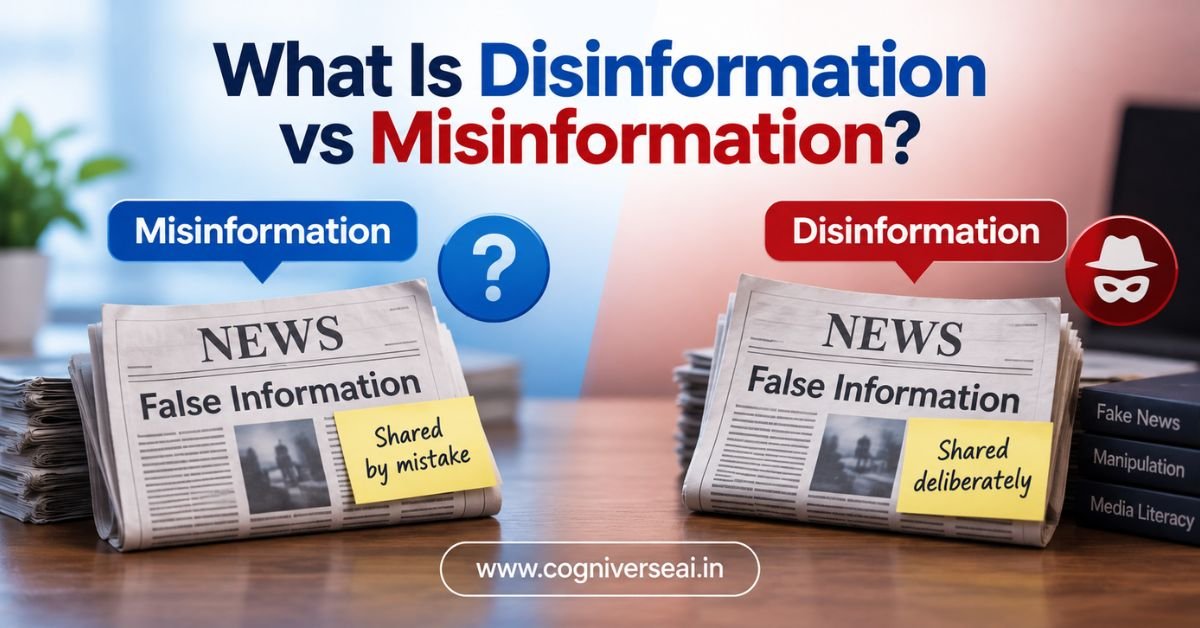
The main difference is intent. Misinformation is false or misleading information shared without an intention to deceive or cause harm. Disinformation is false or misleading information deliberately created or shared to deceive, manipulate, or cause harm. UNESCO and the Council of Europe both use this basic distinction, while noting that determining someone’s intent can be difficult in real-world situations.
For example, imagine someone receives an incorrect health claim in a messaging group and forwards it to friends because they believe it is true. That can be misinformation. If someone knowingly creates the same false claim and distributes it to deceive people, it can be disinformation.
Understanding this difference is useful for students, internet users, journalists, researchers, and anyone who wants to evaluate information more carefully.
What Is Misinformation?
Misinformation is false, inaccurate, or misleading information that is shared without an intention to deceive or cause harm. The person sharing it may genuinely believe that the information is correct.
Misinformation can happen because someone:
- Misunderstands information
- Remembers something incorrectly
- Shares an outdated claim
- Misreads a headline
- Trusts an unreliable source
- Shares a post without checking it
- Repeats something they heard from another person
The important part is the lack of deceptive intent.
Simple Example of Misinformation
Suppose a person sees an old social media post claiming that a particular school will be closed tomorrow.
They believe the post is current and share it with their classmates.
Later, they discover that the post was from several years ago.
The information was false in the current context, but the person did not deliberately create or share it to mislead others. This is an example of how misinformation can spread.
Also read: What Does The Term Open Source Mean In The Context Of Generative AI Models?
What Is Disinformation?
Disinformation is false, inaccurate, or misleading information that is deliberately created or distributed with an intention to deceive, manipulate, cause harm, or sometimes pursue economic or political gain.
Unlike misinformation, disinformation involves an element of intentional deception.
A person or organization may knowingly create a false claim, manipulate an image, remove important context, or present misleading information as if it were genuine.
Simple Example of Disinformation
Imagine someone creates a fake announcement that a company has permanently closed.
They know the announcement is false but publish it online to damage the company’s reputation.
Because the information is deliberately false and intentionally distributed to mislead people, it can be described as disinformation.
Disinformation vs Misinformation at a Glance
The easiest way to understand what is disinformation vs misinformation is to focus on the person’s intention.
| Feature | Misinformation | Disinformation |
|---|---|---|
| Information | False or misleading | False or misleading |
| Intention to deceive | Generally absent | Present |
| Person sharing it | May believe it is true | May know it is false |
| How it spreads | Often accidental | Often deliberate |
| Possible impact | Can still cause harm | Can be designed to cause harm or manipulate |
The same piece of false information can also move from one category to another depending on how different people use it.
For example, one person may unknowingly share a false story because they believe it is true. Another person may deliberately create and distribute that story knowing it is false.
What Is the Main Difference Between Misinformation and Disinformation?
The main difference is intent.
This can be remembered using a simple formula:
Misinformation = False information + No intention to deceive
Disinformation = False or misleading information + Deliberate intent to deceive
However, this distinction is not always easy to apply. In real situations, it may be impossible to know what a person actually intended when they created or shared a piece of content. The Council of Europe specifically notes that determining intent can be challenging.
This is why it is better to examine evidence about the content, its source, context, and distribution rather than automatically assuming someone’s motive.
How Does Misinformation Spread?
Misinformation does not require an organized campaign.
It can spread through ordinary online behavior.
Social Media Sharing
A person may see a surprising claim and share it without checking whether it is accurate.
Messaging Apps
False information can spread quickly through private groups because people may trust messages received from friends or family.
Misleading Headlines
Someone may read only a headline and share an article without understanding the full context.
Old Information
A genuine news report from several years ago may be reshared as though it describes something happening today.
Incorrect Interpretation
A person may misunderstand a statistic, research finding, photograph, or statement and then unintentionally repeat the incorrect interpretation.
These examples show why false information does not always require someone to intentionally create a lie.
How Does Disinformation Spread?
Disinformation can use many of the same channels as misinformation, but the content is deliberately designed or distributed to mislead.
Examples can include:
- Fabricated stories
- Manipulated images
- Misleading videos
- Imposter accounts
- False claims presented as facts
- Real information presented without important context
- Coordinated distribution of misleading content
UNESCO describes several forms of information disorder, including fabricated content, manipulated content, imposter content, false context, and misleading content.
The use of digital technology can make misleading content easier to produce and distribute at scale. UNESCO has also discussed how AI-generated content, deepfakes, automated activity, and digital targeting can contribute to the spread of disinformation.
Can the Same Information Be Both Misinformation and Disinformation?
Yes, depending on who is sharing it and why.
Imagine that Person A creates a false story and knows it is false. Person A shares it deliberately to deceive people.
That is disinformation.
Person B sees the story, believes it, and shares it with friends.
For Person B, the same false claim may be considered misinformation because Person B did not knowingly share a falsehood.
This is an important distinction because the content itself may remain the same while the intent behind its distribution differs.
What Is Malinformation?
When learning about misinformation and disinformation, it is also useful to understand malinformation.
Malinformation generally refers to genuine or factual information that is deliberately used to cause harm. The Council of Europe distinguishes it from misinformation and disinformation because the information itself may be true.
For example, imagine that someone’s genuine private information is exposed publicly with the intention of harming or intimidating that person.
The information may be authentic, but the way it is used can make it harmful.
This gives us three useful categories:
- Misinformation: False information shared without an intention to deceive.
- Disinformation: False or misleading information deliberately shared to deceive or cause harm.
- Malinformation: Genuine information deliberately used to cause harm.
These categories are part of the broader concept often called information disorder.
What Is Fake News and Is It the Same as Disinformation?
The term fake news is often used in everyday conversation, but it is not a precise replacement for misinformation or disinformation.
UNESCO’s journalism guidance notes that the phrase “fake news” can be misleading because false or manipulated content does not necessarily follow the conventions of genuine news.
For example, a misleading meme, manipulated video, fake social media account, or fabricated advertisement may not be “news” at all.
Using more specific terms such as misinformation, disinformation, manipulated content, or false context can make the discussion clearer.
Why Is It Important to Know the Difference?
Understanding what is disinformation vs misinformation helps people think more carefully about information they encounter.
The difference can also affect how we respond.
If someone accidentally shares incorrect information, correcting the mistake and providing reliable evidence may help.
If false information is deliberately created as part of a coordinated effort to deceive people, the response may require additional investigation into its source, distribution, and purpose.
The effects can overlap, even though the intentions are different. UNESCO notes that both misinformation and disinformation can contribute to harmful information environments.
How to Identify Possible Misinformation or Disinformation
You cannot always determine someone’s intent simply by looking at a post. Instead, start by checking whether the claim itself is supported by reliable evidence.
Check the Source
Ask who published the information.
Look for established organizations, official sources, reputable publications, or clearly identified authors with relevant expertise.
Check the Date
Old content can become misleading when it is presented as current.
Look at the original publication date and check whether the situation has changed.
Check the Original Context
Do not rely only on a screenshot or short quote.
Try to find the original article, video, statement, research paper, or announcement.
Compare Multiple Reliable Sources
If an important claim appears in only one unfamiliar source, look for independent confirmation.
Different sources should be compared carefully rather than simply counting how many websites repeat the same claim.
Check Images and Videos
Images and videos can be genuine but presented with incorrect dates, locations, or descriptions.
Reverse image search and other verification tools can help determine where visual content came from.
Be Careful With Emotional Content
Posts designed to make people extremely angry, frightened, or excited may encourage quick sharing.
Strong emotions do not prove that information is false, but they are a useful reason to slow down and verify the claim.
Can Artificial Intelligence Make Misinformation and Disinformation Worse?
AI can make it easier to create realistic text, images, audio, and video. This can increase the difficulty of distinguishing genuine material from manipulated or fabricated content.
For example, generative AI can produce:
- Synthetic images
- AI-generated voices
- Fabricated videos
- Automatically generated articles
- Fake profiles or messages
UNESCO has highlighted the role of AI-generated content and deepfakes in the broader information environment.
However, AI itself does not automatically make content misinformation or disinformation.
The same distinction still applies: what is the content, and how is it being created or shared?
An AI-generated image used clearly as fictional artwork is different from an AI-generated image falsely presented as a real event.
What Should You Do Before Sharing Information?
A simple verification routine can prevent many accidental mistakes.
Before sharing an important claim, ask:
- Who created this information?
- Where did the claim originally come from?
- Is there evidence supporting it?
- Is the information current?
- Does the headline match the actual content?
- Can reliable independent sources confirm it?
- Could the image or video be taken out of context?
If you cannot verify an important claim, it is safer to avoid presenting it as established fact.
This approach is especially useful for health, financial, safety, emergency, and other high-stakes information.
Why Intent Is Difficult to Determine
One of the most important details in the misinformation versus disinformation debate is that intent is often hidden.
You can usually examine what a post says, where it came from, and whether its claims are supported by evidence.
But determining whether someone knew that the information was false can be much harder.
For this reason, it is better to avoid automatically labeling an individual as a disinformation actor without evidence about their knowledge or intent.
The Council of Europe specifically recognizes this difficulty in distinguishing misinformation from disinformation in practice.
Also read: Impromptu Speech Topics for Kids
Conclusion
So, what is disinformation vs misinformation?
The key difference is intent.
Misinformation is false or misleading information shared without an intention to deceive or cause harm. A person may believe the information is true when they share it.
Disinformation is false or misleading information deliberately created or shared to deceive, manipulate, cause harm, or pursue certain gains.
There is also a third useful category: malinformation, which involves genuine information being used deliberately to cause harm.
The distinction matters because false information can spread through both accidental mistakes and deliberate deception. At the same time, determining someone’s intent is not always straightforward.
The best way to protect yourself is to focus first on verification. Check the source, date, original context, supporting evidence, and independent reporting before sharing important information. In an online environment where text, images, audio, and video can be created or altered easily, careful information checking is an important part of digital and media literacy.
Frequently Asked Questions (FAQ)
1. What is the main difference between misinformation and disinformation?
Misinformation is false information shared without intent to deceive. Disinformation is false or misleading information deliberately shared to deceive or cause harm.
2. Can misinformation become disinformation?
The same false claim can be misinformation when shared unknowingly and disinformation when someone knowingly shares it to deceive others.
3. Is misinformation always harmless?
No. Misinformation can cause harm even when the person sharing it does not intend to mislead anyone.
4. What is malinformation?
Malinformation is genuine information that is deliberately shared or used to cause harm, unlike misinformation and disinformation, which involve false or misleading content.
5. How can you avoid spreading misinformation?
Check the source, date, original context, evidence, and reliable independent sources before sharing important information.
1 thought on “What Is Disinformation vs Misinformation?”