Artificial intelligence, or AI, is becoming part of everyday life. We see it in search engines, smartphones, online shopping, navigation apps, recommendation systems, customer service tools, education platforms, and many workplaces. Because AI is becoming more common, understanding how it works and how to use it responsibly can be a useful skill.
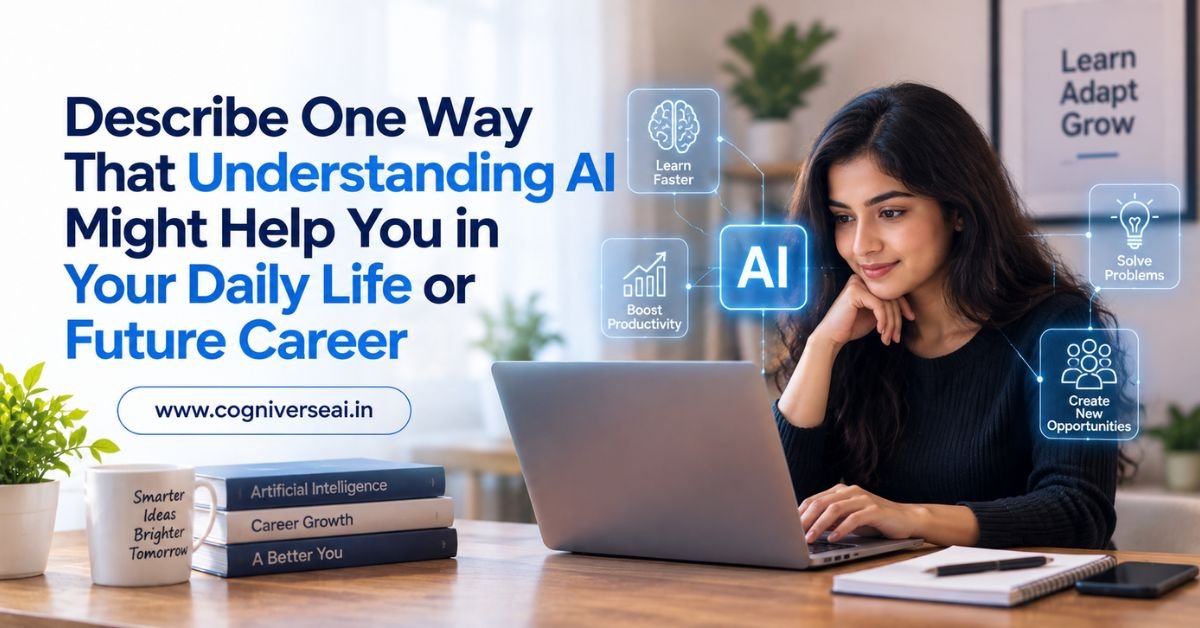
So, describe one way that understanding AI might help you in your daily life or future career: one important way is that understanding AI can help you use technology more effectively and make better decisions about AI-generated information and tools.
You do not need to become an AI engineer to benefit from AI knowledge. Even a basic understanding can help you recognize what AI can do, understand its limitations, check information before trusting it, and use AI tools more responsibly. These skills can be useful in both personal life and almost any future career.
What Does Understanding AI Mean?
Understanding AI does not necessarily mean knowing advanced mathematics, programming, or machine learning algorithms.
At a basic level, AI understanding means knowing:
- What artificial intelligence is
- How AI systems learn patterns from data
- What AI tools can and cannot do
- Why AI sometimes produces incorrect information
- How AI can affect privacy and security
- How to use AI tools responsibly
- When human judgment is still necessary
For example, if you use an AI chatbot to help understand a difficult subject, you should know that the tool can produce useful explanations but can also make mistakes. Understanding this limitation helps you use the tool as an assistant rather than automatically accepting everything it says.
Also read: What Is Disinformation vs Misinformation?
How Understanding AI Can Help in Daily Life?
AI already affects many ordinary activities. Knowing how AI works can help you make more informed choices when using digital services.
Making Better Use of AI Tools
Many people use AI tools for writing, learning, searching for information, creating images, organizing ideas, translating languages, or solving everyday problems.
Someone who understands AI can write clearer instructions and provide useful context when using these tools. This can improve the quality of the results.
For example, a student might ask an AI tool to explain photosynthesis. Instead of simply copying the answer, the student can ask for a simple explanation, examples, important terms, and a short quiz. The student can then compare the information with trusted educational material.
This turns AI into a learning aid rather than simply an answer-generating machine.
Checking Information More Carefully
One of the most useful benefits of understanding AI is learning not to assume that every AI-generated answer is correct.
AI systems can produce information that sounds confident even when it is inaccurate. This can happen because AI systems generate responses based on patterns learned from data and the instructions they receive. They do not automatically guarantee that every statement is true.
For example, if an AI tool gives you information about a product, law, school admission requirement, travel rule, or technical problem, you may need to verify important details using reliable sources.
Understanding this limitation encourages you to ask:
- Where did this information come from?
- Is the information current?
- Can I verify it from another reliable source?
- Does the original source support the claim?
- Is the AI making an assumption?
This habit can improve digital literacy and help reduce the spread of incorrect information.
How Understanding AI Can Help in Your Future Career?
AI knowledge can also be useful when you enter the workplace. You do not have to work directly in technology to encounter AI.
Businesses are increasingly using digital tools for tasks such as customer support, data analysis, marketing, document processing, research, communication, and automation.
Improving Workplace Productivity
Understanding AI can help you identify tasks that may be supported by AI.
For example, an employee may use an AI tool to:
- Create a first draft of a document
- Summarize a long piece of text
- Organize ideas
- Generate a list of questions
- Help analyze information
- Create a basic work plan
- Improve the clarity of writing
- Explain unfamiliar technical concepts
However, the employee should still review the output before using it.
The goal is not to let AI replace human judgment. Instead, AI can assist with suitable tasks while people remain responsible for checking the quality and accuracy of the final work.
Developing Skills Employers May Value
Basic AI literacy can become useful across many different career fields.
A future employee may need to understand how to work with AI-powered software even if their job title does not contain the word “AI.”
For example:
- A marketer may use AI for brainstorming and content analysis.
- A teacher may use AI to create learning activities.
- An engineer may use AI-assisted software for analysis or documentation.
- A business employee may use AI to organize information.
- A designer may use AI tools during the creative process.
- A researcher may use AI to help organize large amounts of information.
- A customer-service employee may work alongside AI-based support systems.
The exact tools will change over time, but the ability to understand technology and evaluate its output can remain useful.
AI Understanding Helps You Work With AI Instead of Simply Using It
There is an important difference between using an AI tool and understanding how to use AI well.
Someone may know how to enter a question into an AI chatbot. But a person with better AI literacy may also understand how to:
- Define the task clearly.
- Give relevant context.
- Ask specific questions.
- Review the response.
- Identify possible errors.
- Protect private information.
- Verify important facts.
- Improve the final result using human judgment.
This process is especially useful in professional environments.
For example, imagine that you need to prepare a business report. AI could help organize your notes or create a first draft. But you should check numbers, names, dates, sources, and conclusions before sharing the report.
The person remains responsible for the final document.
Understanding AI Can Improve Critical Thinking
AI literacy is not only a technology skill. It can also support critical thinking.
When you understand that AI can make mistakes, you become more likely to question information instead of accepting it immediately.
This is important because digital information can come from many different sources. Some information may be incomplete, outdated, misleading, or intentionally false.
AI can also generate realistic text, images, audio, and video. This makes it increasingly important to think carefully about what you see and hear online.
A useful habit is to separate three questions:
Is this possible?
Does this sound reasonable?
Is this actually verified?
The third question is particularly important when information could affect an important decision.
Understanding AI Helps You Protect Your Privacy
Another practical benefit is better awareness of privacy.
AI tools may process the information users provide. Before entering information into an AI service, it is sensible to consider whether the information is private, confidential, or sensitive.
For example, you should be careful about entering:
- Passwords
- Banking information
- Private identification details
- Confidential company documents
- Personal information about other people
- Sensitive business information
Understanding basic AI and data concepts can make you more careful about what you share with online services.
Understanding AI Helps You Recognize Its Limitations
AI can be powerful, but it is not perfect.
Depending on the system and task, AI can struggle with incorrect assumptions, incomplete information, ambiguous instructions, unusual situations, or information that has changed recently.
This is why knowing the limitations of AI is just as important as knowing its benefits.
For example, an AI tool might help you understand a complicated topic, but that does not mean it should automatically replace a teacher, qualified professional, official source, or expert when the situation requires one.
A responsible AI user knows when to use AI and when to seek human expertise.
A Simple Example From Daily Life
Consider a person planning a trip.
They might use AI to create a packing checklist, suggest questions to ask a hotel, organize an itinerary, or explain common travel terms.
That can save time.
However, if the AI provides information about visa requirements, entry rules, health requirements, or official travel documents, the person should verify those details with the relevant official sources.
The AI can help organize the task, but the user remains responsible for checking important information.
This example shows why AI understanding is useful: you learn how to combine the speed of AI with human judgment and reliable information.
How Students Can Start Learning About AI?
Students do not need to begin with complicated programming.
They can start with basic concepts such as:
Learn Basic AI Terms
Understand terms such as:
- Artificial intelligence
- Machine learning
- Generative AI
- Neural networks
- Large language models
- Training data
- AI bias
- Automation
- AI hallucination
- Deepfakes
Learning these terms makes AI-related information easier to understand.
Practice Asking Better Questions
Try giving AI tools clear instructions rather than vague requests.
Instead of asking:
“Tell me about climate change.”
You could ask:
“Explain the main causes of climate change in simple English and give three everyday examples.”
The second request gives the AI a clearer task.
Verify Important Answers
Do not rely on AI alone for information that could have serious consequences.
Compare important claims with reliable sources such as official government websites, educational institutions, professional organizations, or original documents.
Learn Responsible AI Use
AI literacy also includes ethics.
Think about whether using AI is appropriate for a particular task. For schoolwork, for example, students should follow their teacher’s rules about AI use rather than presenting AI-generated work as their own when that is not allowed.
Responsible use means understanding both the benefits and the risks.
Why AI Literacy May Become an Important Career Skill?
Technology changes quickly. Specific AI tools that are popular today may be different in the future.
For this reason, learning only one particular tool may not be enough.
A more useful long-term approach is to develop AI literacy.
AI literacy can include the ability to:
- Understand basic AI concepts
- Use AI tools appropriately
- Communicate clearly with AI systems
- Evaluate AI-generated content
- Recognize potential errors and bias
- Protect personal and confidential information
- Understand ethical concerns
- Know when human expertise is required
These skills can help people adapt as AI becomes part of different types of work.
The Biggest Lesson About Understanding AI
The most important lesson is that understanding AI does not mean believing that AI can do everything.
It means knowing what AI is good at, where it can fail, and how humans should use it responsibly.
AI can help with speed, organization, brainstorming, pattern-based tasks, and many forms of information processing. Humans still provide context, judgment, responsibility, values, creativity, and decision-making.
The strongest approach is often to combine both.
Use AI where it can genuinely help, but review its output and take responsibility for important decisions.
Also read: Moral Topics for School Assembly
Conclusion
If you need to describe one way that understanding AI might help you in your daily life or future career, a clear answer is that understanding AI can help you use modern technology more effectively while making better decisions about AI-generated information and tools.
In daily life, AI knowledge can help you use digital services, learn new subjects, evaluate online information, and protect your privacy. In a future career, it can help you work more effectively with AI-powered tools, identify suitable tasks for automation, and adapt to changing workplace technology.
You do not need to become a programmer or AI researcher to benefit from these skills. Basic AI literacy, critical thinking, responsible technology use, and the ability to verify information can be valuable in many areas of life.
The goal is not simply to know how to use AI. The goal is to understand when to use it, how to use it, and when its answer needs to be checked by a human or a trusted source.
Frequently Asked Questions (FAQ)
1. How can understanding AI help in daily life?
It can help you use AI tools effectively, check information, protect privacy, and make better decisions when using digital services.
2. How can AI knowledge help my future career?
AI knowledge can help you use workplace tools, improve productivity, evaluate AI output, and adapt to technology used in your profession.
3. Do I need programming skills to understand AI?
No. Basic AI literacy does not require programming. You can start by learning what AI does, its limits, risks, and responsible uses.
4. Why is it important to check AI-generated information?
AI can produce inaccurate or outdated information. Checking important claims against reliable sources helps prevent mistakes and poor decisions.
5. What is AI literacy?
AI literacy means understanding basic AI concepts, using AI responsibly, evaluating its output, protecting data, and knowing when human judgment is needed.
1 thought on “Describe One Way That Understanding AI Might Help You In Your Daily Life Or Future Career”