
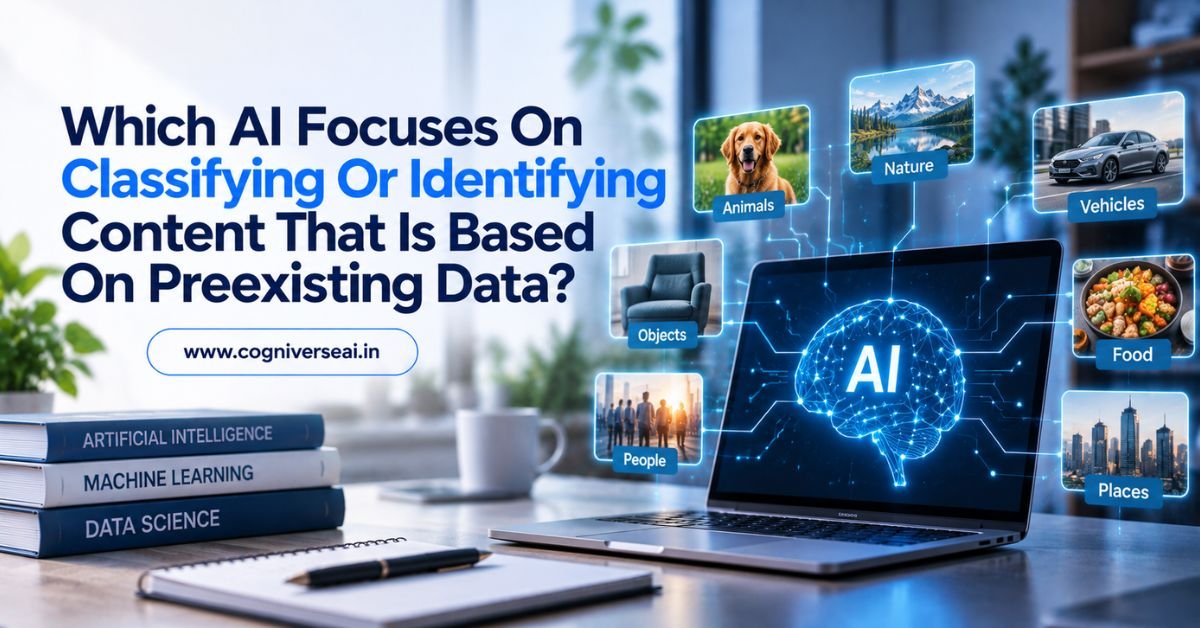
Artificial intelligence can be used for many different purposes. Some AI systems generate new content, while others examine existing information and determine what it represents. This difference is important when learning about modern AI because classification and identification are common tasks in areas such as image recognition, spam detection, fraud prevention, healthcare, search, and customer analytics.
So, Which AI Focuses On Classifying Or Identifying Content That Is Based On Preexisting Data? The answer is discriminative AI, which is designed to distinguish between categories, labels, or outcomes using existing data. Instead of mainly creating new content, discriminative AI learns patterns from data and uses those patterns to decide which category or class a new example belongs to.
For example, an AI system may examine an email and decide whether it is spam or not spam. It may look at a photograph and identify whether it contains a cat, a dog, or neither. It may analyze a transaction and classify it as normal or potentially fraudulent.
This type of AI is closely connected to supervised machine learning, classification models, and predictive analytics.
What Is Discriminative AI?
Discriminative AI is a type of artificial intelligence that focuses on distinguishing between existing categories or predicting an outcome from input data.
The system learns relationships from examples and uses those learned patterns when it receives new information.
For instance, imagine an AI system trained using thousands of emails that are labeled:
- Spam
- Not spam
After learning from those examples, the system can examine a new email and estimate which category it belongs to.
The model is not trying to invent a new email. It is trying to identify the correct category for existing input.
That is the key idea behind discriminative AI.
Also read: What Is True About Using Text-to-image Generation Services?
How Does Discriminative AI Work?
The exact process depends on the algorithm, but the basic idea is fairly simple.
Step 1: Collect Data
The system needs examples related to the task.
For an image classifier, the data might contain pictures with labels such as:
- Car
- Bus
- Bicycle
- Motorcycle
For a medical classification task, the examples might have labels associated with particular conditions or findings.
Step 2: Train the Model
The model examines the available examples and learns patterns that help separate the different categories.
Those patterns can involve many types of information.
In an image, they may relate to shapes, textures, colors, or visual structures.
In text, they may involve words, phrases, or other language patterns.
In financial data, the model may learn relationships among transaction features.
Step 3: Give the Model New Data
Once trained, the system receives information it has not seen before.
Step 4: Predict a Class or Outcome
The model applies what it learned and produces a classification or prediction.
For example:
Input: New email
Output: Spam
Or:
Input: Image
Output: Bicycle
The system is identifying or classifying the input based on patterns learned from preexisting data.
Discriminative AI vs Generative AI
One of the easiest ways to understand discriminative AI is to compare it with generative AI.
Discriminative AI
Discriminative AI generally focuses on deciding what an input is or which category it belongs to.
Examples include:
- Spam classification
- Image classification
- Fraud detection
- Sentiment classification
- Disease-risk classification
- Customer churn prediction
Generative AI
Generative AI focuses on creating new content based on patterns learned during training.
Examples include:
- Writing text
- Creating images
- Generating audio
- Producing video
- Writing computer code
A simple way to remember the difference is:
Discriminative AI asks, “Which category does this belong to?”
Generative AI asks, “What new content can I create from what I have learned?”
The two approaches can also be used together in the same application.
Why Is Discriminative AI Important?
Discriminative AI is important because many real-world problems are classification problems.
Businesses, researchers, governments, hospitals, schools, and technology companies often need systems that can examine information and sort it into meaningful groups.
For example, a company may need to determine:
- Which customers are likely to cancel a service
- Which transactions may require review
- Which messages are unwanted
- Which products match a customer’s behavior
- Which documents belong to a specific category
A person could perform some of these tasks manually, but machine learning can process large amounts of data and make predictions at scale.
Real-World Examples of Discriminative AI
Email Spam Detection
One of the simplest examples is spam filtering.
A system can learn from previously labeled emails and identify patterns often associated with unwanted messages.
When a new email arrives, the classifier predicts whether it belongs in the spam category.
This does not mean the system knows the sender personally or understands every part of the message like a human. It uses patterns learned from its training data.
Image Recognition
Image classification is another common use.
Suppose a model is trained on many labeled images of different animals.
When a new image is provided, the model may predict:
Dog: 92%
Wolf: 6%
Other: 2%
The exact probabilities depend on the model and application, but the basic function is classification.
This type of technology can support systems used for image search, quality inspection, object detection, and other computer vision tasks.
Fraud Detection
Banks and financial services can use machine learning systems to help identify unusual transactions.
The system may analyze factors such as transaction amount, timing, location, account behavior, and other features.
It can then classify a transaction as normal or potentially suspicious.
A classification result does not automatically prove that fraud occurred. It may simply indicate that a transaction deserves further review.
This is an important distinction when AI is used for high-impact decisions.
Sentiment Analysis
Businesses often want to understand how customers respond to products or services.
A text-classification model can examine reviews or messages and classify them as:
- Positive
- Negative
- Neutral
More advanced systems may use a larger range of labels.
This can help organizations analyze large volumes of feedback more efficiently.
Medical Classification
Machine learning can also support medical image analysis and other classification tasks.
For example, an AI system may be trained to distinguish between different image patterns associated with particular findings.
In real healthcare settings, however, AI classification should be used within appropriate clinical, regulatory, and human-review processes.
A prediction from an AI system is not automatically the same thing as a final medical diagnosis.
What Types of Machine Learning Algorithms Are Used?
Many machine learning algorithms can be used for classification or prediction.
Logistic Regression
Despite its name, logistic regression is widely used for classification tasks.
It can estimate the probability that an example belongs to a particular class.
For example, it can be used for binary outcomes such as:
- Yes or no
- Spam or not spam
- Fraud or not fraud
Decision Trees
Decision trees classify information through a sequence of decision rules.
For example:
- Is the transaction amount unusually high?
- Is the location unusual?
- Has the account shown similar activity before?
The answers lead the model toward a final class.
Decision trees are often valued because their structure can be relatively easy to understand.
Random Forests
A random forest combines multiple decision trees and uses them together to make predictions.
This can help improve performance compared with relying on a single tree in many situations.
Random forests are widely used for classification and regression problems.
Support Vector Machines
Support vector machines can classify data by finding boundaries that separate different classes.
They can be effective for certain datasets, especially when the classes have useful patterns that can be separated mathematically.
Neural Networks
Neural networks can also perform classification.
They are particularly important in areas involving complex data such as images, audio, and text.
For example, a neural network can learn patterns in images and use them to classify objects.
Supervised Learning and Discriminative AI
Discriminative AI is strongly associated with supervised learning.
In supervised learning, a model learns from examples where the desired output is already known.
For example:
| Input | Label |
|---|---|
| Email A | Spam |
| Email B | Not Spam |
| Email C | Spam |
| Email D | Not Spam |
The model uses these labeled examples during training.
After learning, it receives a new email and predicts the appropriate label.
This is different from unsupervised learning, where the system may try to find patterns or groups without predefined labels.
It is also different from generative modeling, which focuses on modeling patterns in data in ways that can support creating new samples or content.
Classification vs Identification
The words classification and identification can sound similar, but there is a useful difference.
Classification
Classification means placing something into a predefined category.
For example:
Image → Cat
Email → Spam
Review → Negative
Identification
Identification often means determining what an object, person, pattern, or signal represents.
For example:
Image → Identified as a specific object
Depending on the application, identification can involve classification as one part of the process.
In many educational discussions, both terms are used to describe AI systems that analyze existing input and determine what category or identity best matches it.
Why Preexisting Data Matters?
The phrase “based on preexisting data” is important because machine learning models depend on information used during training.
The quality of that data can strongly influence the quality of the model.
Suppose an image classifier is trained mostly on poor-quality images.
The model may struggle with new images that have different lighting, angles, backgrounds, or object types.
Similarly, if a classification dataset contains incomplete or biased examples, the resulting model may perform poorly for some groups or situations.
This is why good machine learning involves more than choosing an algorithm.
Data quality, labeling, evaluation, and appropriate deployment all matter.
Advantages of Discriminative AI
Discriminative AI can offer several practical advantages.
Efficient Classification
A trained model can classify large numbers of examples quickly.
Automation
Organizations can automate repetitive classification tasks that would otherwise require manual review.
Pattern Detection
Machine learning models can detect patterns that may be difficult to identify consistently at large scale.
Predictive Applications
Classification models can support prediction tasks involving categories or outcomes.
Scalability
Once integrated properly, a classification system can process many inputs without requiring a person to manually inspect each one.
These benefits explain why classification models are widely used in software and business applications.
Limitations of Discriminative AI
Discriminative AI also has important limitations.
It Can Make Mistakes
A model can classify something incorrectly.
This may happen because the example is unusual, the training data was limited, or the model has weaknesses.
It Depends on Data
Poor training data can lead to poor model performance.
It May Struggle With New Situations
A model may perform well on data similar to what it saw during training but behave less reliably when conditions change.
It Can Reflect Bias
If training data contains unfair or unbalanced patterns, the model may reproduce them.
Predictions Are Not Guaranteed Facts
An AI classification is a model output, not a guarantee that the prediction is correct.
These limitations matter especially in high-stakes applications.
How Businesses Use Classification Models?
Businesses can use AI classification in many different workflows.
For example, an online store can classify support tickets into categories such as:
- Order issue
- Payment issue
- Delivery issue
- Return request
- Technical problem
An automated system can assign each new ticket to a category, after which it is routed to the appropriate team.
Another company may classify leads based on characteristics that help sales teams decide which leads need attention first.
The AI system does not necessarily make the entire business decision. It can simply perform one step in the workflow.
The Importance of Human Oversight
When AI classification affects important decisions, human oversight becomes especially valuable.
Consider a system used to flag a potentially fraudulent transaction.
The AI may identify a transaction as suspicious, but a person or a separate review process may still need to determine what action should follow.
This is an important principle:
AI classification can support a decision without being the decision itself.
The amount of human review should depend on the potential consequences of errors.
What Makes a Good Classification Model?
A good classification model is not simply one that performs well on its training data.
It should also be tested on appropriate new data.
Important questions include:
- Does it generalize to unseen examples?
- How often does it make false positives?
- How often does it make false negatives?
- Does performance differ across relevant groups?
- Does it remain useful when real-world conditions change?
- Can its results be monitored after deployment?
Metrics such as accuracy, precision, recall, and F1 score may be useful depending on the task.
The right evaluation method should reflect the real-world purpose of the system.
Discriminative AI in Modern AI Systems
Modern AI applications often combine multiple techniques.
For example, a customer-support platform might use a language model to understand a user’s message and then use classification to determine whether the request is related to billing, delivery, technical support, or another category.
A security application might use generative AI to summarize an event while relying on classification models to detect certain patterns.
This means the distinction between generative and discriminative systems is useful for understanding the technology, but real products may combine several types of AI.
How to Remember the Answer?
A simple memory trick can help.
Think of discriminative AI as a sorter.
It receives information and asks:
“Which group does this belong to?”
Generative AI, on the other hand, can be thought of as a creator.
It asks:
“What new content can I produce from learned patterns?”
For example:
Discriminative:
Photo → Cat
Generative:
Prompt → New image of a cat
This distinction makes the concept easier to remember.
Also read: Bachelor’s Degree in Early Childhood Education
Conclusion
So, Which AI Focuses On Classifying Or Identifying Content That Is Based On Preexisting Data? The answer is discriminative AI.
Discriminative AI focuses on distinguishing between classes, categories, or outcomes by learning patterns from existing data. It is commonly associated with supervised machine learning and is used in applications such as spam detection, image classification, fraud detection, sentiment analysis, customer routing, and many other predictive tasks.
Unlike generative AI, which focuses on creating new content, discriminative AI mainly focuses on determining what existing input is or which category it belongs to.
Understanding this difference is important because classification and identification are some of the most common uses of machine learning. It also helps explain why algorithms such as logistic regression, decision trees, random forests, support vector machines, and neural networks are widely used for predictive tasks.
At the same time, a classification result should not automatically be treated as a guaranteed fact. The quality of the data, model, evaluation process, and real-world implementation all influence how useful the output will be.
The key idea is simple: discriminative AI learns from preexisting examples to distinguish, classify, or predict, while generative AI is designed to create new content.
Frequently Asked Questions (FAQ)
1. Which AI is used for classification?
Discriminative AI is commonly used for classification because it learns patterns that help separate inputs into predefined categories.
2. Is discriminative AI the same as supervised learning?
They are closely related, but they are not exactly the same term. Many discriminative models are trained using supervised learning.
3. What is an example of discriminative AI?
Spam detection is a simple example. The AI examines an email and classifies it as spam or not spam based on learned patterns.
4. How is discriminative AI different from generative AI?
Discriminative AI mainly predicts or classifies existing data, while generative AI focuses on producing new content such as text, images, audio, or code.
5. Which algorithms can be used for discriminative AI?
Common examples include logistic regression, decision trees, random forests, support vector machines, and neural networks.