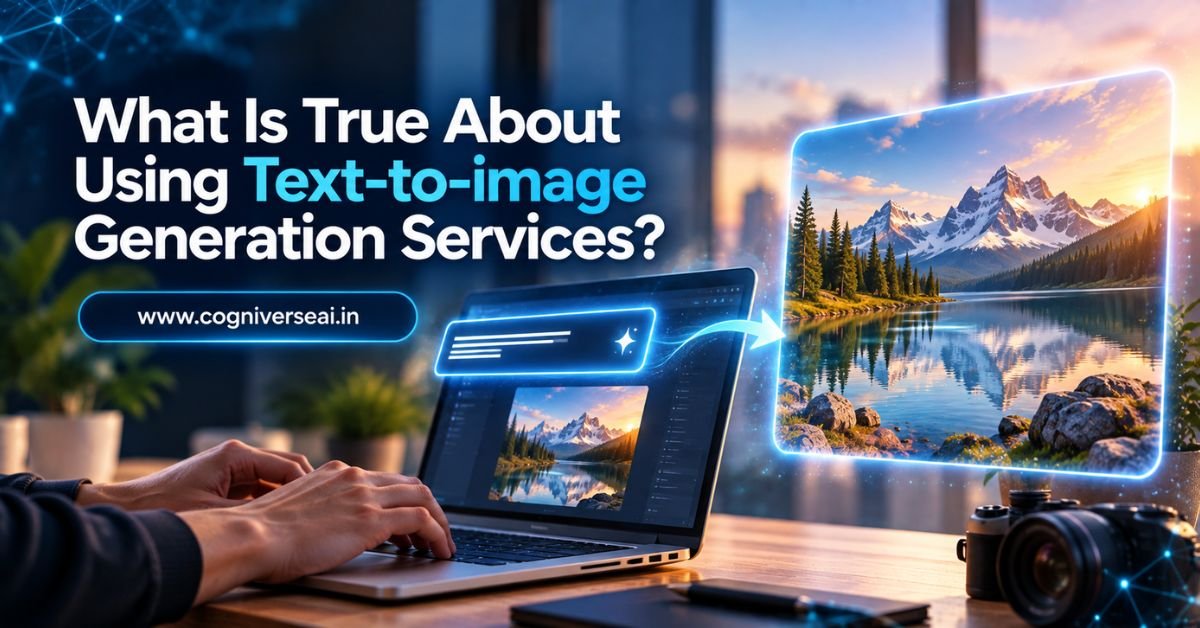
Text-to-image generation services have changed the way people create visual content. Instead of starting with a blank design file, a user can describe an idea in ordinary language and ask an AI system to create an image. These tools can be useful for brainstorming, education, marketing, design, presentations, social media, and many other creative tasks.
So, what is true about using text-to-image generation services? The most important fact is that these services can create images from written prompts, but the results are not automatically perfect, accurate, original in a legal sense, or ready for professional use. Users still need to review the output, understand the service’s terms, protect sensitive information, and consider copyright and other rights before publishing or using an image commercially.
This is especially important as image-generation technology becomes more capable. Modern systems can create highly realistic scenes and can also edit or transform existing images. Google, for example, describes generative image systems as taking a written prompt and using what the model learned about concepts in its training to generate an image, even when the exact image has not appeared in its training data.
The technology offers creative freedom, but responsible use still requires human judgment.
What Are Text-to-Image Generation Services?
Text-to-image generation services are AI-powered tools that create visual content from written instructions.
A prompt might describe:
- The subject
- The setting
- The lighting
- The mood
- The composition
- The art style
- The colors
- The camera or visual perspective
For example, a user could ask for an illustration of a futuristic classroom with students using digital learning tools. The system interprets the description and generates an image based on patterns learned during training.
The user does not need to manually draw every object or photograph the scene.
This makes text-to-image generation different from traditional image creation. Instead of directly placing and drawing every visual element, the user communicates the desired result through language and then refines the generated output.
Also read: Do You Need To Have A Technical AI Background In Order To Start A Generative AI Venture?
How Do Text-to-Image Models Work?
The technical systems behind text-to-image generation can be complex, but the basic idea is easier to understand.
During training, an AI model learns relationships between visual information and other information used to describe or represent that content. When a user provides a prompt, the model uses the learned patterns to produce a new image that matches the request as closely as it can.
The result is not simply a photograph being retrieved from a database.
The system generates a new visual output based on its learned patterns.
This is one reason a single prompt can produce different results at different times or with different settings. Changes to the wording, model, reference image, or generation settings can affect the final image.
What Is True About the Quality of AI-Generated Images?
One common misunderstanding is that a detailed prompt guarantees a perfect image.
It does not.
Text-to-image systems can create impressive results, but they can also make mistakes. Problems may involve:
- Incorrect details
- Unrealistic objects
- Distorted hands or faces
- Incorrect text inside images
- Strange object relationships
- Inconsistent product details
- Unwanted background elements
- Visual details that do not match the prompt
Google itself warns users that AI-generated responses can contain mistakes and provides guidance about the limitations of generative AI.
This means users should inspect an image rather than assuming that a realistic-looking result is automatically correct.
Realism Does Not Mean Accuracy
An AI-generated image may look like a professional photograph while still showing something that never existed.
For example, a generated image could show a realistic-looking product package with the wrong label, incorrect dimensions, or imaginary features.
That distinction matters in advertising and product marketing.
A visually attractive image can still be misleading if it gives customers an incorrect impression of a real product.
Why Prompt Quality Matters?
The wording of a prompt can strongly affect the generated result.
A vague prompt may produce a broad interpretation.
A more specific prompt can provide better direction.
For example, instead of:
“Create a restaurant image.”
A marketer might describe:
“Create a bright, modern restaurant interior with natural daylight, wooden tables, indoor plants, and a clean contemporary style, leaving open space on the left for advertising text.”
The second prompt provides more information about the desired composition and purpose.
However, prompt quality does not remove the need for review. The model still decides how it interprets the instructions.
Text-to-Image Services Are Useful for Creative Ideation
One of the most practical uses of these services is brainstorming.
A designer or marketer may know the campaign idea but not yet know what the final image should look like.
AI can help turn different ideas into visual concepts quickly.
For example, a travel brand could test several visual directions for a mountain campaign:
- A peaceful sunrise
- An adventurous hiking scene
- A family vacation setting
- A luxury mountain resort
- A minimalist landscape
These concepts can help the creative team decide which direction deserves more development.
In this role, AI is useful as a creative exploration tool, not necessarily as the final production method.
They Can Save Time, but They Do Not Remove Creative Work
Text-to-image services can reduce some of the manual effort involved in creating visual concepts.
A user can test several compositions without organizing multiple photo shoots or drawing every concept from the beginning.
But professional creative work still involves much more than generating an image.
The team may need to:
- Define the campaign goal
- Understand the target audience
- Create the visual direction
- Review the output
- Make corrections
- Match the brand
- Add accurate product information
- Resize the artwork
- Combine the image with typography and other design elements
- Obtain required approvals
Therefore, saying that AI “does everything” would be misleading.
The tool can accelerate parts of the workflow, while people remain responsible for the creative and business decisions.
What Is True About Copyright and AI-Generated Images?
Copyright is one of the most important issues to understand before using AI-generated images.
The legal treatment of AI-generated work is not identical in every country, and the answer can depend on how the image was created, how much human creative control was involved, and the applicable law.
The U.S. Copyright Office’s January 2025 report concluded that generative AI outputs can receive copyright protection where a human author has contributed sufficient expressive elements. It also stated that merely providing prompts, by itself, does not provide enough human authorship under its analysis.
This means users should not automatically assume that every image generated by AI gives them the same copyright position as an image created entirely by a human.
At the same time, AI assistance does not automatically prevent copyright protection for a larger work. The Copyright Office has explained that human-created elements, creative arrangement, selection, or meaningful modification can affect the analysis.
Check the Service Terms
Copyright law is only part of the picture.
The terms of the particular AI service can also matter. Different providers may have different rules about commercial use, ownership, training, attribution, and other matters.
For that reason, users should read the current terms that apply to the service they are using rather than assuming that all text-to-image platforms work the same way.
Can an AI-Generated Image Be Completely Original?
This question needs careful wording.
A generated image may be newly produced and may not be a direct copy of one particular existing image. But that does not mean a user can assume that every output is legally risk-free or completely independent of existing creative works.
AI models are trained using large datasets, and questions about training data, copyright, similarity, and authorship remain important areas of legal and policy discussion.
The U.S. Copyright Office continues to examine these issues, including the relationship between AI training and copyright.
Therefore, businesses should perform appropriate legal and brand checks when an AI-generated image will be used in an important commercial campaign.
What About Real People, Brands, and Protected Material?
Users should also be careful when prompts involve recognizable people, brands, logos, characters, artworks, or other protected material.
An AI system may be able to generate an image that resembles a real person or imitates a recognizable visual identity, but the ability to generate something does not automatically mean that using it is appropriate.
Potential issues can involve:
- Personality or publicity rights
- Trademark concerns
- Copyright
- Misleading endorsements
- Brand confusion
- Defamation or harmful representations
- Contractual restrictions
The legal rules vary by jurisdiction and situation.
For high-stakes commercial use, it is sensible to obtain appropriate legal advice rather than treating an AI-generated result as automatically safe.
Privacy Is Another Important Consideration
Text-to-image services may accept prompts, uploaded images, reference materials, or other inputs.
Before uploading confidential material, users should understand how the service handles that information.
For example, a business should think carefully before uploading:
- Confidential product designs
- Internal documents
- Personal information
- Customer images
- Private photographs
- Unreleased marketing materials
- Proprietary business information
Privacy risks can exist in AI systems more broadly, including risks related to personal data, inference, and information exposure. NIST’s work on generative AI and privacy highlights these concerns as part of responsible AI risk management.
The safest approach is to follow the organization’s data-handling policies and the AI service’s current terms before uploading sensitive material.
Why Human Review Is Still Important?
AI can generate an image quickly, but people still need to decide whether the image is suitable.
A human reviewer can identify things the system may have missed.
For example, a marketing team may notice that:
- A product package is inaccurate
- A person’s appearance is inconsistent
- A logo is distorted
- The image unintentionally reinforces a stereotype
- A background contains an inappropriate detail
- The image does not match the company’s brand
- The composition is unsuitable for the intended advertisement
Human review is therefore not just an optional design step. For important applications, it can also be part of responsible AI use.
NIST’s Generative AI Profile identifies issues such as confabulation, harmful content, privacy risks, and harmful bias as areas that organizations should manage.
AI-Generated Images Can Support Different Creative Workflows
Text-to-image services can be useful at different stages.
Brainstorming
Teams can quickly visualize ideas that would otherwise remain abstract.
Mood Boards
AI-generated images can help establish a visual direction for a campaign.
Concept Development
Designers can explore composition, environments, color ideas, and visual themes.
Early Prototypes
A rough AI image can show what a campaign might look like before final production begins.
Creative Variations
Teams can explore different versions of the same visual concept.
Image Editing
Some modern systems can also modify existing images, depending on the service and its available functions.
The value is often greatest when AI is integrated into an existing creative workflow rather than treated as a complete replacement for it.
Content Provenance Can Add Transparency
As synthetic media becomes more realistic, knowing how an image was created can become useful.
The Coalition for Content Provenance and Authenticity, or C2PA, has developed an open technical standard called Content Credentials that can record information about the origin and editing history of digital media. Its guidance includes ways to indicate when AI was involved in creating or modifying content.
Google also explains that Content Credentials can provide information about the origin and history of media, including whether AI or other tools were involved. However, it notes that credentials do not by themselves prove that a piece of content is definitely AI-generated.
This makes provenance useful as one piece of a broader transparency and verification process.
Common Misunderstandings About Text-to-Image Services
Several assumptions about AI image generation can cause problems.
“If AI Created It, It Must Be Accurate”
False. AI-generated images can contain incorrect or impossible details.
“A Realistic Image Must Show a Real Event”
False. A realistic AI image can depict a completely fictional event or place.
“One Prompt Gives Me Full Creative Ownership”
Not necessarily. Copyright and ownership questions depend on the applicable law, the service terms, and the amount and type of human contribution.
“AI Images Never Need Editing”
False. Professional work often requires human correction, composition changes, branding, and quality checks.
“All AI Image Services Have the Same Rules”
False. Features, terms, privacy practices, and commercial-use conditions can differ between providers.
Understanding these points helps users approach AI image generation more realistically.
How to Use Text-to-Image Services Responsibly?
A responsible workflow can be simple.
Start With a Clear Purpose
Know why you are generating the image and where it will be used.
Avoid Unnecessary Sensitive Data
Do not upload confidential or personal information unless the service and your organization’s policies allow it.
Review the Output Carefully
Check people, objects, text, products, logos, backgrounds, and other important details.
Verify Real-World Claims
If an image represents a real product, location, person, event, or situation, make sure the visual does not create a false impression.
Check Usage Rights
Read the current terms of the service and consider applicable copyright, trademark, publicity, and other legal requirements.
Keep Human Judgment in the Process
Use AI for speed and exploration while letting people make the final creative and publishing decisions.
This approach reflects a wider responsible-AI principle: AI systems should be evaluated and managed according to their purpose, risks, and real-world use rather than being treated as automatically trustworthy. NIST’s AI Risk Management Framework encourages organizations to identify, measure, manage, and govern AI risks throughout the system lifecycle.
What Is the Best Way to Think About Text-to-Image AI?
The most useful way to think about text-to-image generation is as a creative tool with both capabilities and limitations.
It can help turn ideas into visuals quickly. It can make experimentation easier and allow people to explore concepts that may be difficult or expensive to produce manually.
But the final responsibility still belongs to the person or organization using the image.
A strong workflow combines:
AI generation + human creativity + fact checking + rights awareness + quality control.
That combination is more reliable than assuming the AI system can make every creative, legal, and business decision on its own.
Also read: How Can We Decide A Certain Table Is Perfect For Studying According To The Text?
Conclusion
So, what is true about using text-to-image generation services? They can create images from natural-language descriptions and can be valuable for brainstorming, creative exploration, prototyping, editing, and producing visual variations.
However, the output is not automatically perfect, factual, legally protected, or ready for commercial publication.
AI-generated images can contain visual errors, misleading details, privacy concerns, or content that requires further review. Copyright treatment also varies according to jurisdiction and the nature of human involvement. The U.S. Copyright Office, for example, has emphasized that human authorship remains important when determining copyrightability of AI-assisted works in the United States.
The best approach is to use text-to-image services as part of a human-led creative process. Generate ideas quickly, examine the output carefully, make necessary corrections, check the applicable rights and terms, and use appropriate transparency measures when needed.
The technology can make visual creation faster, but human judgment remains essential for accuracy, responsibility, and meaningful creative decisions.
Frequently Asked Questions (FAQ)
1. What are text-to-image generation services?
They are AI tools that create images from written prompts describing subjects, scenes, styles, compositions, or other visual details.
2. Are AI-generated images always accurate?
No. They can contain incorrect text, distorted objects, unrealistic details, or visual elements that do not match the prompt.
3. Can I copyright an AI-generated image?
It depends on the law, human contribution, and circumstances. In the U.S., the Copyright Office says human authorship is important for copyright protection.
4. Can businesses use AI-generated images commercially?
Often they can, but commercial use depends on the service’s terms and applicable laws. Businesses should check usage rights before publishing important work.
5. Should AI-generated images be reviewed before use?
Yes. Review helps catch visual errors, inaccurate products, inappropriate content, privacy issues, and problems with branding or context.