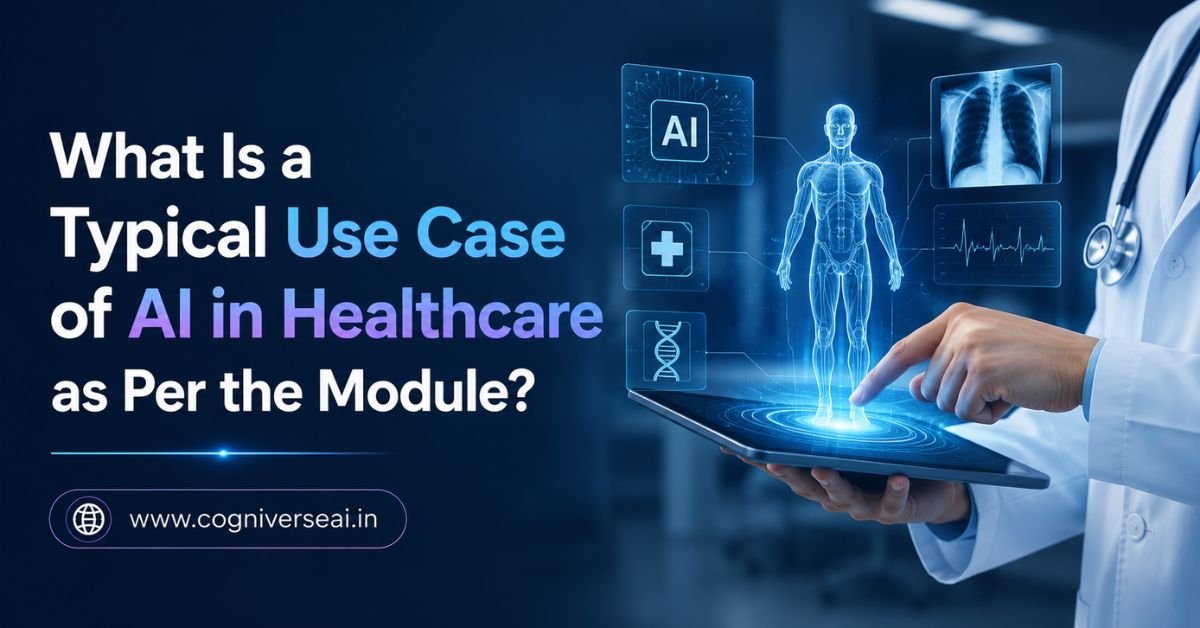
Artificial Intelligence (AI) is transforming healthcare faster than ever before. Hospitals, clinics, research organisations, and healthcare professionals are using AI to improve patient care, reduce medical errors, and make healthcare services more efficient. From analysing medical images to predicting diseases and assisting doctors during diagnosis, AI is becoming an essential part of modern medicine.
Many students and professionals preparing for AI courses or certification exams often ask, “What is a typical use case of AI in healthcare as per the module?”
In most introductory AI learning modules, the most common use case highlighted is medical diagnosis and disease detection using medical imaging. AI systems are trained to analyse X-rays, CT scans, MRI scans, and other medical images to help doctors identify diseases more quickly and accurately.
However, AI’s role in healthcare extends far beyond medical imaging. It also supports drug discovery, personalised treatment plans, patient monitoring, hospital management, virtual health assistants, robotic surgery, and predictive healthcare.
In this comprehensive guide, you’ll learn what is a typical use case of AI in healthcare as per the module, how AI works in healthcare, its major applications, benefits, limitations, future possibilities, and why it is becoming one of the most valuable technologies in modern medicine.
What Is Artificial Intelligence in Healthcare?
Artificial Intelligence in healthcare refers to the use of intelligent computer systems that can analyse medical data, learn from information, recognise patterns, and assist healthcare professionals in making better decisions.
Instead of replacing doctors, AI is designed to support them by providing faster analysis, improving diagnostic accuracy, and automating repetitive tasks.
Healthcare AI combines several technologies, including:
- Machine Learning
- Deep Learning
- Natural Language Processing (NLP)
- Computer Vision
- Predictive Analytics
Together, these technologies help improve patient outcomes while reducing workload for healthcare professionals.
Also read: What Is a Common Use Case for Machine Learning in Banking?
What Is a Typical Use Case of AI in Healthcare as Per the Module?
In most AI learning modules, the typical use case of AI in healthcare is medical diagnosis through image analysis.
Medical imaging generates enormous amounts of visual data every day. Doctors must examine X-rays, MRI scans, CT scans, ultrasounds, and other images to identify diseases or abnormalities.
AI systems are trained using thousands or even millions of medical images. They learn to recognise patterns associated with different diseases and can assist doctors by highlighting areas that may require closer examination.
For example, AI can help detect:
- Lung cancer
- Breast cancer
- Brain tumours
- Pneumonia
- Bone fractures
- Diabetic retinopathy
- Heart disease
Rather than replacing medical professionals, AI serves as a decision-support tool that improves both speed and accuracy.
Why Medical Diagnosis Is the Most Common AI Use Case?
Healthcare professionals face increasing workloads while managing large numbers of patients.
Medical imaging requires careful examination, and even experienced specialists can occasionally overlook subtle abnormalities.
AI helps by:
- Analysing images within seconds
- Identifying tiny abnormalities
- Supporting early disease detection
- Reducing diagnostic errors
- Assisting doctors in complex cases
Early diagnosis often leads to earlier treatment, improving patient outcomes.
How AI Analyses Medical Images?
Understanding how AI works makes its role easier to appreciate.
Step 1: Collecting Medical Images
Hospitals collect large datasets containing:
- X-rays
- CT scans
- MRI scans
- Mammograms
- Ultrasound images
- Retinal scans
Each image is labelled by medical experts.
Step 2: Training the AI Model
Machine learning and deep learning algorithms analyse thousands of labelled images.
The system gradually learns what healthy tissue looks like and how diseased tissue differs.
Step 3: Recognising Patterns
When a new scan is uploaded, AI compares it with previously learned patterns.
It searches for signs such as:
- Tumours
- Inflammation
- Fractures
- Bleeding
- Infections
- Organ abnormalities
Step 4: Supporting the Doctor
The AI highlights suspicious areas and provides probability scores.
The final diagnosis always remains the responsibility of the healthcare professional.
Real-World Example
Imagine a patient visits a hospital with persistent chest pain and difficulty breathing.
The doctor orders a chest X-ray.
An AI system analyses the image within seconds and identifies an area that appears consistent with early-stage pneumonia.
The doctor reviews both the AI findings and the X-ray before confirming the diagnosis.
In this case, AI speeds up the review process while helping ensure important details are not overlooked.
Other Important Use Cases of AI in Healthcare
Although medical diagnosis is the most common example taught in AI modules, healthcare uses AI in many other ways.
Disease Prediction
AI analyses patient records to predict the likelihood of future illnesses.
It considers factors such as:
- Age
- Medical history
- Family history
- Lifestyle
- Blood test results
- Vital signs
Doctors can then recommend preventive care before serious illness develops.
Personalised Treatment Plans
Every patient is different.
AI helps create customised treatment plans by analysing:
- Medical history
- Genetic information
- Previous treatments
- Medication responses
This allows healthcare providers to choose treatments that are more suitable for each individual.
Drug Discovery
Developing new medicines traditionally takes many years.
AI speeds up the process by analysing enormous biological datasets and identifying promising drug candidates much faster than conventional research methods.
Researchers can prioritise the most promising compounds for laboratory testing.
Robotic Surgery
AI-powered surgical systems assist surgeons during complex operations.
Benefits include:
- Greater precision
- Smaller incisions
- Reduced blood loss
- Faster recovery
- Lower complication rates
The surgeon remains in control throughout the procedure.
Virtual Health Assistants
Many healthcare providers use AI-powered virtual assistants.
These assistants help patients:
- Book appointments
- Receive medication reminders
- Ask basic health questions
- Access healthcare information
They improve patient engagement while reducing administrative workload.
Patient Monitoring
Wearable devices collect continuous health information.
AI analyses data such as:
- Heart rate
- Blood pressure
- Oxygen levels
- Blood glucose
- Sleep patterns
If abnormal patterns appear, healthcare providers can be alerted quickly.
Administrative Automation
Hospitals perform many repetitive administrative tasks.
AI helps automate:
- Medical record management
- Appointment scheduling
- Billing
- Insurance processing
- Clinical documentation
This allows healthcare staff to spend more time caring for patients.
Natural Language Processing in Healthcare
Natural Language Processing helps computers understand medical language.
Doctors often write lengthy clinical notes.
NLP extracts important information such as:
- Diagnoses
- Medications
- Allergies
- Laboratory results
- Treatment history
This makes medical records easier to search and analyse.
Benefits of AI in Healthcare
Artificial Intelligence offers significant advantages across the healthcare industry.
Earlier Disease Detection
AI identifies subtle patterns that may indicate disease before symptoms become severe.
Earlier treatment often leads to better outcomes.
Improved Diagnostic Accuracy
AI assists healthcare professionals by analysing large volumes of medical information quickly and consistently.
Faster Decision-Making
Medical images and patient records can be reviewed much more rapidly than through manual processes alone.
Better Patient Care
Healthcare providers receive additional insights that support more informed clinical decisions.
Reduced Administrative Burden
Automation decreases paperwork and repetitive tasks.
Healthcare professionals can devote more attention to patient care.
Lower Healthcare Costs
Efficient workflows, earlier diagnosis, and improved resource management can reduce unnecessary healthcare expenses over time.
Challenges of AI in Healthcare
Although AI offers many advantages, several challenges remain.
Data Privacy
Medical records contain highly sensitive personal information.
Healthcare organisations must protect patient privacy using strong security measures and comply with applicable data protection regulations.
High Development Costs
Building reliable AI systems requires advanced technology, skilled professionals, and significant investment.
Bias in Training Data
If AI is trained using limited or unrepresentative data, it may perform less accurately for certain patient groups.
Developers must continuously monitor and improve datasets.
Regulatory Approval
Healthcare AI systems often require rigorous testing and approval before they can be used in clinical settings.
Human Oversight
AI supports medical professionals but should not replace clinical judgement.
Doctors remain responsible for diagnosis and treatment decisions.
AI vs Traditional Healthcare Systems
| Traditional Healthcare | AI-Assisted Healthcare |
| Manual image analysis | AI-assisted image analysis |
| Longer review times | Faster analysis |
| Higher administrative workload | Automated routine tasks |
| Limited predictive insights | Predictive analytics |
| Standard treatment recommendations | Personalised treatment support |
| Manual record review | Intelligent record analysis |
AI complements traditional healthcare by improving efficiency rather than replacing healthcare professionals.
Industries Supporting Healthcare AI
Healthcare AI involves collaboration between several industries.
These include:
- Hospitals
- Medical imaging companies
- Pharmaceutical companies
- Research institutions
- Health insurance providers
- Biotechnology firms
- Medical device manufacturers
Together, they continue developing new AI-powered healthcare solutions.
The Future of AI in Healthcare
Artificial Intelligence is expected to become even more important in healthcare over the coming years.
Future developments may include:
- Earlier disease prediction
- More personalised treatments
- Faster drug discovery
- Advanced robotic surgery
- Continuous remote patient monitoring
- Improved hospital management
- AI-assisted medical research
- Better preventive healthcare
As technology advances, AI systems will become more accurate, efficient, and integrated into everyday medical practice.
At the same time, responsible AI development, transparency, patient privacy, and strong human oversight will remain essential to ensure safe and trustworthy healthcare.
Why Understanding AI in Healthcare Matters?
Understanding what is a typical use case of AI in healthcare as per the module helps students and professionals appreciate how artificial intelligence is improving modern medicine.
Whether it is analysing medical images, supporting doctors with diagnosis, predicting diseases, or improving hospital efficiency, AI is helping healthcare systems deliver faster, safer, and more personalised care.
As AI continues to evolve, healthcare professionals who understand these technologies will be better prepared to work alongside intelligent systems and deliver improved patient outcomes.
Also read: What Extracurricular Activities Do Colleges Look For?
Conclusion
So, what is a typical use case of AI in healthcare as per the module? The answer most commonly taught in introductory AI courses is medical diagnosis through medical image analysis.
By analysing X-rays, CT scans, MRI scans, and other medical images, AI helps healthcare professionals detect diseases earlier, improve diagnostic accuracy, and support better clinical decision-making.
Beyond diagnosis, AI is transforming healthcare through predictive analytics, personalised treatment planning, robotic surgery, patient monitoring, drug discovery, virtual assistants, and administrative automation. While AI is not a replacement for doctors, it is becoming a powerful partner that enhances efficiency and improves patient care.
As technology continues to advance, AI will play an even greater role in creating safer, smarter, and more accessible healthcare systems around the world.
Frequently Asked Questions (FAQ)
1. What is a typical use case of AI in healthcare as per the module?
Medical image analysis is the most common AI healthcare use case, helping doctors detect diseases more quickly and accurately.
2. How does AI help doctors diagnose diseases?
AI analyses medical images, patient records, and clinical data to identify patterns that may indicate diseases and support diagnosis.
3. Can AI replace doctors in healthcare?
No. AI assists healthcare professionals with analysis and decision support, but doctors remain responsible for diagnosis and treatment.
4. What technologies power AI in healthcare?
Machine Learning, Deep Learning, Natural Language Processing, Computer Vision, and predictive analytics are widely used in healthcare AI.
5. What are the benefits of AI in healthcare?
AI improves diagnostic accuracy, speeds up analysis, supports personalised treatment, automates routine tasks, and enhances patient care.