Artificial Intelligence (AI) has become one of the most talked-about technologies in the world. It is changing the way we work, learn, communicate, shop, and even receive healthcare. From voice assistants like Siri and Google Assistant to personalised recommendations on Netflix and Amazon, AI is now a part of our daily lives.
Despite its growing popularity, many people still ask one simple question: What is artificial intelligence primarily focused on?
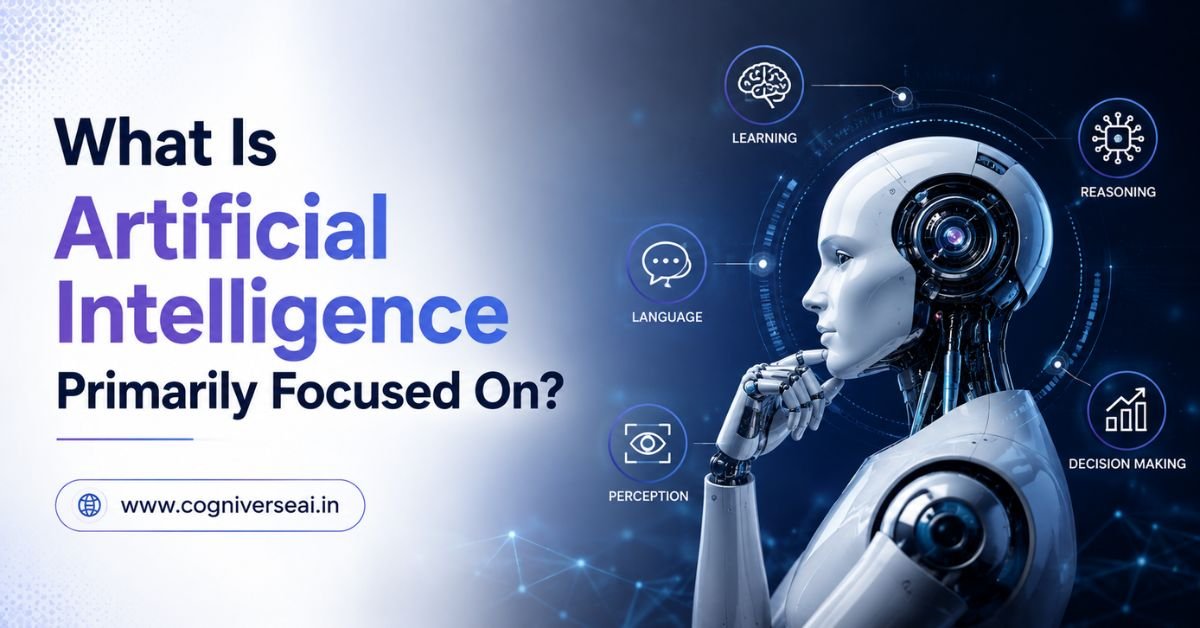
The short answer is that artificial intelligence is primarily focused on enabling machines to perform tasks that normally require human intelligence. These tasks include learning from experience, recognising patterns, understanding language, solving problems, making decisions, and improving performance over time.
However, there is much more to AI than this simple definition. Artificial intelligence is not just about robots or futuristic machines. It is about building intelligent systems that can analyse information, adapt to new situations, and help people solve complex problems more efficiently.
In this comprehensive blog, you’ll learn what artificial intelligence is primarily focused on, how it works, its key goals, real-world applications, benefits, challenges, and why it is becoming one of the most important technologies of the 21st century.
What Is Artificial Intelligence?
Artificial Intelligence is a branch of computer science that focuses on creating machines and software capable of performing tasks that typically require human intelligence.
Instead of simply following fixed instructions, AI systems can analyse data, recognise patterns, learn from previous experiences, and make decisions with minimal human intervention.
Artificial intelligence combines several technologies, including:
- Machine Learning
- Deep Learning
- Natural Language Processing (NLP)
- Computer Vision
- Robotics
- Expert Systems
Together, these technologies allow computers to perform increasingly complex tasks that once required human thinking.
Also read: What Is a Typical Use Case of AI in Healthcare as Per the Module?
What Is Artificial Intelligence Primarily Focused On?
The primary focus of artificial intelligence is to develop systems that can think, learn, reason, and make decisions in ways that resemble human intelligence.
Rather than replacing humans completely, AI is mainly designed to assist people by improving speed, accuracy, and efficiency.
Its main objectives include:
- Learning from data
- Solving problems
- Automating repetitive tasks
- Making informed decisions
- Understanding language
- Recognising images and speech
- Predicting future outcomes
- Continuously improving performance
In simple terms, artificial intelligence aims to help machines become smarter so they can complete tasks more effectively.
Why Was Artificial Intelligence Created?
Humans have always looked for ways to make work easier.
Early computers could only follow exact instructions provided by programmers. They could not learn from mistakes or adapt to new situations.
Artificial intelligence was developed to overcome these limitations.
Instead of programming every possible situation, AI systems learn from data and improve automatically over time.
This allows them to solve problems that are too large or too complex for traditional computer programs.
The Main Goals of Artificial Intelligence
To better understand what artificial intelligence is primarily focused on, let’s explore its major goals.
Learning From Data
One of AI’s biggest goals is learning.
Instead of relying only on fixed programming, AI analyses data to identify patterns and relationships.
For example, an email spam filter learns to recognise unwanted messages by studying thousands of previous emails.
The more data it receives, the better it becomes at identifying spam.
Solving Complex Problems
Many real-world problems involve enormous amounts of information.
AI helps solve these challenges by processing data much faster than humans.
Examples include:
- Medical diagnosis
- Financial forecasting
- Weather prediction
- Traffic management
- Supply chain optimisation
AI allows organisations to make better decisions based on data rather than guesswork.
Making Better Decisions
Artificial intelligence supports decision-making by analysing multiple factors simultaneously.
Businesses use AI to:
- Predict customer behaviour
- Detect fraud
- Manage inventory
- Improve marketing campaigns
- Reduce operational costs
AI provides insights that help decision-makers choose the best possible actions.
Automating Repetitive Tasks
Many everyday jobs involve repetitive work.
Artificial intelligence automates these tasks, allowing employees to focus on more valuable activities.
Examples include:
- Data entry
- Invoice processing
- Customer support
- Appointment scheduling
- Document classification
Automation improves productivity while reducing human error.
Understanding Human Language
Artificial intelligence is increasingly focused on communicating naturally with people.
Natural Language Processing enables AI to:
- Read text
- Understand questions
- Translate languages
- Generate responses
- Summarise documents
This technology powers chatbots, virtual assistants, and AI writing tools.
Recognising Images and Objects
Computer Vision allows AI to interpret visual information.
Applications include:
- Face recognition
- Medical image analysis
- Quality inspection
- Self-driving vehicles
- Security surveillance
By recognising objects accurately, AI can assist humans in many industries.
Predicting Future Outcomes
Artificial intelligence analyses historical data to forecast future events.
Businesses use prediction models for:
- Product demand
- Equipment maintenance
- Customer purchases
- Disease outbreaks
- Financial markets
These predictions support better planning and risk management.
How Artificial Intelligence Learns
Unlike traditional software, AI improves through experience.
The learning process generally includes:
- Collecting data.
- Identifying patterns.
- Training algorithms.
- Testing predictions.
- Correcting mistakes.
- Improving future performance.
As the system receives more data, its accuracy often increases.
This ability to learn is one of AI’s defining characteristics.
Core Areas Artificial Intelligence Focuses On
Artificial intelligence is a broad field with several specialised areas.
Machine Learning
Machine Learning enables computers to learn from data without being explicitly programmed for every situation.
Examples include:
- Recommendation systems
- Fraud detection
- Customer segmentation
Deep Learning
Deep Learning uses neural networks inspired by the human brain.
It is especially useful for:
- Image recognition
- Speech recognition
- Language translation
- Autonomous driving
Natural Language Processing (NLP)
NLP helps computers understand and generate human language.
Examples include:
- AI chatbots
- Voice assistants
- Text summarisation
- Sentiment analysis
Computer Vision
Computer Vision allows machines to interpret images and videos.
It is widely used in:
- Healthcare
- Manufacturing
- Agriculture
- Retail
Robotics
Robotics combines AI with mechanical engineering to build intelligent machines capable of performing physical tasks.
Examples include:
- Warehouse robots
- Surgical robots
- Industrial automation
Real-World Examples of AI’s Primary Focus
Understanding practical applications makes AI much easier to understand.
Healthcare
AI analyses medical images to help doctors detect diseases earlier.
It also predicts patient risks and assists with treatment planning.
The focus is improving diagnosis and healthcare outcomes.
Banking
Banks use AI to detect suspicious transactions.
The system analyses millions of transactions in seconds.
Its focus is preventing fraud and improving security.
Education
AI personalises learning experiences.
Students receive customised lessons based on their progress.
The focus is improving learning outcomes.
Agriculture
Farmers use AI to monitor crops, detect pests, and predict weather conditions.
The focus is increasing productivity while reducing waste.
Retail
Online stores recommend products based on previous purchases.
The focus is improving customer satisfaction and increasing sales.
Manufacturing
Factories use AI for predictive maintenance and quality control.
The focus is improving efficiency while reducing downtime.
Benefits of Artificial Intelligence
Artificial intelligence provides numerous advantages across industries.
Improved Accuracy
AI reduces many human errors by analysing data consistently.
Faster Processing
Machines process enormous datasets within seconds.
Increased Productivity
Automation allows businesses to complete work more efficiently.
Better Decision-Making
AI provides valuable insights based on data analysis.
Cost Savings
Automation reduces labour costs and improves operational efficiency.
Personalised Experiences
Businesses can deliver customised recommendations to customers.
Challenges Artificial Intelligence Faces
Although AI offers many benefits, it also presents several challenges.
Data Privacy
AI systems often require large amounts of personal data.
Protecting this information is essential.
Bias
If training data contains bias, AI may produce unfair outcomes.
Developers must carefully monitor AI systems.
High Development Costs
Building advanced AI solutions often requires significant investment.
Lack of Transparency
Some AI systems make decisions that are difficult to explain.
Improving explainability remains an important goal.
Job Displacement
Automation may change certain job roles.
However, AI also creates new career opportunities in technology, research, and data science.
Artificial Intelligence vs Human Intelligence
Although AI performs many impressive tasks, it is still different from human intelligence.
| Artificial Intelligence | Human Intelligence |
| Learns from data | Learns from life experiences |
| Processes information quickly | Thinks creatively and emotionally |
| Works continuously | Needs rest |
| Excellent at repetitive tasks | Excellent at judgement and empathy |
| Follows algorithms | Uses intuition and common sense |
Rather than replacing humans, AI is most effective when working alongside people.
Common Misconceptions About AI
Many myths exist about artificial intelligence.
Myth 1: AI Thinks Like Humans
AI analyses patterns but does not possess emotions, consciousness, or self-awareness.
Myth 2: AI Will Replace Every Job
Most AI systems are designed to assist humans, not replace them entirely.
Many careers will evolve rather than disappear.
Myth 3: AI Is Only About Robots
Robots are only one application of AI.
Most AI exists as software running behind websites, apps, and business systems.
Myth 4: AI Never Makes Mistakes
AI can make errors if trained on poor-quality or incomplete data.
Human oversight remains essential.
Future Focus of Artificial Intelligence
Artificial intelligence continues to evolve rapidly.
In the coming years, AI will increasingly focus on:
- Personalised healthcare
- Climate change solutions
- Smart cities
- Autonomous transportation
- Cybersecurity
- Scientific research
- Education
- Sustainable agriculture
Future AI systems will become more accurate, more efficient, and more capable of working alongside humans.
At the same time, ethical AI development, responsible data use, and transparency will become even more important as organisations adopt AI across different sectors.
Why Understanding AI’s Focus Matters?
Understanding what artificial intelligence is primarily focused on helps individuals and businesses make better decisions about adopting this technology.
For students, it provides valuable knowledge about one of the fastest-growing career fields.
For businesses, it highlights opportunities to improve efficiency, reduce costs, and enhance customer experiences.
For society, it encourages informed discussions about responsible AI development, privacy, fairness, and long-term innovation.
The more people understand AI, the better prepared they will be to benefit from its capabilities while addressing its challenges.
Also read: Best Extracurricular Activities for High School Students
Conclusion
So, what is artificial intelligence primarily focused on? The answer is simple: artificial intelligence is primarily focused on enabling machines to learn from data, solve problems, make informed decisions, recognise patterns, understand human language, and automate tasks that typically require human intelligence.
Its ultimate goal is not to replace people but to assist them by improving speed, accuracy, productivity, and decision-making across countless industries. Whether it is helping doctors diagnose diseases, supporting businesses with data analysis, recommending products, or enabling smarter transportation, AI continues to transform the way we live and work.
As technology advances, artificial intelligence will become even more integrated into our daily lives. Understanding its primary focus helps us appreciate both its potential and the responsibility required to develop and use it wisely.
Frequently Asked Questions (FAQ)
1. What is artificial intelligence primarily focused on?
Artificial intelligence focuses on enabling machines to learn, solve problems, make decisions, recognise patterns, and automate tasks efficiently.
2. Why is learning important in artificial intelligence?
Learning allows AI systems to improve with experience, increasing accuracy and helping them make better predictions without constant reprogramming.
3. How does artificial intelligence help businesses?
AI helps businesses automate tasks, analyse data, improve customer service, detect fraud, and make faster, more informed decisions.
4. What industries benefit most from artificial intelligence?
Healthcare, finance, education, manufacturing, agriculture, retail, and transportation all use AI to improve efficiency and decision-making.
5. Can artificial intelligence think like humans?
No. AI processes data and recognises patterns but does not possess human emotions, consciousness, creativity, or independent understanding.