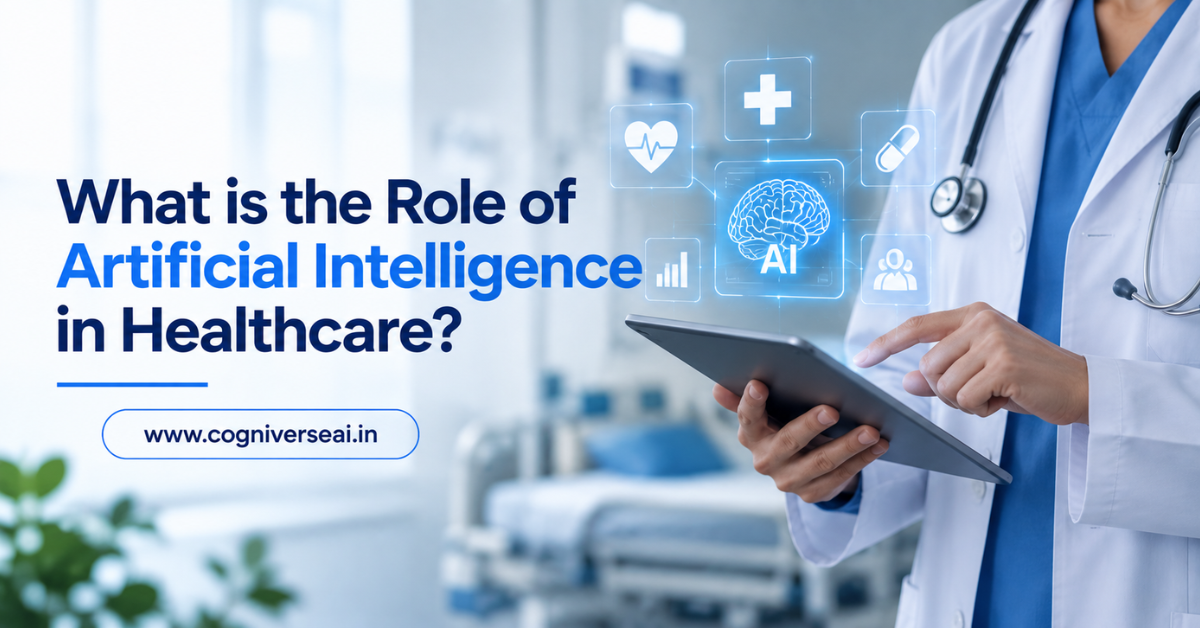
Artificial intelligence is changing how healthcare organizations collect information, support medical decisions, manage routine work, and develop new treatments. From analyzing medical images to helping researchers study diseases, AI can process large amounts of health data and identify patterns that may be difficult to find manually.
So, what is the role of artificial intelligence in healthcare? AI’s main role is to support healthcare professionals by analyzing data, assisting with diagnosis and risk assessment, improving administrative processes, supporting research and drug development, and helping deliver more personalized and efficient care. It is not a replacement for doctors or other healthcare professionals.
The World Health Organization recognizes potential uses of AI in areas such as diagnosis, clinical care, drug development, disease surveillance, outbreak response, and health-system management. At the same time, WHO emphasizes that AI in healthcare needs appropriate ethics, governance, safety, and human oversight.
What Is Artificial Intelligence in Healthcare?
Artificial intelligence in healthcare refers to the use of AI systems to perform tasks that normally require human analysis or decision-making.
Healthcare produces large amounts of information, including:
- Medical images
- Laboratory results
- Electronic health records
- Patient histories
- Clinical notes
- Research data
- Genetic information
- Health-monitoring data
AI can analyze certain types of this information and identify patterns or provide predictions, recommendations, summaries, or other outputs.
For example, an AI-enabled medical system may analyze an image and highlight an area that deserves a healthcare professional’s attention. Other systems can help organize information or support clinical workflows.
The exact role depends on the AI system, the data it uses, and the intended medical purpose.
Also read: Why Human Validated AI Audio Is the Future of Enterprise Knowledge Sharing?
What Is the Main Role of AI in Healthcare?
The main role of AI in healthcare is to support people who provide, manage, and research healthcare.
AI can help with tasks such as:
- Detecting patterns in medical data
- Supporting medical image analysis
- Assessing certain risks
- Organizing clinical information
- Automating repetitive administrative tasks
- Supporting drug discovery and research
- Monitoring population health
- Helping healthcare organizations manage resources
The U.S. Food and Drug Administration (FDA) describes AI and machine learning applications in medical devices that can support areas such as image processing, early disease detection, diagnosis, prognosis, risk assessment, and identification of patterns in disease progression.
However, an AI output should not automatically be treated as a final medical decision. The appropriate role of human healthcare professionals depends on the specific technology, its intended use, evidence, and applicable rules.
How AI Is Used in Diagnosis and Disease Detection?
One of the most discussed uses of AI in healthcare is medical diagnosis.
Medical Image Analysis
Doctors and specialists often work with images such as X-rays, CT scans, MRI scans, mammograms, and other medical images.
AI systems can analyze images and identify patterns associated with particular conditions. In some cases, the system can highlight an area that may require further review.
This can help a healthcare professional focus attention on relevant findings.
Importantly, AI image analysis does not mean that a computer independently replaces the medical professional. The usefulness of an AI system depends on its intended use, validation, performance, and how it is incorporated into clinical practice.
The FDA maintains a list of AI-enabled medical devices that have met applicable premarket requirements in the United States, although the agency notes that the list is not comprehensive.
Identifying Patterns in Patient Data
AI can also analyze combinations of information such as symptoms, test results, medical history, and other available data.
Depending on the system, it may help identify patterns associated with disease risk or support clinical decision-making.
This can be particularly useful when healthcare professionals need to consider large amounts of information.
AI and Personalized Healthcare
Not every patient has the same needs.
Healthcare professionals already consider factors such as age, medical history, symptoms, test results, lifestyle, and other individual circumstances when planning care.
AI can support this process by analyzing large datasets and identifying patterns that may help with risk assessment or treatment planning.
For example, an AI system might help identify patient groups that share particular characteristics or help clinicians examine information relevant to a patient’s condition.
However, personalized healthcare does not mean that an AI system should decide what treatment a person receives on its own. Medical decisions require clinical judgment, patient preferences, appropriate evidence, and professional responsibility.
AI in Drug Discovery and Medical Research
Developing a new medicine can require years of research and testing.
AI can support parts of this process by helping researchers analyze large datasets, identify patterns, explore potential drug candidates, and study biological information.
AI can also support scientific research by helping researchers process information more efficiently.
The WHO identifies drug development and health research among areas where AI has potential applications.
AI does not remove the need for laboratory research, clinical trials, regulatory review, or scientific validation. Instead, it can act as a tool that helps researchers investigate possibilities more efficiently.
AI Can Reduce Administrative Work
Healthcare involves much more than diagnosis and treatment.
Doctors, nurses, hospitals, laboratories, and other healthcare organizations also deal with administrative work.
Examples include:
- Organizing patient information
- Summarizing documentation
- Scheduling
- Managing records
- Processing routine requests
- Supporting communication
- Handling repetitive documentation tasks
AI-based tools can automate or assist with some of these activities.
This can potentially reduce the amount of time healthcare workers spend on certain repetitive tasks. However, organizations still need to review AI-generated information and ensure that privacy and security requirements are followed.
AI in Remote Monitoring and Digital Health
AI can also be used with digital health technologies and monitoring systems.
Depending on the technology, data from devices may be analyzed to identify patterns or changes that could require attention.
For example, a monitoring system might analyze health-related measurements over time and flag an unusual pattern for review.
The important point is that an alert is not automatically a diagnosis. It may simply indicate that further assessment is appropriate.
This distinction matters because patients and healthcare professionals need to understand what an AI system is designed to do and what it cannot determine.
AI and Public Health
AI can also have applications beyond individual patient care.
Healthcare systems collect information that can help researchers and public health organizations understand patterns of disease and health conditions.
AI may support areas such as:
- Disease surveillance
- Outbreak response
- Population health analysis
- Health resource planning
- Public health research
WHO identifies disease surveillance and outbreak response among potential applications of AI for health.
The usefulness of these systems depends heavily on data quality, appropriate methods, privacy protections, and responsible governance.
How Generative AI Is Changing Healthcare?
Generative AI is another important part of the healthcare discussion.
Generative AI can create text, summaries, images, and other forms of content. In healthcare environments, it may assist with tasks such as summarizing information, drafting certain types of documentation, or helping professionals interact with large amounts of information.
WHO’s 2025 guidance on large multimodal models discusses their potential applications in healthcare, scientific research, public health, and drug development while also highlighting the need for appropriate governance.
Generative AI needs particular care because it can produce convincing information that may be incomplete or incorrect.
For this reason, healthcare organizations should establish clear rules about when and how these systems can be used.
Benefits of Artificial Intelligence in Healthcare
AI can offer several potential benefits when properly designed, evaluated, and implemented.
Faster Analysis of Large Amounts of Data
Healthcare data can be difficult for people to process manually when the volume becomes very large.
AI can analyze certain datasets quickly and help identify patterns.
Support for Healthcare Professionals
AI can act as a decision-support tool, helping professionals examine information or identify areas that deserve closer attention.
More Efficient Workflows
Automation can help reduce repetitive work and support administrative processes.
Support for Research
Researchers can use AI to analyze large datasets and explore potential patterns or relationships.
New Healthcare Tools
AI is also helping create new types of software and medical devices.
The FDA’s current AI-enabled medical device resources show that AI is already being incorporated into regulated medical technologies, while regulatory agencies continue developing approaches for evaluating their safety and effectiveness.
What Are the Risks of AI in Healthcare?
Understanding the role of AI also means understanding its limitations.
Incorrect Results
AI systems can produce incorrect outputs. An AI-generated recommendation should therefore be evaluated according to the system’s intended use and appropriate clinical processes.
Bias in Data
AI systems learn from data. If the data used to develop or evaluate a system does not adequately represent the people who will use it, performance may vary across groups.
This is one reason why data quality, validation, and ongoing monitoring matter.
Privacy and Security
Healthcare information can be highly sensitive.
Organizations need appropriate safeguards when collecting, storing, processing, and sharing health data with AI systems.
Lack of Transparency
Some AI systems can be difficult for users to understand because their internal processes may be complex.
Healthcare professionals need enough information about a system’s purpose, limitations, performance, and appropriate use to make responsible decisions.
Overreliance on AI
Perhaps one of the most important risks is treating an AI output as automatically correct.
AI should support appropriate healthcare processes rather than remove human responsibility.
WHO emphasizes that ethical and human-rights considerations should be central to the design, deployment, and use of AI in health.
Why Human Oversight Matters in AI Healthcare?
Healthcare decisions can have serious consequences.
A useful AI system should therefore operate within a broader process that includes trained professionals, appropriate evidence, quality controls, and accountability.
For example, if an AI system highlights a possible abnormality in a medical image, a qualified professional may need to review the image and consider the patient’s wider clinical situation.
Similarly, if an AI system produces a summary of patient information, the healthcare professional should check whether the summary is accurate and complete enough for its intended use.
Human oversight does not mean AI has no value. It means AI is being used as part of a responsible healthcare system.
How Healthcare Organizations Can Use AI Responsibly?
Successful AI adoption requires more than purchasing an AI tool.
Organizations should consider:
Define the Purpose
The organization should know exactly what problem the AI system is intended to solve.
Evaluate Performance
AI systems should be appropriately tested and evaluated for their intended use.
Protect Patient Information
Data protection and cybersecurity should be considered throughout the system’s lifecycle.
Train Healthcare Workers
Users need to understand what the AI system does, what its limitations are, and when human review is required.
Monitor the System
AI systems can behave differently when data, clinical practices, or environments change. Ongoing monitoring can therefore be important.
Regulators are also paying attention to the full lifecycle of AI-enabled medical devices. The FDA’s guidance work includes considerations around development, documentation, maintenance, and changes to AI-enabled devices.
What Is the Future of AI in Healthcare?
The future of AI in healthcare is likely to involve deeper integration into clinical, administrative, research, and public health workflows.
AI may increasingly help professionals analyze information, support medical imaging, manage documentation, conduct research, and develop new healthcare technologies.
At the same time, healthcare organizations will need strong governance.
WHO’s recent work on AI for health emphasizes safety, equity, governance, and responsible adoption. WHO has also highlighted concerns about legal uncertainty, data quality, affordability, workforce readiness, and other barriers to responsible AI adoption.
This means the future of healthcare AI is not simply about making systems more powerful. It is also about making them reliable, appropriately evaluated, secure, understandable, and useful to healthcare professionals and patients.
Also read: Impromptu Speech Topics for Kids
Conclusion
So, what is the role of artificial intelligence in healthcare? AI’s role is to support healthcare through data analysis, diagnosis assistance, risk assessment, medical research, drug development, administrative automation, public health applications, and other healthcare tasks.
AI can help healthcare professionals work with large amounts of information and may improve the efficiency of certain processes. It can also support the development of new medical technologies and research methods.
However, AI is not automatically accurate, unbiased, or suitable for every medical task. Healthcare requires careful attention to privacy, safety, data quality, bias, regulation, and human oversight.
The most useful way to think about AI in healthcare is not as a replacement for healthcare professionals, but as a technology that can support them when it is properly designed, evaluated, implemented, and monitored.
The future of healthcare AI will depend not only on what the technology can do, but also on how responsibly people and organizations choose to use it.
Frequently Asked Questions (FAQ)
1. What is the main role of AI in healthcare?
AI mainly supports healthcare professionals by analyzing data, assisting with diagnosis, improving workflows, and supporting research and decision-making.
2. How is AI used in medical diagnosis?
AI can analyze certain medical images and patient data to identify patterns that may help healthcare professionals assess diseases or health risks.
3. Can AI replace doctors?
AI is not a replacement for doctors. It can support healthcare professionals, but medical decisions require appropriate human judgment, evidence, and responsibility.
4. What are the risks of AI in healthcare?
Key risks include incorrect results, biased data, privacy problems, security risks, limited transparency, and overreliance on AI-generated recommendations.
5. Why is AI important for the future of healthcare?
AI can support medical research, data analysis, clinical workflows, and new healthcare technologies when it is used safely and responsibly.
1 thought on “What Is The Role Of Artificial Intelligence In Healthcare?”