AI has changed the way people create content. A task that once took hours can now be completed in minutes with the help of an AI writing tool. Blog posts, product descriptions, social media captions, emails, outlines, and even research summaries can all be generated much faster.
But faster content creation does not automatically mean better content.
If you use AI to generate content, you must ensure that the final material is accurate, original, useful, relevant, and reviewed by a human before publication. AI can produce fluent and convincing text while still making factual errors, inventing information, repeating common ideas, or missing important context.
This is why responsible AI-assisted content creation requires more than simply entering a keyword and copying the generated response.
Whether you are a blogger, business owner, marketer, student, or SEO professional, understanding what to check when using AI can help you create content that genuinely serves readers and maintains trust.
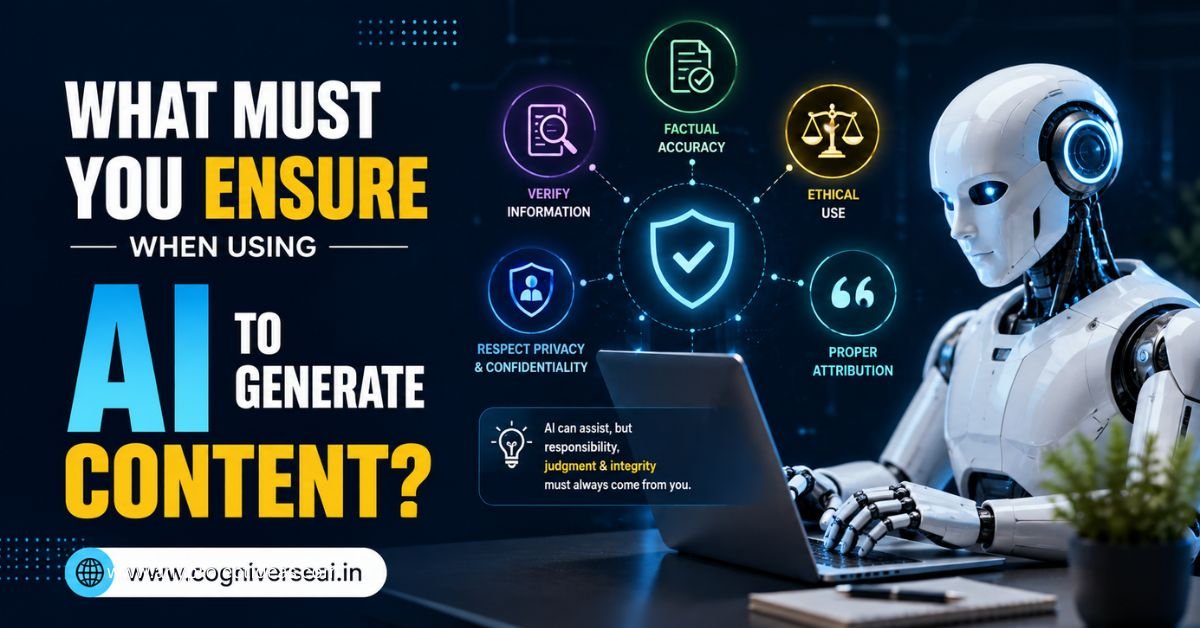
What Must You Ensure When Using AI to Generate Content?
When using AI to generate content, you should ensure that the content is factually accurate, original, helpful, relevant to the audience, properly reviewed, and free from misleading or unsupported claims.
AI should be treated as a content-assistance tool rather than an automatic replacement for human judgment.
A strong AI-assisted workflow usually looks like this:
- Define the purpose and audience.
- Give AI clear instructions.
- Review the generated information.
- Fact-check important claims.
- Add human experience and original insights.
- Improve the structure and readability.
- Check for originality and unnecessary repetition.
- Optimize naturally for search engines.
- Review privacy and copyright concerns.
- Perform a final human edit before publishing.
The goal is not to hide AI involvement. The goal is to make sure the published content is genuinely useful and trustworthy.
1. Ensure the Information Is Accurate
One of the most important things to check when using AI-generated content is accuracy.
AI systems can sometimes produce incorrect information, outdated facts, inaccurate statistics, or statements that sound authoritative but cannot be verified. This is particularly important when writing about health, finance, law, technology, science, or current events.
For example, imagine an AI-generated article says that a particular law changed in a specific year. If you publish that statement without checking it, readers could receive incorrect information.
Before publishing, verify:
- Statistics
- Dates
- Names
- Research findings
- Legal information
- Product specifications
- Medical claims
- Prices
- Current events
- Quotes
- References and sources
The higher the potential impact of an error, the more carefully you should verify the information.
Why Human Fact-Checking Matters
AI can help you gather and organize information, but humans remain responsible for deciding whether a claim is reliable enough to publish.
For important topics, check trustworthy primary sources whenever possible. Government websites, official documentation, academic research, company documentation, and recognized professional organizations can be more reliable than blindly accepting an AI-generated statement.
Also read: What Does R Stand for in the RTF Framework?
2. Ensure the Content Provides Real Value
Generating 2,000 words does not automatically create a valuable article.
One of the biggest mistakes in AI content creation is focusing on word count instead of usefulness.
A reader should leave the article knowing something they did not know before, understanding a complicated concept more clearly, or having practical information they can actually use.
For example, if you are writing about “how to choose a laptop,” simply listing generic advice such as “check the processor, RAM, and battery” does not provide much value.
A better article could explain:
- Which processor specifications matter for different users
- How much RAM is appropriate for common tasks
- What battery specifications readers should examine
- Which features are unnecessary for basic users
- How to compare two laptops in real-world situations
The difference is depth and practical usefulness.
3. Ensure There Is Human Review
Human review is one of the most important steps in responsible AI-assisted content creation.
Even when AI produces grammatically correct and well-structured writing, the content may still contain problems that require human judgment.
A human editor can identify:
- Incorrect claims
- Awkward explanations
- Repetitive sections
- Missing information
- Unsupported conclusions
- Incorrect tone
- Poor examples
- Generic statements
- Inconsistencies
- Information that no longer applies
Think of AI as an assistant that creates a draft. Your role is to turn that draft into a reliable final resource.
Add Your Own Experience
Human experience can make AI-assisted content much stronger.
For example, if you are writing about website SEO and have personally tested different approaches, explain what you observed. If you are writing a product guide, include practical considerations that readers might not find in a generic description.
This creates a stronger connection between the content and the real-world needs of the reader.
4. Ensure the Content Is Original
Originality is another major consideration when using AI.
AI learns patterns from large amounts of information, so its output can sometimes resemble common phrasing or widely repeated ideas. That does not mean every AI-generated sentence is copied, but it does mean you should not assume that generated content is automatically original simply because it was produced by a machine.
Before publication, look for:
- Repeated ideas
- Generic introductions
- Common phrasing
- Unnecessary filler
- Similar explanations found across competing articles
- Claims that lack a distinctive perspective
More importantly, add information that reflects your own expertise, observations, examples, analysis, and experience.
Originality Is More Than Changing Words
Simply rewriting AI-generated sentences with synonyms does not necessarily create genuinely original content.
Real originality comes from adding something meaningful.
That could be:
- A unique example
- Personal experience
- Original analysis
- A new comparison
- A practical process
- Expert commentary
- First-hand observations
- Better explanations of difficult concepts
This is particularly important for websites that want to build long-term authority.
5. Ensure the Content Matches Search Intent
SEO content should answer the question the searcher actually has.
Suppose someone searches:
“What does R stand for in the RTF framework?”
They probably want a direct answer first. An article that spends 500 words discussing unrelated aspects of artificial intelligence before answering the question creates a poor user experience.
The introduction should address the search intent quickly, followed by a detailed explanation for readers who want more information.
Before publishing an AI-generated article, ask:
What is the reader actually trying to find out?
Then check whether the article answers that need.
Search intent may be:
- Informational
- Commercial
- Transactional
- Navigational
- Comparison-based
- Problem-solving
Understanding intent helps prevent AI-generated content from becoming unnecessarily broad or repetitive.
6. Ensure the Writing Sounds Natural
AI-generated writing can sometimes sound predictable.
You may notice repeated phrases, overly formal language, identical sentence structures, or introductions that follow the same pattern.
For example, phrases such as “In today’s fast-paced digital world” can become repetitive when used across many articles.
A human editor should improve the writing by:
- Varying sentence length
- Removing unnecessary filler
- Using natural transitions
- Adding specific examples
- Simplifying complicated explanations
- Removing repetitive statements
- Writing for humans rather than algorithms
The objective should be clear and natural communication, not simply producing text that looks sophisticated.
7. Ensure SEO Is Natural, Not Forced
AI can help with keyword research, outlines, title ideas, FAQs, and content organization. However, SEO should never become an excuse to stuff keywords into every paragraph.
If your target keyword is “using AI to generate content,” you do not need to repeat the exact phrase unnaturally throughout the article.
Instead, cover the topic comprehensively using related concepts and natural language.
Good SEO content should prioritize:
- Search intent
- Helpful information
- Clear headings
- Natural keyword usage
- Internal linking
- Relevant examples
- Readability
- Accurate information
- A useful page title and meta description
Search engines ultimately serve users, so content created primarily to manipulate rankings is unlikely to provide the same long-term value as genuinely helpful content.
8. Ensure AI-Generated Statistics and Sources Are Verified
Statistics can make an article appear authoritative, but they can also create serious credibility problems if they are incorrect.
Never assume a statistic is accurate simply because AI presents it confidently.
For every important statistic, ask:
Where did this number come from?
If you cannot identify a trustworthy source, consider removing the statistic or replacing it with a properly verified fact.
The same principle applies to citations.
AI can occasionally provide references that are incomplete, incorrect, or difficult to verify. Always check whether a cited source actually exists and supports the statement being made.
9. Protect Sensitive and Private Information
Another important consideration is privacy.
Do not enter confidential customer information, passwords, private business documents, personal identification numbers, or other sensitive information into an AI tool unless you understand the platform’s data handling practices and have appropriate authorization.
For businesses, this is particularly important.
Before using AI with internal information, consider:
- What information is being entered?
- Is it confidential?
- Do you have permission to use it?
- What does the AI provider’s privacy policy say?
- Does your organization have an AI usage policy?
- Could the information identify a customer or employee?
Good AI content practices should include responsible data handling, not just writing quality.
10. Ensure Copyright and Attribution Issues Are Considered
AI-generated content can also raise copyright and attribution questions.
If you ask AI to summarize research, use information from external sources, or create material based on existing work, you should still respect applicable copyright rules and attribution requirements.
Do not assume that AI-generated text gives you permission to reproduce someone else’s protected material.
For example, if an AI provides a quotation from an article, verify the original source before publishing it. If your article depends heavily on research, cite appropriate sources where needed.
A responsible content creator checks the origin and rights associated with important material rather than treating AI output as automatically free of legal or ethical concerns.
11. Give AI Clear Instructions From the Beginning
The quality of AI-generated content often depends partly on the quality of the instructions you provide.
Instead of saying:
“Write an article about home loans.”
You could provide:
“Act as an experienced personal finance writer. Write a beginner-friendly guide explaining how home loans work, including eligibility, interest rates, repayment, common fees, and mistakes borrowers should avoid. Use clear H2 and H3 headings and practical examples.”
The second instruction gives the AI more context.
Clear prompts can help you control:
- Audience
- Tone
- Topic
- Scope
- Structure
- Word count
- Examples
- Formatting
- Key questions
However, even an excellent prompt does not remove the need for human review.
12. Ensure the Content Does Not Contain Unsupported Claims
AI-generated articles can sometimes make statements that sound reasonable but lack evidence.
Be especially careful with claims involving words such as:
- “Always”
- “Never”
- “Guaranteed”
- “Best”
- “Safest”
- “Most effective”
- “Proven”
- “100%”
These words make strong claims and should be used only when the evidence genuinely supports them.
For example, saying that a particular SEO technique “guarantees first-page rankings” would be misleading because search rankings depend on many factors outside the writer’s control.
Strong content uses careful language when certainty is not possible.
13. Make Sure the Content Is Written for People First
The most important principle is simple: write for the reader first.
AI can make it tempting to produce large amounts of content very quickly. But publishing dozens of generic articles is not necessarily better than publishing a smaller number of genuinely useful resources.
Ask yourself:
- Does this article answer the reader’s question?
- Is the information accurate?
- Are the examples useful?
- Does the article provide something beyond obvious information?
- Would I trust this article if I were the reader?
- Does it demonstrate genuine knowledge?
- Have I checked important facts?
If the answer is yes, your AI-assisted content is much more likely to be useful and trustworthy.
A Practical AI Content Review Checklist
Before publishing an AI-generated article, use this simple process.
Step 1: Check Accuracy
Verify important facts, numbers, names, dates, claims, and references.
Step 2: Check Relevance
Make sure every major section contributes to the reader’s search intent.
Step 3: Check Originality
Remove generic filler and add your own examples, insights, experience, or analysis.
Step 4: Check Readability
Break up long paragraphs and simplify complicated sentences.
Step 5: Check SEO
Review the title, meta description, headings, keyword usage, internal links, and search intent.
Step 6: Check Trustworthiness
Make sure claims are supported and important information can be verified.
Step 7: Perform a Human Edit
Read the entire article from beginning to end as if you were the target reader.
This final step can reveal problems that automated tools may miss.
Can AI-Generated Content Rank on Google?
AI assistance itself should not be treated as the deciding factor in whether content is useful.
The more important question is whether the content provides genuine value to users.
AI can be used to help brainstorm ideas, create outlines, improve clarity, summarize information, or assist with drafting. But publishing large quantities of unreviewed, repetitive, low-value material simply because it can be generated quickly is a poor content strategy.
A better approach is to use AI as part of a broader editorial process where humans remain responsible for accuracy, usefulness, originality, and quality.
Also read: Collage Ideas for School Project
Final Thoughts
So, what must you ensure when using AI to generate content?
You must ensure that the content is accurate, original, useful, relevant, trustworthy, naturally written, and reviewed by a human before publication.
AI can dramatically improve the speed of content creation, but speed should never replace judgment. The strongest AI-assisted content combines machine efficiency with human expertise, experience, fact-checking, editing, and original insight.
If you treat AI as a tool rather than an automatic content publisher, you can use it to produce better drafts, explore ideas faster, organize information, and improve your overall workflow while maintaining the quality readers expect.
Frequently Asked Questions (FAQ)
1. What must you check before using AI-generated content?
Check AI content for accuracy, originality, relevance, unsupported claims, privacy concerns, and readability. Always review important facts before publishing.
2. Is it safe to publish AI-generated content directly?
Publishing AI content without human review can lead to factual errors, repetition, or misleading claims. Always edit, fact-check, and improve it before publication.
3. How can you make AI-generated content more original?
Add original research, personal experience, expert insights, unique examples, analysis, and practical information instead of simply rewriting AI-generated text.
4. Does AI-generated content need human editing?
Yes. Human editing helps identify factual errors, weak explanations, repetition, tone problems, unsupported claims, and missing information before publication.
5. How should AI be used for SEO content?
Use AI for research, brainstorming, outlines, and drafting, but prioritize search intent, accuracy, originality, helpfulness, natural keywords, and human review.