Businesses create and share a huge amount of knowledge every day. This includes training materials, meeting notes, product information, company policies, research, customer insights, technical documents, and internal instructions. The challenge is not only creating this knowledge but also making sure employees can understand and use it easily.
This is where AI audio is becoming useful. AI can turn written information into natural-sounding audio, making enterprise knowledge easier to consume while people are working, commuting, or learning. However, AI-generated audio should not always be trusted without review. Incorrect pronunciation, missing context, misunderstood information, or an inaccurate script can reduce its value.
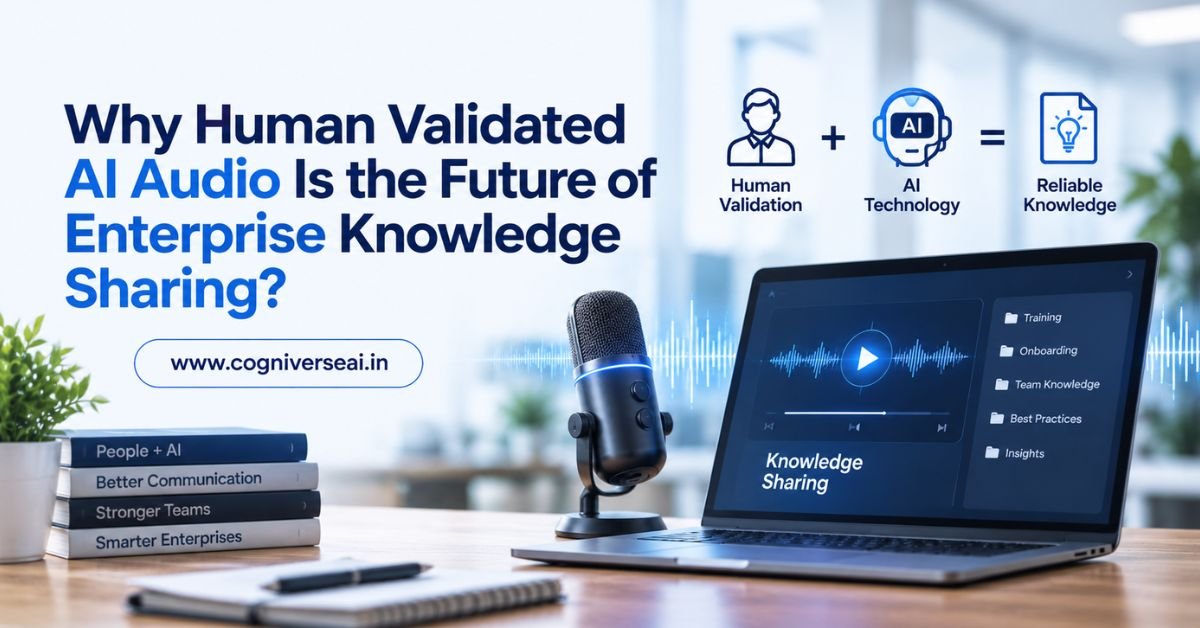
That is why Why Human Validated AI Audio Is the Future of Enterprise Knowledge Sharing is an important question for modern organizations. The answer is simple: human validation can combine the speed and scalability of AI audio with the accuracy, context, judgment, and responsibility of people.
Instead of choosing between humans and AI, organizations can use both. AI can help create and distribute audio quickly, while humans can check whether the information is accurate, appropriate, clear, and useful.
What Is Human Validated AI Audio?
Human validated AI audio is audio content created or supported by artificial intelligence and then reviewed by a human before it is used or shared.
The process can be simple:
- A company provides written information or approved source material.
- AI converts the information into an audio script or narration.
- An AI voice produces the audio.
- A human reviews the content.
- Errors, unclear sections, pronunciation issues, or sensitive information are corrected.
- The final audio is approved and shared with employees.
The human does not necessarily have to create the entire recording manually. Instead, the person acts as a quality and accuracy checkpoint.
This approach is particularly useful when the information is important enough that an AI-generated output should not be accepted without review.
Also read: Describe One Way That Understanding AI Might Help You In Your Daily Life Or Future Career
Why Enterprise Knowledge Sharing Needs a New Approach?
Traditional enterprise knowledge sharing often depends on documents, presentations, emails, training sessions, and internal websites.
These formats are useful, but employees do not always have the time to read long documents or attend every training session.
For example, imagine a company introducing a new internal process. The information might be available in a 20-page document. An employee may need the information but may not have time to read the entire document immediately.
A short, well-structured audio explanation could make the information easier to consume.
AI makes this approach more practical because organizations can create audio versions of large amounts of approved content without recording every piece manually.
However, speed should not come at the cost of accuracy. This is where human validation becomes important.
How AI Audio Can Improve Knowledge Sharing?
Making Information Easier to Consume
Audio gives employees another way to access information.
Someone can listen to a short training explanation while:
- Traveling to work
- Walking
- Taking a break
- Preparing for a task
- Reviewing information before a meeting
- Completing routine work
Audio does not replace written documents. Instead, it provides another format for learning and reviewing information.
This can be particularly useful for employees who prefer listening to reading or who need quick explanations of lengthy material.
Turning Long Documents Into Short Learning Content
Companies often have large amounts of internal information.
AI can help transform approved documents into structured audio lessons, summaries, explanations, or training modules.
For example, a company could have a long product manual. Instead of expecting every employee to read the entire document at once, the organization could create several short audio sections:
- Product overview
- Main features
- Customer questions
- Common problems
- Troubleshooting
- Important safety information
A human reviewer can then check each section before publication.
This creates a more manageable knowledge-sharing experience.
Why Human Validation Matters?
AI-generated content can be useful, but AI systems can also make mistakes.
An AI-generated audio system may pronounce a person’s name incorrectly, misunderstand an abbreviation, simplify an important instruction too much, or create a script that does not match the company’s approved information.
Human validation provides an additional layer of quality control.
Accuracy
A reviewer can compare the generated script with the original source.
This is important when the content includes:
- Numbers
- Product specifications
- Legal requirements
- Technical instructions
- Company policies
- Financial information
- Medical or safety information
- Names and terminology
A small error in ordinary content may be inconvenient. A small error in an important business instruction could create much bigger problems.
Context
AI can process information, but context matters.
A human reviewer can ask whether the explanation makes sense for the intended audience.
For example, a technical document written for engineers may contain specialized terminology. If the same information is converted into training audio for new employees, some terms may need explanation.
Human review helps ensure that the audio is not merely accurate word-for-word but also understandable in context.
Tone and Clarity
Enterprise communication needs the right tone.
Training audio should be clear and professional. A customer-facing explanation may need a different tone from an internal technical briefing.
Human reviewers can identify sections that sound confusing, too formal, too casual, or unnatural.
Human Validation and Responsible AI
Human validated AI audio is also connected to responsible AI use.
When organizations use AI to create internal knowledge, they should consider more than production speed. They should also think about accuracy, privacy, transparency, security, and accountability.
A human review process creates a clear point where someone can check the output before it reaches employees or customers.
This does not make the content automatically perfect. Human reviewers can also make mistakes. But it creates an important opportunity to catch problems before distribution.
The goal is not to claim that human validation eliminates every AI risk. Instead, it helps organizations manage risks through a defined review process.
Where Human Validated AI Audio Can Be Used?
Human validated AI audio can support many enterprise use cases.
Employee Training
Organizations can turn approved training material into short audio lessons.
For example, a new employee could listen to an introduction covering company values, workplace procedures, product knowledge, or basic job responsibilities.
A human reviewer can confirm that the information matches the company’s current training material.
Product Knowledge
Sales and customer-service teams often need to understand products quickly.
AI audio can help turn product documentation into short learning modules covering features, benefits, common questions, and troubleshooting steps.
Employees can listen to these modules when they need a quick refresher.
Meeting and Knowledge Recaps
Important meetings can generate large amounts of information.
Approved meeting notes can be transformed into structured audio summaries so employees can review key decisions and action items more conveniently.
Human review is especially important here because meeting summaries may contain confidential information or details that require context.
Internal Policies
Companies regularly update internal policies.
Audio summaries can help employees understand what changed, especially when the policy document is lengthy.
The original policy should remain the authoritative source, while the audio can act as an additional explanation or learning format.
Technical Knowledge
Technical teams often work with complex documentation.
AI can help create audio explanations of approved technical material, while subject-matter experts can review the content for accuracy.
This can be useful when organizations need to make specialized knowledge easier to understand for a wider internal audience.
AI Audio Does Not Replace the Original Source
One important principle is that AI audio should not automatically become the only version of important enterprise information.
If a company creates an audio summary of a policy, the original policy should still be available.
The audio can help employees understand or review the information, but the official written document may remain the authoritative source.
This distinction is important because summaries can leave out details.
A responsible knowledge-sharing system should make it clear when audio is:
- A summary
- A training explanation
- A simplified version
- A narration of an approved document
- The official source itself
Clear labeling helps employees understand how they should use the content.
A Practical Human Validation Workflow
A good workflow does not need to be complicated.
Step 1: Start With Approved Information
AI should work from reliable company material rather than unverified information.
Step 2: Generate the Script
AI can organize the source material into a clear audio-friendly structure.
Step 3: Review the Script
A human checks facts, numbers, terminology, names, and context.
Step 4: Generate the Audio
After the script is approved, an AI voice can produce the narration.
Step 5: Listen to the Output
The reviewer should listen to the actual audio rather than checking only the written script.
Some problems become obvious only when content is spoken.
Step 6: Approve and Publish
Once the content meets the organization’s requirements, it can be distributed through the appropriate internal platform.
Step 7: Review When Information Changes
Enterprise information changes over time.
If a product, policy, process, or procedure changes, its associated audio should be reviewed and updated rather than remaining available indefinitely.
What Makes Human Validated AI Audio Different From Ordinary AI Audio?
The key difference is the quality-control process.
With ordinary AI audio, content may move directly from generation to publication.
With human validated AI audio, there is a deliberate human checkpoint.
| AI Audio | Human Validated AI Audio |
|---|---|
| Focuses mainly on automated generation | Combines AI generation with human review |
| Can be produced quickly | Can be produced quickly with a quality checkpoint |
| May contain unnoticed errors | Review can catch many errors before publication |
| May lack audience-specific context | Humans can check audience and context |
| Suitable for lower-risk uses | Better suited to important enterprise knowledge when properly reviewed |
| Quality depends heavily on the AI workflow | Quality depends on both AI and the review process |
Human validation does not guarantee that every output will be correct. Its value comes from adding another layer of review.
Challenges Organizations Should Consider
Human validated AI audio also has limitations.
Review Takes Time
Human validation adds an extra step. Organizations need enough reviewers and a clear approval process.
Sensitive Information Requires Care
Companies should avoid putting confidential information into AI systems unless the system and organization’s policies allow that use.
Privacy and data-handling requirements should be considered before implementing an AI audio workflow.
Voice Quality Is Not the Same as Content Quality
An AI voice may sound natural, but good audio does not automatically mean good information.
Organizations should evaluate both the voice experience and the accuracy of the content.
Information Can Become Outdated
A perfectly accurate recording can become incorrect when the underlying information changes.
For this reason, companies should maintain version control and review important audio content regularly.
Why This Approach Can Shape the Future of Enterprise Knowledge Sharing?
The future of enterprise knowledge sharing is likely to involve multiple formats rather than one single format.
Employees may want to read a document, watch a video, listen to an explanation, search a knowledge base, or ask an AI assistant a question.
AI can help organizations create these different formats faster. Human validation can help ensure that important content remains accurate, relevant, and appropriate for its intended use.
This combination is especially valuable because enterprise knowledge is not just about information. It is about trusted information that people can use to make decisions and perform their work.
Human-reviewed AI audio can support this goal by making approved knowledge more accessible without removing human responsibility from the process.
How Businesses Can Start Using Human Validated AI Audio?
Companies do not need to convert their entire knowledge library into audio immediately.
A better approach is to start with a limited use case.
For example, an organization could select:
- New employee training
- Product introductions
- Internal learning materials
- Frequently asked questions
- Non-sensitive process explanations
The company can then create a small number of audio pieces, define a human review process, collect employee feedback, and improve the workflow.
Before expanding, the organization should establish clear rules for:
- Which information can be used
- Who reviews AI-generated content
- Which sources are authoritative
- How errors are corrected
- How outdated audio is removed or replaced
- How confidential information is protected
This makes AI audio part of a controlled knowledge-management process rather than simply another content-generation tool.
Also read: Science and Technology Topics For Students
Conclusion
Why Human Validated AI Audio Is the Future of Enterprise Knowledge Sharing comes down to a simple idea: organizations need both AI’s efficiency and human judgment.
AI can help transform approved business information into accessible audio at a scale that would be difficult to achieve through manual recording alone. Employees can then use audio to learn, review, and access knowledge in more flexible ways.
But speed alone is not enough for enterprise communication. Important information needs accuracy, context, clarity, privacy, and accountability.
Human validation provides an essential quality checkpoint. A person can review the source, check the script, listen to the final audio, identify problems, and confirm that the content is suitable for its intended audience.
The future of enterprise knowledge sharing is therefore not simply about replacing human-created content with AI-generated content. It is about building smarter workflows where AI helps create and distribute knowledge while humans remain responsible for trust and quality.
When implemented carefully, human validated AI audio can become a practical part of modern enterprise learning, training, documentation, and knowledge management.
Frequently Asked Questions (FAQ)
1. What is human validated AI audio?
It is AI-generated audio that a person reviews for accuracy, clarity, context, and suitability before it is shared.
2. Why is human validation important for AI audio?
Human review can catch errors in facts, pronunciation, context, terminology, and sensitive information before the audio is distributed.
3. How can AI audio help enterprise knowledge sharing?
AI audio can turn approved information into convenient listening formats for training, product knowledge, internal learning, and document summaries.
4. Can AI audio replace enterprise documents?
Usually, it should not. Audio can complement important documents, while the original approved document can remain the authoritative source.
5. Is human validated AI audio suitable for employee training?
Yes. It can support employee training when the content is reviewed, kept current, and used alongside appropriate official training materials.
1 thought on “Why Human Validated AI Audio Is the Future of Enterprise Knowledge Sharing?”