
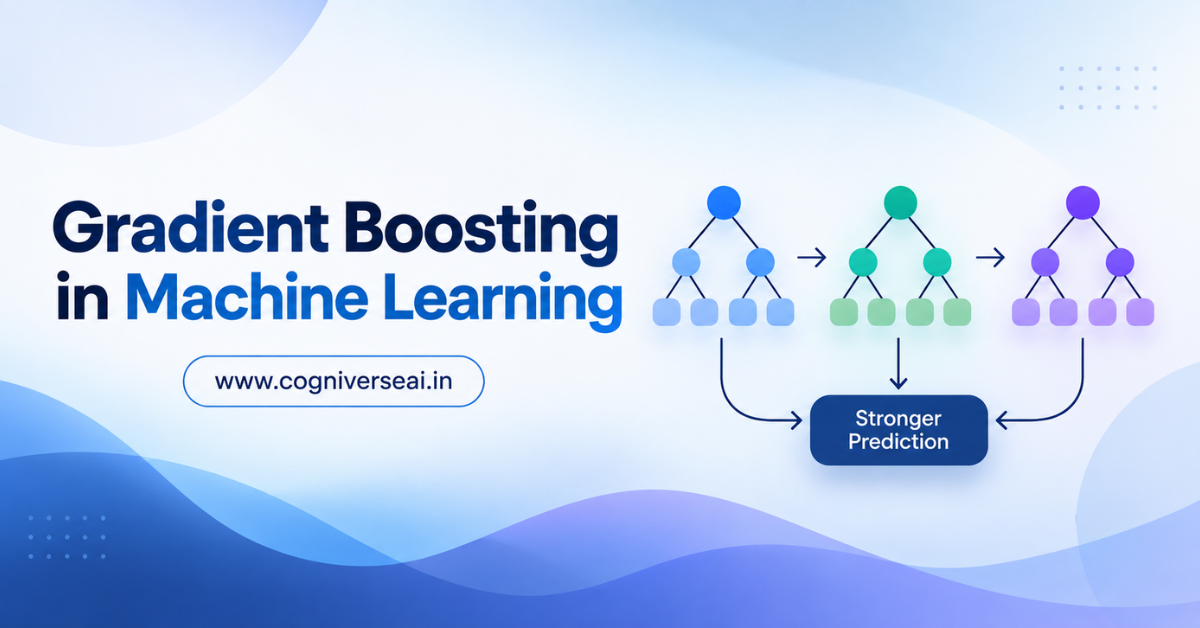
Gradient boosting in machine learning is a powerful supervised learning technique used to make accurate predictions by combining many simple models, usually decision trees. Instead of building one large and complicated model, gradient boosting builds a sequence of smaller models, with each new model focusing on the mistakes made by the previous ones.
In simple terms, gradient boosting improves predictions step by step by learning from previous errors.
It can be used for both classification and regression. For example, it can predict whether a customer will leave a service, estimate the price of a house, identify fraudulent transactions, or predict a numerical business outcome.
Gradient boosting is popular because it can capture complex relationships in structured data while often providing strong predictive performance. However, it also needs careful tuning because an overly complex boosting model can overfit the training data.
What Is Gradient Boosting in Machine Learning?
Gradient boosting is an ensemble machine learning algorithm. Ensemble learning means combining multiple models to create a stronger predictive model.
Gradient boosting usually uses decision trees as weak learners. These trees are intentionally kept relatively simple. Instead of asking one tree to solve the entire problem, the algorithm creates trees one after another.
The basic process looks like this:
Initial prediction → Find errors → Build a tree to reduce those errors → Update prediction → Repeat
Each new tree contributes to improving the overall prediction.
The word “gradient” comes from the optimization process used to reduce a chosen loss function. The algorithm determines the direction in which the model should change to reduce prediction error and then adds a new model that moves the overall system in that direction.
This makes gradient boosting different from simply creating many independent decision trees.
Also read: Interesting Topics to Research for Students
How Does Gradient Boosting Work?
To understand gradient boosting, imagine that you want to predict house prices.
Suppose the actual price of a house is ₹50 lakh, but the first model predicts ₹40 lakh. The model has made an error of ₹10 lakh.
Gradient boosting uses the information from the error to build another tree that helps correct the first prediction.
The new model might add ₹6 lakh to the prediction. The combined prediction becomes ₹46 lakh.
There is still an error, so another tree is trained to improve the remaining mistake.
The process continues:
₹40 lakh → ₹46 lakh → ₹49 lakh → ₹49.7 lakh
These numbers are only a simple illustration. Real gradient boosting uses a loss function and mathematical optimization rather than manually correcting prices this way.
Step 1: Start With an Initial Prediction
The algorithm first creates a basic prediction.
For some regression problems, this may be related to the average target value. For classification, the initial model works with an appropriate representation of the target and loss function.
This first prediction is usually not very accurate.
Step 2: Calculate the Errors
The algorithm compares the predictions with the actual target values.
Instead of simply thinking about raw errors, gradient boosting uses the gradient of the loss function to determine what the next model should learn.
This provides a direction for improving the model.
Step 3: Build a New Decision Tree
A small decision tree is trained to predict the information needed to reduce the current loss.
This tree becomes the next component of the ensemble.
Step 4: Add the New Tree to the Model
The prediction from the new tree is combined with the existing model.
A learning rate usually controls how much the new tree contributes.
Step 5: Repeat the Process
The algorithm keeps adding trees.
Each tree tries to improve the current model rather than starting from scratch.
After enough iterations, the combined model can produce highly accurate predictions.
Why Does Gradient Boosting Use Weak Learners?
A weak learner is a model that performs only moderately well on its own but becomes powerful when combined with other models.
In gradient boosting, shallow decision trees are commonly used because they can learn useful patterns without becoming excessively complex.
The power comes from the combination of many trees.
This is an important idea in boosting:
Many small improvements can combine into a strong predictive model.
Each tree does not need to solve the whole problem. It only needs to contribute something useful to the current model.
Gradient Boosting vs. Random Forest
Gradient boosting and random forests both use decision trees, but they build and combine those trees differently.
Random Forest
A random forest creates many trees that are generally trained independently. It uses randomness in the training process and combines their predictions.
The trees can be built in parallel because one tree does not normally depend on the previous tree.
Gradient Boosting
Gradient boosting builds trees sequentially.
Each new tree is influenced by the errors or loss remaining after the existing ensemble.
This makes the two approaches fundamentally different.
| Feature | Gradient Boosting | Random Forest |
|---|---|---|
| Tree building | Sequential | Mostly independent |
| Main idea | Correct previous errors | Average or vote across trees |
| Common base model | Decision trees | Decision trees |
| Training | Can be slower | Easier to parallelize |
| Main tuning concern | Learning rate, depth, number of trees | Number and size of trees |
Neither method is universally better. The right choice depends on the dataset, objective, computational resources, and required performance.
Important Parameters in Gradient Boosting
Gradient boosting has several parameters that strongly affect model behavior.
Learning Rate
The learning rate controls how much each new tree changes the overall model.
A smaller learning rate generally means that each tree makes a smaller contribution.
This often requires more trees, but the resulting model can be easier to control.
For example:
- Low learning rate + more trees
- Higher learning rate + fewer trees
These combinations can behave differently even when they produce similar training performance.
Number of Trees
The number of boosting iterations determines how many trees are added to the ensemble.
Too few trees can lead to underfitting, where the model has not learned enough from the data.
Too many trees can increase the risk of overfitting, particularly when other complexity controls are not used properly.
Tree Depth
Tree depth controls how complicated individual trees can become.
Shallow trees learn simpler relationships. Deeper trees can capture more complicated interactions but may increase model complexity and overfitting risk.
Subsampling
Some gradient boosting implementations allow training each tree on a random subset of the available training data.
This can add randomness and may help control overfitting in some settings.
Regularization
Regularization methods can limit model complexity and improve generalization.
The exact regularization options depend on the gradient boosting implementation being used.
What Are the Advantages of Gradient Boosting?
Gradient boosting has several important strengths.
Strong Predictive Performance
Gradient boosting can model complicated relationships and interactions between input variables. It is especially effective on many types of structured or tabular data.
Handles Nonlinear Relationships
Linear models assume a particular form of relationship between inputs and the target. Decision-tree-based boosting does not have the same linearity requirement.
This allows it to capture nonlinear patterns.
Works for Classification and Regression
Gradient boosting can be used for different supervised learning tasks.
Examples include:
- Predicting house prices
- Customer churn classification
- Credit risk prediction
- Fraud detection
- Demand forecasting
- Customer response prediction
Can Handle Mixed Feature Types
Depending on the implementation and preprocessing approach, tree-based boosting methods can work well with numerical and categorical information.
Some modern implementations provide particularly strong support for categorical features.
Feature Importance Can Be Examined
Many implementations provide ways to estimate feature importance.
This can help identify which variables contribute to predictions, although feature importance should not automatically be treated as proof of causation.
What Are the Limitations of Gradient Boosting?
Gradient boosting is powerful, but it is not perfect.
It Can Overfit
If the model becomes too complex, it may learn details specific to the training data instead of patterns that generalize to new data.
This is why parameters such as tree depth, learning rate, number of trees, and regularization matter.
Training Can Be Computationally Expensive
Because traditional gradient boosting builds trees sequentially, training can be less naturally parallel than methods that build independent trees.
Large datasets and complex models may require significant computing resources.
Hyperparameter Tuning Matters
A poorly tuned gradient boosting model may perform much worse than a carefully tuned one.
Common parameters that require attention include:
- Learning rate
- Number of estimators
- Tree depth
- Minimum samples or leaf constraints
- Subsampling
- Regularization settings
Less Interpretable Than a Single Tree
A single decision tree can often be visualized and explained relatively easily.
A boosting model containing hundreds or thousands of trees is much harder to understand directly.
Interpretability tools can help, but explaining an ensemble is still more complicated than explaining one small tree.
Common Gradient Boosting Algorithms and Libraries
The basic gradient boosting idea has led to several widely used implementations.
XGBoost
XGBoost, short for Extreme Gradient Boosting, is a popular optimized implementation of gradient boosting. It includes regularization and engineering improvements designed for efficient and accurate model training.
LightGBM
LightGBM is another gradient boosting framework designed with efficiency and scalability in mind. It is widely used for large-scale machine learning tasks.
CatBoost
CatBoost is a gradient boosting library known for its handling of categorical features and its focus on reducing some common problems associated with categorical data.
Scikit-Learn Gradient Boosting
Python’s scikit-learn library provides gradient boosting implementations that are useful for learning, experimentation, and many practical machine learning projects.
These tools implement related ideas but differ in their algorithms, features, speed, memory behavior, and handling of different types of data.
When Should You Use Gradient Boosting?
Gradient boosting is a strong candidate when you are working with structured or tabular data and want a model capable of learning nonlinear relationships.
It can be especially useful when:
- Prediction accuracy is important.
- Your data contains complex interactions.
- You have a supervised learning problem.
- You are working with tabular business data.
- You can spend time tuning the model.
- You need a strong baseline beyond simple linear models.
For example, an online business could use gradient boosting to predict whether a customer is likely to make a purchase based on previous activity, product information, and other available features.
The model can learn combinations of variables that may be difficult to capture with a simple linear relationship.
When Might Gradient Boosting Not Be the Best Choice?
Gradient boosting is not automatically the right algorithm for every problem.
For extremely high-dimensional sparse data, certain linear models may be more suitable.
For unstructured data such as raw images, audio, or large bodies of text, specialized deep-learning architectures may be a more natural choice.
Also, if interpretability is the highest priority and a simple model provides sufficient accuracy, a simpler algorithm may be preferable.
A good machine learning workflow compares multiple reasonable approaches rather than assuming one algorithm will always win.
A Practical Gradient Boosting Example
Suppose a bank wants to predict whether a loan applicant is likely to default.
The dataset might contain features such as:
- Income
- Loan amount
- Employment information
- Existing debt
- Credit history
- Loan duration
The first boosting model makes initial predictions.
The next tree focuses on patterns associated with the remaining prediction errors.
Additional trees continue refining the model.
Eventually, the complete ensemble produces a probability or classification that can be evaluated on previously unseen data.
The important part is that the model should be evaluated using a suitable validation strategy. For a real financial application, model performance alone is not enough; fairness, data quality, explainability, privacy, regulatory requirements, and operational risks also matter.
Gradient Boosting and Overfitting
Overfitting is one of the most important issues to understand when using gradient boosting.
A model is overfitting when it performs very well on training data but performs poorly on new data.
You can reduce this risk through techniques such as:
- Using shallower trees
- Reducing the learning rate
- Using regularization
- Choosing an appropriate number of trees
- Using subsampling where supported
- Applying early stopping where available
- Evaluating the model on validation data
Early stopping is particularly useful in many boosting implementations. The training process can stop when additional trees no longer improve performance on a validation set.
This helps prevent unnecessary model complexity.
Is Gradient Boosting the Same as Boosting?
Gradient boosting is a type of boosting, but the terms are not always interchangeable.
Boosting is a broader ensemble-learning concept in which models are combined sequentially to create a stronger model.
Gradient boosting specifically uses optimization based on a loss function and its gradients to guide the addition of new learners.
Other boosting approaches, such as AdaBoost, use a different mechanism for focusing subsequent learners on difficult examples.
Understanding this distinction helps avoid treating all boosting algorithms as identical.
Also read: What Is One Of The Key Advantages To Having Several Hidden Layers In Your Artificial Neural Network?
Conclusion
Gradient boosting in machine learning is an ensemble technique that builds a strong predictive model by adding decision trees sequentially. Each new tree is trained to help reduce the remaining loss of the current model.
Its biggest strength is the ability to learn complex, nonlinear relationships from data while combining many relatively simple models into a powerful ensemble.
Important parameters such as learning rate, number of trees, tree depth, subsampling, and regularization determine how the model behaves. Good tuning and proper validation are essential because a highly complex boosting model can overfit.
Gradient boosting is particularly valuable for structured and tabular data and is available through popular tools such as XGBoost, LightGBM, CatBoost, and scikit-learn.
The main idea is simple: make a prediction, identify what the current model still gets wrong, add a model that helps correct it, and repeat the process. That step-by-step improvement is what makes gradient boosting such an important technique in modern machine learning.
Frequently Asked Questions (FAQ)
1. What is gradient boosting in machine learning?
Gradient boosting builds multiple decision trees sequentially, with each new tree helping reduce the errors made by the existing model.
2. Is gradient boosting used for classification?
Yes. Gradient boosting can solve classification problems, such as predicting whether a customer will churn or whether a transaction may be fraudulent.
3. What is the main advantage of gradient boosting?
Its main advantage is strong predictive performance. It can learn complex nonlinear relationships and interactions in structured data.
4. Can gradient boosting overfit?
Yes. Too many trees or overly complex trees can cause overfitting. Learning rate, tree depth, regularization, and early stopping can help control it.
5. What is the difference between gradient boosting and random forest?
Gradient boosting builds trees sequentially to improve previous predictions, while random forest builds largely independent trees and combines their results.
1 thought on “Gradient Boosting in Machine Learning: A Complete Guide”