Artificial intelligence is becoming part of everyday life. People use AI for search, education, healthcare, customer service, content creation, business operations, and many other activities. These technologies can provide real benefits, but they can also create social, economic, ethical, and environmental problems when they are poorly designed or used without appropriate safeguards.
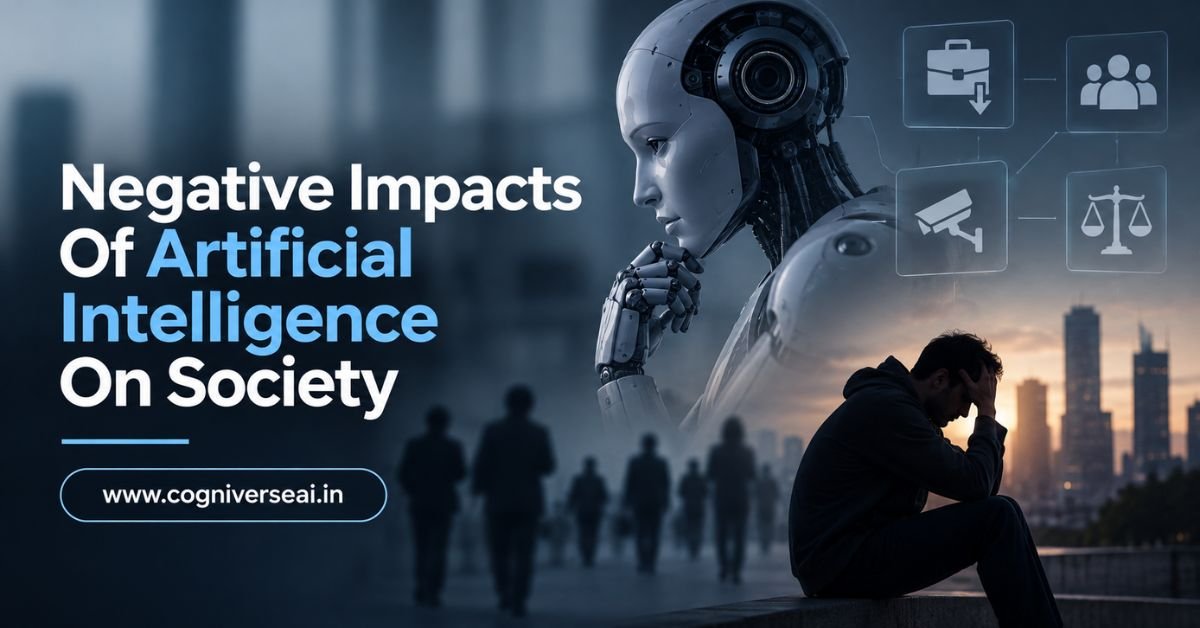
So, what are the Negative Impacts Of Artificial Intelligence On Society? The main concerns include job disruption, privacy loss, biased decisions, misinformation and deepfakes, overdependence on technology, inequality, cybersecurity risks, reduced human oversight, and environmental costs. The seriousness of each impact depends on the AI system, how it is used, who controls it, and whether appropriate safeguards are in place.
UNESCO’s global recommendation on AI ethics recognizes that AI can have both positive and negative effects on societies and emphasizes human rights, fairness, transparency, environmental sustainability, and human oversight.
Understanding these risks does not mean that AI is always harmful. It means recognizing where problems can appear so that individuals, companies, schools, and governments can use AI more responsibly.
Job Displacement and Changes in Employment
One of the most discussed negative impacts of artificial intelligence on society is its effect on work.
AI systems can automate certain tasks that were previously performed by people. These tasks may include basic data processing, document handling, customer support, content generation, scheduling, or other repetitive activities.
However, the effect on employment is more complicated than simply saying that AI will replace everyone.
The International Labour Organization’s 2025 research found that around one in four workers globally are in occupations with some exposure to generative AI. It also found that, because human involvement remains necessary for many tasks, job transformation is more common than complete job replacement.
This means some workers may see parts of their jobs automated while their overall roles change.
Also read: Why Is It Important To Understand Different Machine Learning Algorithms?
Why This Can Be a Social Problem?
Workers may need to learn new skills as workplaces adopt AI tools. People who have fewer opportunities for training may find it harder to adapt.
There can also be differences between industries, countries, income groups, and types of workers.
This creates an important question: who benefits from increased productivity, and who carries the cost of adapting to technological change?
Responsible AI adoption therefore requires attention not only to efficiency but also to training, job quality, worker participation, and fair transitions.
Privacy and Loss of Control Over Personal Data
AI systems often depend on large amounts of data. Depending on the application, this may include information about people’s behavior, preferences, communication, location, purchases, or other personal details.
The more data an AI system uses, the more important privacy and security become.
For example, an organization might use AI to analyze customer interactions. If information is collected or stored without appropriate controls, people may have less understanding of how their information is being used.
Generative AI systems also create privacy concerns. NIST’s Generative AI Risk Management Profile notes that some AI models may expose, infer, or memorize sensitive information and that incorrect inferences about individuals can also cause harm.
Why Privacy Matters?
Privacy is not only about keeping passwords secret. Personal data can influence how people are treated by organizations.
If sensitive information is collected, combined, or inferred without proper safeguards, it may affect a person’s reputation, opportunities, or ability to control information about themselves.
Strong data governance, limited data collection, security controls, and clear rules about data use are therefore important parts of responsible AI.
Bias and Unfair Decisions
AI systems learn patterns from data. If the data contains historical bias, incomplete information, or unequal representation, an AI system may reproduce or amplify those problems.
This can become a serious concern when AI is used in areas that affect people’s opportunities or access to services.
For example, an automated system could be used to support decisions involving recruitment, lending, education, insurance, or other areas. If the system performs differently across groups, the effects may not be equally distributed.
It is important to understand that bias does not always come from the algorithm itself. It can enter through training data, problem design, labels, assumptions, system deployment, or the way people interpret the output.
UNESCO’s AI ethics framework specifically highlights fairness, non-discrimination, diversity, inclusion, and human oversight as important principles for AI systems.
Misinformation, Deepfakes, and Loss of Trust
Generative AI has made it easier to create realistic text, images, audio, and video.
This can be useful for legitimate purposes, but the same technology can be used to create misleading or deceptive content.
AI-generated images can make fictional events look real. Synthetic audio can imitate voices. AI-generated videos can make people appear to say or do things that never happened.
This creates a wider problem: people may find it harder to determine whether online content is genuine.
UNESCO has highlighted concerns about AI-generated and synthetic media contributing to misinformation and disinformation, while also emphasizing the importance of education and media literacy.
The Bigger Problem Is Trust
The problem is not only that false content can be produced.
People may also begin to doubt genuine content because they know convincing AI-generated material exists.
This can affect journalism, education, public communication, business, and ordinary online conversations.
One useful response is stronger verification: checking original sources, looking for independent confirmation, examining dates and context, and avoiding sharing important claims based only on a screenshot, video, or AI-generated answer.
Overdependence on Artificial Intelligence
Another negative impact of artificial intelligence on society is the possibility of becoming too dependent on automated systems.
AI can make tasks faster and easier, but using it for everything may reduce opportunities for people to practice certain skills themselves.
For example, students who always use AI to produce answers may spend less time developing their own writing, research, problem-solving, or reasoning abilities.
Similarly, employees who automatically accept AI-generated recommendations may become less likely to question them.
The problem is not simply the use of AI. The issue is how much human thinking remains part of the process.
AI should support human abilities rather than make people unwilling or unable to perform important tasks without it.
Reduced Human Oversight and Accountability
AI systems can influence decisions, but they do not remove human responsibility.
If an organization allows an automated system to make important decisions without meaningful human review, it can become difficult to determine who is responsible when something goes wrong.
This matters especially in sensitive areas such as healthcare, education, employment, finance, and public services.
A human reviewer can question an output, consider information the system missed, and recognize situations that do not fit the model’s assumptions.
UNESCO’s AI ethics framework states that AI systems should not displace ultimate human responsibility and accountability.
Human oversight does not mean manually checking every minor AI action. It means maintaining meaningful responsibility for decisions where errors could seriously affect people.
Digital Inequality and Unequal Access
AI may create new opportunities, but those opportunities may not be available equally.
People need devices, internet access, digital skills, suitable education, and sometimes access to paid AI services to benefit from advanced technologies.
Businesses and countries with greater financial and technical resources may also be able to adopt powerful AI systems more quickly.
This can widen existing gaps between people or regions.
UNESCO’s AI ethics framework emphasizes inclusiveness and the importance of ensuring that the benefits of AI are accessible to different communities rather than concentrated among a small group.
Skills Also Matter
Access to a tool is not enough.
Two people may have access to the same AI system but achieve very different results because one understands how to verify information, protect privacy, write good instructions, and identify errors.
AI literacy is therefore becoming an important part of reducing some forms of digital inequality.
Cybersecurity and New Forms of Misuse
AI can also be used by people with harmful intentions.
For example, AI can help create convincing phishing messages, automate certain types of fraudulent communication, generate deceptive content, or support other cyber-related activities.
At the same time, defenders can also use AI for threat detection and security analysis.
This creates a situation where the same general technology can support both security and misuse.
The important point is that AI does not automatically make harmful activity possible, but it can change its speed, scale, or sophistication in some situations.
Organizations therefore need security controls, employee awareness, monitoring, and clear rules for acceptable AI use.
Environmental Impact of AI
AI also has a physical infrastructure behind it.
AI models are trained and operated in data centres that require electricity for computing, cooling, networking, and storage.
The International Energy Agency reported in 2025 that data centres accounted for around 1.5% of global electricity consumption in 2024, and it identified AI as a major driver of growing data-centre demand. More recent IEA analysis found that data-centre electricity use increased by 17% in 2025, while electricity use from AI-focused data centres grew faster still.
AI’s environmental impact is not only about electricity. It also involves hardware production, infrastructure, water use in some cooling systems, and the resources required to build and operate data centres.
At the same time, AI can potentially help reduce energy use in some applications. The environmental question is therefore not simply whether AI is good or bad for the environment, but how much energy and other resources AI systems require and what they are being used to achieve.
Effects on Human Communication and Creativity
AI-generated content can make writing, image creation, music production, and other creative tasks faster.
However, widespread use of automated content can also create concerns about originality and the value placed on human-created work.
For example, if large amounts of online content are produced automatically, it may become harder for audiences to distinguish carefully researched human work from low-quality automated material.
There are also questions about how creators should be credited, how their work may be used in AI systems, and how businesses should identify AI-generated content.
These are not purely technical questions. They involve cultural, legal, economic, and ethical considerations.
Errors Can Spread Quickly at Large Scale
A person making a mistake may affect a limited number of people.
An automated system can potentially repeat the same mistake across thousands or millions of interactions.
This is an important difference between ordinary human error and errors produced through automation.
For example, if an AI system gives incorrect information in a customer-service workflow, the same incorrect answer may be delivered repeatedly until the problem is detected.
This does not mean that AI is always more error-prone than humans. It means that automation can increase the scale of an error when an incorrect system is deployed widely.
Testing, monitoring, feedback systems, and human escalation processes can help reduce this risk.
How Society Can Reduce the Negative Impacts of AI?
The negative impacts of artificial intelligence on society cannot be addressed simply by avoiding AI.
A more practical approach is responsible development and use.
Improve AI Literacy
People should learn basic concepts such as AI limitations, misinformation, privacy, data use, and algorithmic bias.
Protect Personal Data
Organizations should collect and use information responsibly and provide appropriate security measures.
Keep Human Oversight
Important decisions should have meaningful human responsibility and review.
Test for Bias and Reliability
AI systems should be evaluated before and after deployment, especially when they affect important decisions.
Support Workers
Organizations introducing AI should consider training, job redesign, and the effects on working conditions.
Improve Transparency
People should understand when AI is being used and, where appropriate, what its role is in a decision or service.
These principles are consistent with major AI ethics frameworks that emphasize human rights, fairness, transparency, sustainability, and accountability.
Why Understanding AI Ethics Matters?
The negative impacts of artificial intelligence are closely connected to AI ethics.
AI ethics asks questions such as:
- Is the technology being used fairly?
- Is people’s privacy protected?
- Can the system be held accountable?
- Is human oversight available?
- Could the system increase inequality?
- Are people able to understand important decisions?
- Are the environmental costs being considered?
- What happens when the system makes a mistake?
These questions help shift the conversation from simply asking “Can AI do this?” to also asking “Should it be done this way, and what safeguards are needed?”
That distinction is important because technological capability does not automatically determine responsible use.
Also read: Science and Technology Topics For Students
Conclusion
The Negative Impacts Of Artificial Intelligence On Society include several important issues: changes in employment, privacy risks, algorithmic bias, misinformation and deepfakes, overdependence on technology, unequal access, cybersecurity misuse, reduced human oversight, environmental costs, and the possibility of errors spreading at large scale.
These impacts are not all inevitable, and they do not affect every person, industry, or country in the same way. The results depend heavily on how AI systems are designed, trained, deployed, regulated, and used.
Current research also shows why the picture should not be reduced to simple claims about AI destroying jobs or solving every problem. For example, the ILO’s recent research points toward significant occupational transformation and uneven effects rather than a single universal employment outcome.
The most useful response is responsible AI use. That includes protecting privacy, testing systems for bias, maintaining human oversight, improving digital and AI literacy, supporting workers through technological change, and considering environmental costs.
Understanding the risks does not mean rejecting AI. It helps society make better decisions about where AI should be used, where safeguards are needed, and where human judgment should remain central.
Frequently Asked Questions (FAQ)
1. What are the main negative impacts of AI on society?
Major concerns include job disruption, privacy risks, bias, misinformation, inequality, cybersecurity misuse, overdependence, and environmental costs.
2. Can AI cause people to lose their jobs?
AI can automate some tasks and change job roles. Research suggests many occupations are more likely to be transformed than completely replaced.
3. How does AI affect privacy?
AI systems can process large amounts of personal data and may sometimes expose or infer sensitive information, creating privacy and security risks.
4. Can AI increase misinformation?
Yes. AI can make realistic text, images, audio, and video, which can be misused to create misleading content and make online information harder to verify.
5. How can the risks of AI be reduced?
Risks can be reduced through human oversight, privacy protection, bias testing, AI literacy, security controls, transparency, monitoring, and responsible governance.