Artificial Intelligence (AI) has become one of the most exciting technologies of the modern era. From voice assistants and recommendation systems to self-driving cars and chatbots, AI is transforming the way we live and work. Recently, another term has gained massive popularity—Generative AI.
Many people now ask, how does generative AI differ in its output compared to traditional AI? While both technologies belong to the field of artificial intelligence, they serve different purposes and produce very different results.
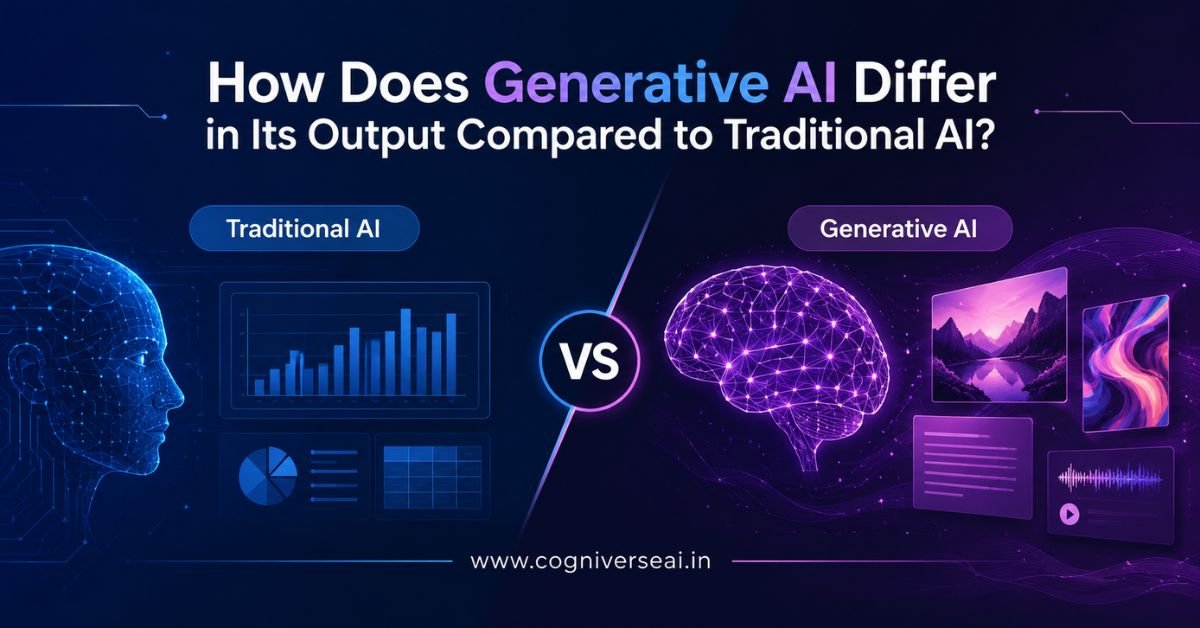
Traditional AI is mainly designed to analyse data, recognise patterns, and make decisions based on existing information. Generative AI, on the other hand, goes a step further. Instead of simply analysing data, it creates entirely new content such as text, images, music, videos, computer code, and even realistic voices.
Understanding the difference between these two types of AI is important for students, professionals, business owners, and anyone interested in technology. In this article, you’ll learn exactly how generative AI differs in its output compared to traditional AI, along with practical examples, real-world applications, benefits, limitations, and future possibilities.
What Is Artificial Intelligence?
Artificial Intelligence refers to computer systems that perform tasks requiring human intelligence. These tasks include learning, reasoning, problem-solving, recognising speech, understanding language, identifying images, and making decisions.
AI works by analysing large amounts of data, identifying patterns, and using those patterns to make predictions or perform actions.
Artificial intelligence can generally be divided into several categories, but two of the most commonly discussed today are:
- Traditional AI
- Generative AI
Although both rely on machine learning and advanced algorithms, their outputs are very different.
What Is Traditional AI?
Traditional AI focuses on analysing existing data and making decisions based on predefined objectives.
Instead of creating something new, traditional AI identifies patterns and provides predictions, classifications, recommendations, or automated decisions.
Traditional AI is commonly used in:
- Email spam detection
- Credit card fraud detection
- Medical diagnosis support
- Product recommendations
- Navigation systems
- Face recognition
- Customer analytics
The primary goal of traditional AI is accuracy and efficiency when working with existing information.
What Is Generative AI?
Generative AI is a newer form of artificial intelligence that creates completely new content based on patterns learned from large datasets.
Rather than simply recognising information, it generates original outputs.
Generative AI can create:
- Articles
- Stories
- Emails
- Images
- Videos
- Music
- Computer code
- Marketing content
- Product descriptions
- Business reports
The output is not copied from one source. Instead, the AI generates new content by predicting the most suitable sequence based on what it has learned during training.
How Does Generative AI Differ in Its Output Compared to Traditional AI?
This is the main question many people want answered.
The biggest difference is the type of output each system produces.
Traditional AI mainly produces:
- Predictions
- Decisions
- Recommendations
- Labels
- Scores
- Classifications
Generative AI produces:
- New text
- Original images
- Music
- Videos
- Voice recordings
- Software code
- Designs
- Creative ideas
In simple words:
Traditional AI answers questions about existing data.
Generative AI creates entirely new content.
Understanding the Difference with a Simple Example
Imagine two different AI systems.
Traditional AI
A bank wants to know whether a customer is likely to repay a loan.
The AI analyses:
- Income
- Credit history
- Employment
- Previous loans
Output:
“Loan Approved”
or
“Loan Rejected”
The AI makes a decision.
Generative AI
A marketing company wants a product advertisement.
The AI generates:
- Headline
- Description
- Social media caption
- Email campaign
- Product slogan
The AI creates new content.
This clearly shows how generative AI differs in its output compared to traditional AI.
Traditional AI vs Generative AI
| Traditional AI | Generative AI |
| Analyses existing data | Creates new content |
| Makes predictions | Produces original outputs |
| Classifies information | Generates text, images, audio and code |
| Decision-focused | Creativity-focused |
| Usually follows predefined tasks | Can perform many creative tasks |
| Output is structured | Output can be highly creative |
Types of Outputs Produced by Traditional AI
Traditional AI usually generates outputs that help users make decisions.
Classification
It determines which category something belongs to.
Example:
- Spam email
- Not spam
Prediction
It forecasts future outcomes.
Example:
- Weather prediction
- Stock market forecasting
- Equipment failure prediction
Recommendation
It suggests suitable options.
Examples include:
- Netflix movie recommendations
- Amazon product suggestions
- Spotify playlists
Detection
Traditional AI identifies unusual behaviour.
Examples:
- Fraud detection
- Cybersecurity threats
- Manufacturing defects
These outputs are analytical rather than creative.
Types of Outputs Produced by Generative AI
Generative AI creates content that did not previously exist.
Text Generation
It writes:
- Blog articles
- Emails
- Reports
- Stories
- Product descriptions
- Research summaries
Image Generation
It creates:
- Illustrations
- Product designs
- Marketing banners
- Digital artwork
- Logos
- Concept art
Video Creation
Generative AI can produce:
- Promotional videos
- Educational animations
- Social media content
Music Generation
It composes:
- Background music
- Instrumental tracks
- Sound effects
Code Generation
Developers use generative AI to create:
- Website code
- Mobile applications
- SQL queries
- Python scripts
- HTML and CSS
This wide variety of creative outputs makes generative AI unique.
Real-World Examples
Let’s compare real-world situations.
Healthcare
Traditional AI analyses medical scans and identifies possible diseases.
Generative AI creates detailed patient reports, explains medical findings in simple language, and assists doctors with documentation.
Banking
Traditional AI detects suspicious financial transactions.
Generative AI generates personalised financial advice, customer emails, and investment summaries.
Education
Traditional AI grades multiple-choice exams.
Generative AI creates lesson plans, quizzes, study notes, and personalised learning materials.
E-commerce
Traditional AI recommends products.
Generative AI writes product descriptions, advertising copy, promotional emails, and customer responses.
Software Development
Traditional AI identifies software bugs.
Generative AI writes new code, explains programming concepts, and suggests complete software solutions.
Why Is Generative AI More Creative?
Generative AI learns relationships between words, images, sounds, and patterns.
Instead of memorising information, it predicts what should come next based on context.
For example, when writing an article, it predicts one word after another until a complete paragraph is created.
The same principle applies to images.
Given a prompt like “a futuristic city at sunset,” the AI generates a completely new image by combining learned visual patterns.
This ability to create rather than simply analyse makes generative AI much more creative than traditional AI.
Advantages of Traditional AI
Traditional AI remains extremely valuable.
Some of its major strengths include:
High Accuracy
Traditional AI performs repetitive tasks with remarkable consistency.
Faster Decision-Making
It quickly processes massive datasets.
Reliable Predictions
Businesses rely on traditional AI for forecasting and risk assessment.
Lower Creativity Risk
Since outputs follow defined rules, unexpected results are less common.
Advantages of Generative AI
Generative AI offers several unique benefits.
Increased Productivity
It helps users create content much faster.
Supports Creativity
It generates fresh ideas for writing, design, marketing, and product development.
Saves Time
Tasks that once required hours can often be completed in minutes.
Personalisation
Businesses can create customised content for individual customers.
Wider Accessibility
People without specialised creative skills can produce professional-quality content.
Limitations of Traditional AI
Traditional AI also has certain limitations.
It generally cannot:
- Write articles
- Design images
- Create music
- Generate videos
- Produce original stories
Its strength lies in analysing existing information rather than creating something new.
Limitations of Generative AI
Although powerful, generative AI is not perfect.
Some challenges include:
Incorrect Information
AI can sometimes generate inaccurate or misleading content.
Hallucinations
It may confidently produce information that sounds correct but is factually wrong.
Bias
If training data contains bias, outputs may also reflect those biases.
Copyright Concerns
Businesses must ensure generated content respects intellectual property laws.
Human Review Is Necessary
Important documents should always be checked by human experts before publication.
Can Traditional AI and Generative AI Work Together?
Absolutely.
Many modern businesses combine both technologies.
For example:
A customer support system may use traditional AI to classify customer complaints and determine their priority.
Generative AI then writes a personalised response to the customer.
This combination delivers both efficiency and excellent customer experience.
Which Industries Benefit the Most?
Both types of AI are transforming multiple industries.
Some leading sectors include:
- Healthcare
- Banking
- Education
- Retail
- Manufacturing
- Marketing
- Entertainment
- Software Development
- Legal Services
- Customer Support
Each industry uses traditional AI for analysis and generative AI for content creation.
Future of Generative AI and Traditional AI
The future of artificial intelligence will likely involve both technologies working together rather than replacing one another.
Traditional AI will continue to excel in prediction, automation, fraud detection, optimisation, and decision-making. At the same time, generative AI will become even better at producing high-quality content, designing products, assisting with research, writing software, and supporting creative work.
As AI models improve, businesses will increasingly use hybrid systems that combine analytical intelligence with creative generation. This will enable organisations to automate routine tasks while also producing personalised experiences for customers.
However, human expertise will remain essential. Professionals will still be needed to verify information, make ethical decisions, and ensure AI-generated content is accurate, reliable, and aligned with business goals.
Best Use Cases for Each
Choose traditional AI when you need:
- Predictions
- Fraud detection
- Recommendations
- Classification
- Risk analysis
- Process automation
Choose generative AI when you need:
- Content creation
- Image generation
- Marketing copy
- Code generation
- Creative writing
- Design concepts
Selecting the right type of AI depends on the task you want to accomplish.
Also read: Me Museum Project Ideas
Conclusion
So, how does generative AI differ in its output compared to traditional AI? The answer lies in the nature of the results each system produces.
Traditional AI focuses on analysing existing data, identifying patterns, making predictions, and supporting decisions. Its outputs are structured, analytical, and designed to improve accuracy and efficiency.
Generative AI, by contrast, creates entirely new content. Whether it’s writing an article, designing an image, composing music, generating software code, or producing marketing copy, generative AI delivers original outputs that did not exist before.
Rather than competing with one another, these technologies complement each other. Traditional AI provides intelligence through analysis, while generative AI adds creativity through content generation. Together, they are reshaping industries and opening new possibilities for innovation, productivity, and problem-solving.
Frequently Asked Questions (FAQ)
1. How does generative AI differ in its output compared to traditional AI?
Generative AI creates new content like text, images, and code, while traditional AI mainly analyses data to make predictions or decisions.
2. Can traditional AI generate original content?
No. Traditional AI focuses on analysing and classifying data rather than creating original text, images, videos, or other creative outputs.
3. Is generative AI better than traditional AI?
Neither is better overall. Generative AI excels at creating content, while traditional AI is stronger at analysis, prediction, and decision-making.
4. What industries use generative AI and traditional AI?
Healthcare, finance, education, retail, manufacturing, marketing, and software development use both AI types for different business tasks.
5. Can generative AI and traditional AI work together?
Yes. Many organisations combine traditional AI for analysis with generative AI for content creation to improve efficiency and customer experiences.