Artificial Intelligence (AI) has changed the way we create content. Today, AI tools can write articles, generate emails, create social media posts, answer customer queries, summarise documents, and even help with coding. These tools save time and improve productivity, making them valuable for students, businesses, marketers, and content creators.
However, despite their impressive capabilities, AI-generated content is not always accurate. AI can misunderstand context, provide outdated information, make factual errors, or generate content that sounds convincing but is incorrect. This is why one of the most important steps after using AI is validation.
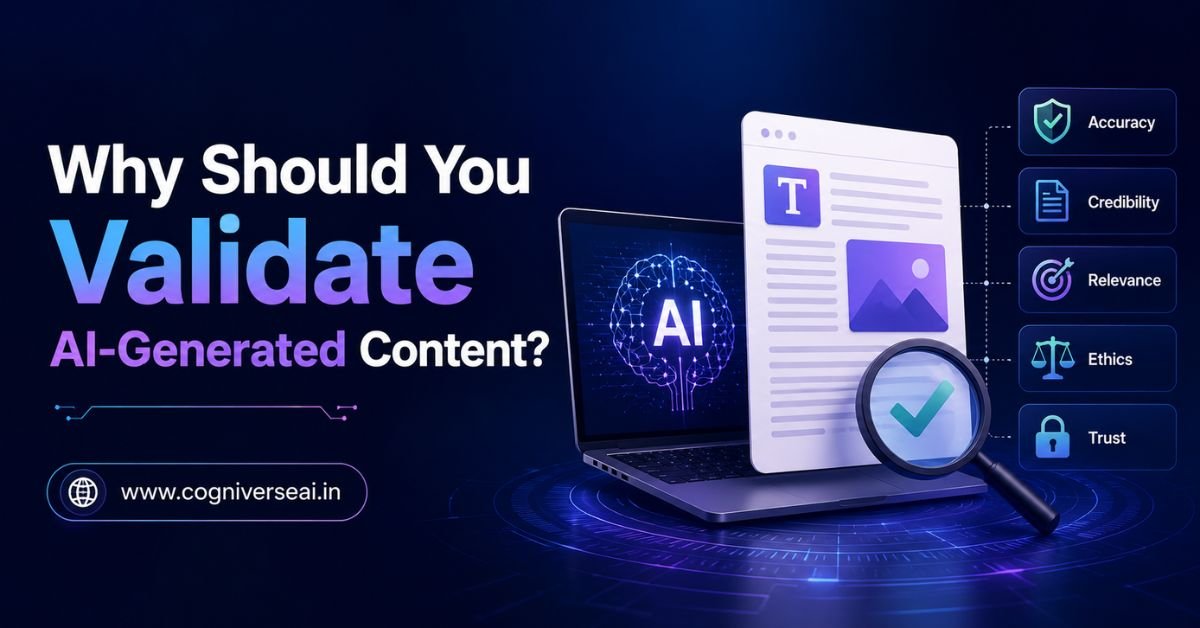
Many people ask, “Why should you validate AI-generated content?”
The simple answer is that you should validate AI-generated content to ensure it is accurate, reliable, relevant, unbiased, and suitable for your audience before publishing or using it.
Whether you’re writing a blog, preparing a business report, creating educational material, or publishing marketing content, validating AI-generated information helps protect your credibility and ensures readers receive trustworthy information.
In this blog, you’ll learn why validating AI-generated content is essential, what risks can arise if you skip validation, how to verify AI content effectively, best practices for reviewing AI-generated material, and why human oversight remains important in the age of artificial intelligence.
What Is AI-Generated Content?
AI-generated content refers to any text, image, audio, video, or other digital material created with the help of artificial intelligence.
Examples include:
- Blog articles
- Product descriptions
- Emails
- Social media posts
- News summaries
- Marketing copy
- Website content
- Business reports
- Chatbot responses
- Educational materials
Modern AI systems generate this content by analysing patterns learned from large datasets rather than by understanding information in the same way humans do.
As a result, the output can be highly useful but should always be reviewed before publication.
Also read: How Does Generative AI Differ in Its Output Compared to Traditional AI?
What Does It Mean to Validate AI-Generated Content?
Validation means carefully reviewing AI-generated content to confirm that it is:
- Factually accurate
- Up to date
- Relevant to the intended audience
- Grammatically correct
- Free from misleading information
- Consistent with your goals
- Ethical and appropriate
Validation ensures the content meets quality standards before it reaches readers.
Why Should You Validate AI-Generated Content?
There are several important reasons why validation is essential.
AI Can Make Factual Mistakes
AI systems sometimes generate information that appears correct but is actually inaccurate.
For example, an AI tool may:
- State an incorrect historical date
- Attribute a quote to the wrong person
- Misidentify a scientific fact
- Mix information from different sources
Publishing incorrect information can damage your credibility.
Always verify important facts using reliable sources.
AI Information May Be Outdated
AI models are not always aware of the latest events, regulations, research, or product updates.
For example:
- Laws may have changed.
- Medical guidelines may have been updated.
- Companies may have launched new products.
- Statistics may no longer be current.
Validating content ensures readers receive the most recent information available.
AI May Misunderstand Context
Human language is full of subtle meanings.
The same word can have different meanings depending on the situation.
AI sometimes misunderstands context and produces responses that do not fully answer the user’s question.
Reviewing the content helps ensure it matches your intended message.
AI Can Produce Confident but Incorrect Answers
One challenge with AI is that incorrect information is often written confidently.
The content may sound convincing even when it contains mistakes.
Without validation, readers may assume incorrect information is true.
AI Cannot Replace Human Expertise
AI assists with generating content, but it does not replace human judgement, professional experience, or subject matter expertise.
Experts can recognise details that AI may overlook, including:
- Industry standards
- Practical experience
- Local regulations
- Business requirements
- Audience expectations
Human review adds real-world knowledge that improves content quality.
Protecting Your Credibility
Your reputation depends on the quality of the information you publish.
Whether you own a blog, run a business, or create educational content, readers expect reliable information.
Publishing inaccurate AI-generated content can lead to:
- Loss of reader trust
- Reduced brand credibility
- Negative customer experiences
- Lower engagement
- Damaged professional reputation
Validating content protects your credibility over the long term.
Improving SEO Performance
Search engines aim to deliver accurate, useful, and trustworthy information.
Although AI-generated content itself is not prohibited, low-quality or inaccurate content is unlikely to perform well.
Validating AI content helps improve:
- Accuracy
- Readability
- User satisfaction
- Relevance
- Originality
- Trustworthiness
These qualities support stronger SEO performance and a better user experience.
Supporting Google’s E-E-A-T Principles
Google encourages content that demonstrates:
- Experience
- Expertise
- Authoritativeness
- Trustworthiness
Validation helps strengthen each of these principles.
Experience
Adding practical examples and personal insights makes AI-generated content more valuable.
Expertise
Experts can correct technical details and explain complex concepts clearly.
Authoritativeness
Accurate, well-researched content builds authority within your niche.
Trustworthiness
Verified information increases reader confidence and encourages repeat visits.
Avoiding Misinformation
Misinformation spreads quickly online.
Even small factual mistakes can confuse readers or influence poor decisions.
This is especially important for topics such as:
- Healthcare
- Finance
- Law
- Education
- Government
- Safety
Before publishing AI-generated content in these areas, every important fact should be carefully verified.
Ensuring Content Matches Your Brand Voice
AI can generate well-written content, but it may not always reflect your brand’s personality.
Validation allows you to adjust:
- Tone
- Writing style
- Vocabulary
- Formatting
- Messaging
- Customer focus
This creates a more consistent experience across your website and marketing materials.
Detecting Bias
AI systems learn from existing data.
If the training data contains bias, the generated content may unintentionally reflect it.
Validation helps identify language that could be:
- Unfair
- Stereotypical
- Misleading
- Insensitive
- One-sided
Reviewing content carefully supports fairness and inclusivity.
Checking Grammar and Readability
Although AI usually produces grammatically correct text, mistakes can still occur.
During validation, review:
- Grammar
- Spelling
- Sentence structure
- Paragraph flow
- Heading hierarchy
- Readability
Simple language improves the user experience and keeps readers engaged.
Verifying Statistics and Numbers
Statistics often change over time.
Before publishing numerical information, confirm:
- Percentages
- Dates
- Population figures
- Research findings
- Financial data
- Industry reports
Using verified statistics increases credibility.
Ensuring Originality
Although AI generates new combinations of text, reviewing content for originality remains important.
You should:
- Rewrite generic sections.
- Add unique examples.
- Include original insights.
- Share practical experience.
Original content provides greater value to readers.
Real-World Example
Imagine a travel company uses AI to create a blog about visa requirements.
The AI states that citizens of a particular country can travel without a visa.
However, immigration rules changed recently.
If the company publishes the article without checking, readers may rely on outdated information and experience travel problems.
A simple validation process would have identified the updated rules before publication.
This example shows why reviewing AI-generated content is essential.
How to Validate AI-Generated Content
Following a structured process makes validation much easier.
Step 1: Read the Entire Content
Begin by reading the complete article carefully.
Look for sections that seem unclear, repetitive, or inconsistent.
Step 2: Verify Facts
Check important claims using trusted and up-to-date sources.
Pay special attention to:
- Dates
- Statistics
- Definitions
- Scientific information
- Legal requirements
Step 3: Check the Context
Ensure every answer actually addresses the intended topic.
Sometimes AI includes extra information that is unnecessary or slightly off-topic.
Step 4: Improve Readability
Simplify complicated sentences.
Replace technical language where appropriate.
Ensure the article flows naturally.
Step 5: Add Human Insights
Include:
- Personal experience
- Industry knowledge
- Practical examples
- Expert opinions
- Case studies
These additions make the content more valuable.
Step 6: Proofread Before Publishing
Conduct one final review to check:
- Grammar
- Formatting
- Internal consistency
- Spelling
- Heading structure
A final proofreading pass often catches small issues.
Best Practices for Validating AI Content
Following these best practices improves overall quality.
Use Reliable Sources
Verify information using trusted publications, official organisations, academic institutions, or recognised industry experts.
Keep Information Current
Update articles whenever important changes occur.
Fresh content provides greater value.
Review Sensitive Topics Carefully
Healthcare, finance, legal advice, and safety topics require particularly thorough validation.
Maintain Human Oversight
AI should assist content creation, not replace editorial review.
Human judgement remains essential.
Customise Every Article
Edit AI-generated content so it reflects your audience, goals, and writing style rather than publishing it unchanged.
Common Mistakes People Make
Many users rely too heavily on AI.
Common mistakes include:
- Publishing content without reviewing it
- Assuming every AI response is accurate
- Ignoring outdated information
- Failing to verify statistics
- Leaving generic examples unchanged
- Not checking grammar and formatting
- Forgetting to update older articles
Avoiding these mistakes improves both quality and credibility.
The Future of AI Content Validation
AI technology continues to improve rapidly.
Future systems will likely generate more accurate, personalised, and context-aware content.
However, even as AI becomes more advanced, validation will remain essential.
Human reviewers provide qualities that AI cannot fully replace, including:
- Critical thinking
- Ethical judgement
- Practical experience
- Creativity
- Cultural understanding
- Subject expertise
The best results will continue to come from combining AI efficiency with human expertise.
Why Human Oversight Will Always Matter?
Artificial intelligence is an excellent assistant, but it is not a substitute for careful review.
People understand nuance, audience expectations, emotional tone, and real-world context in ways AI cannot fully replicate.
By validating AI-generated content, you ensure your readers receive information that is accurate, helpful, and trustworthy.
This balance between technology and human expertise produces the highest-quality content.
Also read: Comic Ideas for School Project
Conclusion
So, why should you validate AI-generated content? Because validation ensures the content is accurate, up to date, trustworthy, relevant, and suitable for your audience before it is published.
AI can save significant time and improve productivity, but it can also generate factual errors, outdated information, misleading statements, or content that lacks context. Reviewing every article, verifying important facts, improving readability, and adding human expertise help create content that readers can rely on.
Whether you’re publishing blog posts, business reports, educational materials, or marketing content, combining AI with careful human validation is the best way to maintain quality, protect your credibility, improve SEO performance, and deliver genuine value to your audience.
Frequently Asked Questions (FAQ)
1. Why should you validate AI-generated content?
Validation ensures AI-generated content is accurate, relevant, up to date, and trustworthy before sharing it with readers or customers.
2. Can AI-generated content contain mistakes?
Yes. AI may produce factual errors, outdated details, or misleading information, so important content should always be reviewed carefully.
3. Does validating AI content improve SEO?
Yes. Accurate, useful, and trustworthy content supports Google’s quality guidelines and can improve user experience and search visibility.
4. What should you check when reviewing AI-generated content?
Check facts, grammar, readability, statistics, context, tone, originality, and whether the information is current and reliable.
5. Can AI replace human editors?
No. AI helps create content efficiently, but human editors are still needed to verify accuracy, add expertise, and ensure overall quality.