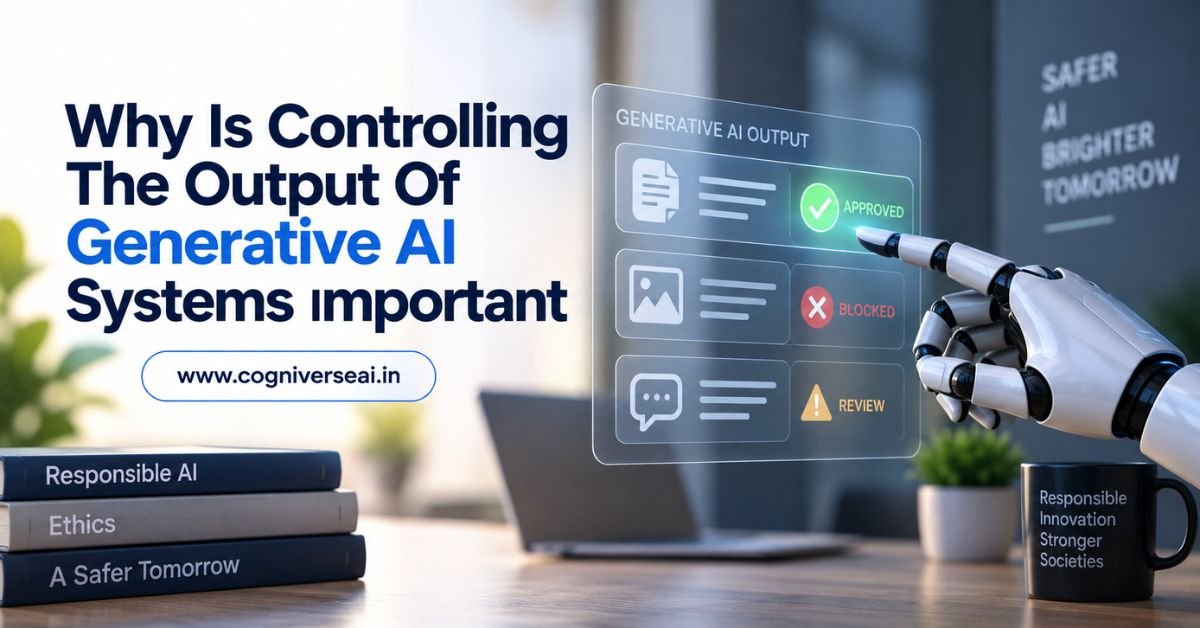
Generative artificial intelligence can create text, images, audio, video, code, summaries, and other types of content within seconds. This makes it useful for education, business, software development, marketing, research, and many everyday tasks. However, the fact that an AI system can generate something does not mean that the result is automatically accurate, safe, appropriate, or suitable for use.
So, why is controlling the output of generative AI systems important? The main reason is that AI-generated output can contain errors, harmful content, biased information, misleading claims, privacy risks, or unsafe instructions. Controlling and reviewing that output helps reduce these risks and makes AI systems more reliable and responsible.
Output control does not mean stopping AI from being creative. It means putting suitable checks around what an AI system produces and how that output is used. Depending on the situation, these checks can include content filters, validation rules, human review, source verification, access controls, structured formats, and monitoring.
This is an important part of responsible AI because the quality of an AI system depends not only on the model itself but also on how its outputs are handled.
What Does Controlling AI Output Mean?
Controlling AI output means checking or limiting the content produced by a generative AI system before it is accepted, displayed, stored, or used to make another decision.
The level of control depends on the purpose of the system.
For a simple brainstorming tool, basic review may be enough. For an AI system used in healthcare, finance, education, software, or other sensitive areas, stronger controls may be necessary.
Output control can include:
- Checking facts and sources
- Filtering harmful or inappropriate content
- Validating the format of the response
- Detecting sensitive information
- Checking for biased or unfair language
- Requiring human approval for high-risk decisions
- Sanitizing outputs before sending them to another software system
- Logging and monitoring unusual outputs
The goal is not to make every AI response identical. The goal is to make sure that the output is appropriate for its intended purpose.
Also read: Negative Impacts Of Artificial Intelligence On Society
Why Is Controlling the Output of Generative AI Systems Important?
The importance of output control comes from a simple fact: generative AI can produce convincing content that is not necessarily correct or safe.
NIST describes a common problem called “confabulation,” where generative AI produces false or incorrect information while presenting it confidently. NIST notes that such errors can become particularly serious when AI is used in high-impact areas such as healthcare or other consequential decision-making.
This means an organization should not judge an AI response only by how fluent or professional it sounds.
AI Can Produce Incorrect Information
Generative AI systems can generate answers that contain incorrect facts, missing context, or invented references.
For example, an AI tool might create a business report that includes an incorrect number or produce a summary that leaves out an important detail.
Without review, users may assume that the output is trustworthy simply because it is written clearly.
Output validation can help identify these problems before the information is used.
AI Can Produce Harmful or Inappropriate Content
Generative AI can also produce content that is offensive, unsafe, discriminatory, or otherwise inappropriate for a particular audience.
A company chatbot, for example, should not be allowed to respond to customers in a way that contains abusive language or inappropriate information.
Content moderation and clearly defined output rules can help reduce this risk.
AI Can Repeat Bias
AI systems learn patterns from data, and those patterns can sometimes reflect existing biases.
As a result, generated content may contain unfair assumptions, stereotypes, or unequal treatment.
Output checks can help organizations identify problematic language or decisions and create processes for human review.
UNESCO’s AI ethics framework emphasizes fairness, non-discrimination, transparency, and human oversight as important principles for responsible AI.
Controlling AI Output Helps Protect Users
People often interact directly with generative AI systems through chatbots, writing tools, image generators, and other applications.
Users may trust these systems because the responses sound natural and confident.
That creates a risk when a person acts on incorrect or harmful information.
For example, a student may receive an incorrect explanation and use it in an assignment. A customer may receive a wrong product instruction. An employee may copy an inaccurate summary into a business document.
Output controls can reduce the chance that problematic information reaches users without any review.
This is especially important when the consequences of an error are serious.
Output Control Is Important for Privacy
Generative AI systems can process information provided by users or connected applications. Some outputs may accidentally reveal personal, confidential, or sensitive information.
For example, an AI assistant connected to company documents could potentially include internal information in a response if the system is not designed and controlled properly.
Output monitoring can help identify sensitive data before it is displayed or passed to another system.
Privacy protection is especially important when AI is used with:
- Customer information
- Employee records
- Financial data
- Medical information
- Business secrets
- Personal identification details
A good AI system should not treat every piece of information as appropriate for every output.
Output Control Improves AI Accuracy
Controlling output is not only about blocking harmful content. It can also make AI responses more useful.
For example, an organization might require an AI system to provide answers using a specific format.
Instead of allowing a system to produce an open-ended response, a company could require:
- A short answer
- Key supporting information
- A source or reference where available
- A confidence or review indicator
- A warning when information cannot be verified
Structured outputs can make responses easier to check and integrate into business workflows.
OWASP’s 2025 guidance highlights the importance of validating, sanitizing, and appropriately handling LLM outputs before they are passed to other components or systems.
Why Output Control Matters in AI Applications?
The importance becomes even greater when AI output is connected to another system.
Imagine an application that uses an AI model to generate information and then automatically sends that information to a database, website, email system, or software tool.
If the generated output is not validated, a model response could cause unintended behavior.
OWASP identifies improper output handling as a significant risk in generative AI applications. It gives examples where unsanitized model output can contribute to security problems such as cross-site scripting, SQL injection, path traversal, or unauthorized actions when the output is passed directly into downstream systems.
This is why AI output should be treated as untrusted data unless it has been properly validated for the intended context.
Human Review Still Matters
Automation can make AI faster, but human judgment remains important for many high-impact uses.
A human reviewer can consider context that an automated filter may miss.
For example, an AI system may generate a technically correct sentence that is inappropriate for a particular customer or situation. A person may recognize the problem immediately because they understand the wider context.
UNESCO emphasizes that AI systems should not replace ultimate human responsibility and accountability.
Human review is especially useful for:
- Healthcare information
- Legal or financial content
- Important business decisions
- Educational assessments
- Public-facing communication
- Sensitive customer interactions
- High-risk automated actions
This does not mean that every AI response needs manual approval. The amount of human oversight should match the potential risk.
Controlling AI Output Helps Prevent Misinformation
Generative AI can create convincing text, images, audio, and video. That creates another challenge: misleading content can look authentic.
An AI-generated article might contain false claims. An image might show an event that never happened. A generated voice recording may sound like a real person.
Output controls can help by requiring fact checks, source verification, labels, or human review before certain content is published.
This is particularly important for organizations producing public information.
The basic principle is simple: the more important the information, the stronger the verification process should be.
Prompt Injection Makes Output Control Even More Important
Generative AI applications can also face prompt injection attacks.
A prompt injection occurs when input is crafted to change an AI system’s behavior in an unintended way. OWASP’s current guidance explains that such attacks can manipulate model outputs, expose sensitive information, influence connected functions, or affect critical decisions.
For example, an AI application may be instructed to summarize a document. If that document contains malicious instructions designed to influence the model, the output could be affected.
This shows why controlling output is only one part of a larger security approach. AI systems may need:
- Input validation
- Output validation
- Access controls
- Monitoring
- Least-privilege permissions
- Human approval for high-risk actions
- Testing against adversarial inputs
OWASP specifically recommends defining and validating expected output formats, using input and output filters, limiting system privileges, and requiring human approval for high-risk actions.
Different Types of Output Controls
There is no single method that works for every AI system.
Content Filters
Filters can look for categories of content that are not allowed or require additional review.
Examples may include harmful instructions, abusive material, or sensitive information.
Rule-Based Validation
An application can check whether the AI response follows specific rules.
For example, a system might require an output to contain a valid product ID and a predefined response format.
Source and Fact Checking
For factual applications, outputs can be checked against trusted sources or databases.
This is especially useful when accuracy matters more than creativity.
Human-in-the-Loop Review
A person can review the AI output before it is used.
This approach is particularly useful for high-risk tasks.
Monitoring and Logging
Organizations can monitor AI outputs to identify repeated errors, unusual activity, or attempts to manipulate the system.
Monitoring also makes it easier to investigate problems after they occur.
A Simple Example of Output Control
Imagine a company’s AI assistant helps customer-service employees answer questions.
Without output controls, the assistant might generate an incorrect refund policy or promise something the company does not actually offer.
A controlled system could work differently.
The AI generates an answer, then the application checks whether the response follows company rules and whether it is supported by approved information. If the answer passes the checks, it can be shown to the employee. If not, the system can flag it for review.
This approach combines AI’s speed with a layer of quality control.
The same principle can apply to many other applications.
Output Control Should Match the Risk
Not every AI application needs the same level of restriction.
Consider two examples.
A tool that generates creative birthday messages has relatively low consequences if the output is imperfect.
An AI system supporting a medical workflow has much higher potential consequences if the output is wrong.
This means organizations should use a risk-based approach.
A useful question is:
What could happen if this AI output is wrong, harmful, misleading, or misused?
The more serious the possible consequence, the stronger the testing, validation, monitoring, and human oversight should be.
Does Controlling AI Output Limit Creativity?
Some people may worry that too many controls make generative AI less useful.
That can happen if controls are designed poorly.
The goal should not be to block harmless creativity. Instead, controls should focus on the risks that actually matter for the application.
For a creative writing tool, the system may allow a wide range of language and ideas.
For a healthcare assistant, the system may require stricter factual grounding and professional review.
Good output control is therefore about appropriate boundaries, not unnecessary restriction.
How Businesses Can Build Better Output Controls?
Organizations planning to use generative AI should think about output control from the beginning rather than adding it only after a problem occurs.
A practical process can include:
Define the Intended Output
Clearly decide what the AI is supposed to produce and what it should never produce.
Identify High-Risk Scenarios
Consider what could happen if the output is wrong, manipulated, biased, or leaked.
Set Validation Rules
Use automated checks where possible to confirm that outputs follow required rules.
Add Human Review Where Needed
Use human approval for decisions or content with significant consequences.
Monitor Real-World Performance
Review the system after deployment and update controls when new problems appear.
Keep Responsibilities Clear
People should know who is responsible for reviewing, approving, correcting, and monitoring AI-generated content.
This human-centered approach is consistent with UNESCO’s emphasis on human oversight, transparency, fairness, and responsible AI governance.
The Future of Generative AI Output Control
As generative AI becomes part of more applications, output control is likely to become a standard part of AI development rather than an optional feature.
Future systems may use combinations of:
- Automated safety checks
- Source grounding
- Structured output validation
- Specialized models for verification
- Human review
- Continuous monitoring
- Security testing
- Clear audit trails
The goal will be to make AI systems useful without assuming that their outputs are automatically correct.
This is particularly important as AI moves from simple chat interfaces into systems that can interact with business software, databases, websites, and other tools.
The more power an AI application has to affect the real world, the more important output validation becomes.
Also read: Shark Tank Ideas for Students That Actually Work
Conclusion
So, why is controlling the output of generative AI systems important? Because generative AI can produce information that is incorrect, biased, harmful, misleading, private, or unsafe to use without review.
Output control helps organizations reduce these risks through validation, filtering, source checking, human oversight, security controls, and monitoring. It also helps ensure that AI-generated content fits the purpose for which it was created.
This matters because an AI system is not useful simply because it can generate content quickly. It must also produce content that people can use safely and appropriately.
The right approach is not to control every AI output in exactly the same way. Instead, organizations should match their controls to the risk, purpose, audience, and potential consequences of the system.
When AI is used responsibly, output control can help balance innovation with accuracy, safety, privacy, security, and human accountability. That makes it an important part of ethical and practical generative AI adoption.
Frequently Asked Questions (FAQ)
1. Why is controlling AI output important?
It helps reduce inaccurate, harmful, biased, misleading, private, or unsafe content produced by generative AI systems.
2. Can generative AI always produce accurate information?
No. Generative AI can produce confident but incorrect information, so important outputs may need verification or human review.
3. What is AI output validation?
AI output validation means checking generated content against rules, expected formats, trusted information, safety requirements, or other quality standards.
4. Does human review matter in generative AI?
Yes. Human oversight can help identify context, accuracy, fairness, and safety problems that automated controls may miss.
5. How can businesses control generative AI output?
They can use filters, validation rules, source checking, access controls, monitoring, and human approval for high-risk outputs.
1 thought on “Why Is Controlling The Output Of Generative AI Systems Important?”