Artificial intelligence is becoming part of everyday business operations. Organizations use AI for customer support, data analysis, marketing, software development, document processing, research, automation, and many other tasks. As AI becomes more common, executives and leaders have an important role in making sure employees know how to use it and that the technology is introduced responsibly.
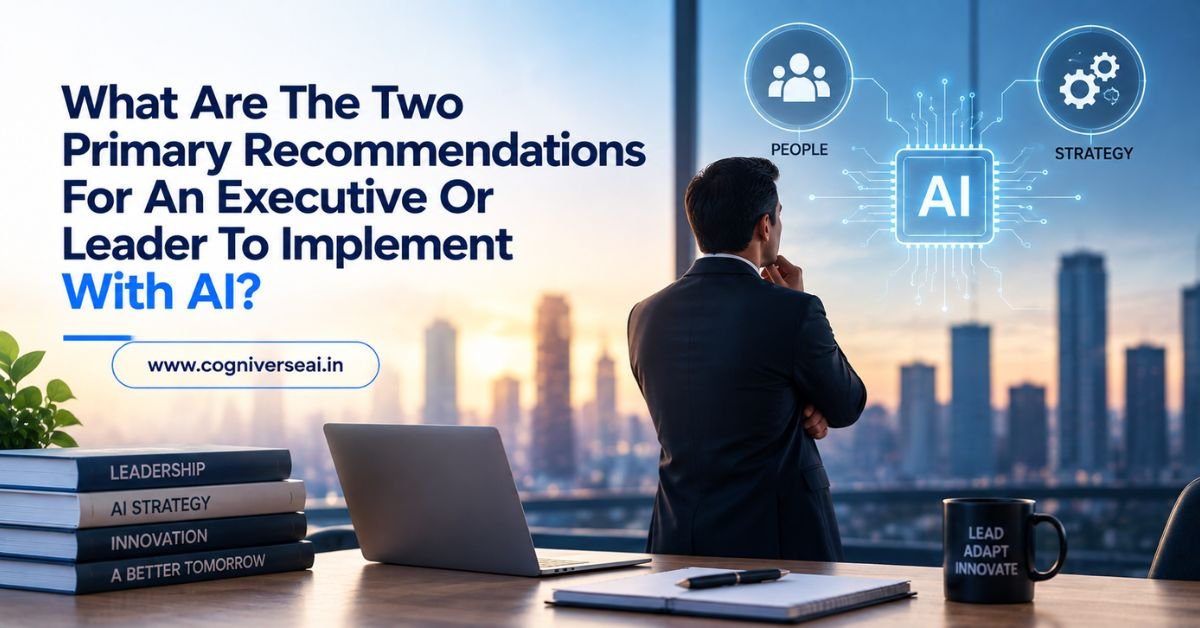
So, what are the two primary recommendations for an executive or leader to implement with AI? The two recommendations are offer training for all employees and establish an AI ethics board.
These two actions address two important parts of AI adoption. Employee training helps people understand how to use AI effectively, recognize its limitations, protect sensitive information, and work with AI responsibly. An AI ethics board or similar governance group can provide oversight and help an organization address issues such as privacy, bias, accountability, transparency, security, and responsible AI use.
These recommendations should not be viewed as the only steps an organization needs. AI implementation also requires suitable policies, risk assessment, technical controls, monitoring, and clear responsibilities. However, training and ethical oversight provide a strong foundation for responsible AI adoption.
Why Executives Have an Important Role in AI Implementation?
AI implementation is not only a technical decision.
An organization may purchase an AI tool, but the tool will still be used by people. Employees decide what information to provide, how to use the output, whether to verify it, and when to rely on it.
Leadership decisions also influence the organization’s overall approach to AI.
For example, executives may need to decide:
- Which AI uses are appropriate
- What information employees can enter into AI systems
- Who is responsible for reviewing AI outputs
- Which decisions require human approval
- What employees need to learn
- How AI risks should be monitored
- How the organization should respond when an AI system causes a problem
The NIST AI Risk Management Framework is designed to help organizations manage AI risks throughout the design, development, deployment, use, and evaluation of AI systems. It also emphasizes organizational roles, responsibilities, risk management, and trustworthy AI practices.
This shows why AI leadership involves both people and governance, not just technology.
Also read: Why Might Marketers Use Text-to-image Models In The Creative Process?
Recommendation One: Offer Training for All Employees
The first primary recommendation is to offer AI training for all employees.
AI should not be treated as a tool that only the IT department needs to understand. Employees in different departments may interact with AI in different ways, even when they are not directly responsible for developing an AI system.
For example, a marketing employee may use AI to create content, while a finance employee may use it to summarize documents. A customer-service employee may work with an AI assistant, while a manager may use AI to analyze business information.
Each person needs to understand the basic rules and risks that apply to their work.
What Should AI Employee Training Include?
AI training should go beyond teaching employees how to write prompts.
A useful program can cover:
- Basic AI concepts
- Generative AI and machine learning
- Strengths and limitations of AI
- AI-generated errors and hallucinations
- Data privacy and security
- Bias and fairness
- Fact checking and source verification
- Appropriate use of company information
- Human review and accountability
- AI-related company policies
The goal is to help employees become informed AI users rather than simply giving them access to AI tools.
UNESCO’s AI ethics framework specifically highlights awareness, literacy, education, digital skills, and AI ethics training as important parts of responsible AI adoption.
Why Training All Employees Matters?
Imagine that an organization gives every employee access to a generative AI assistant but provides no training.
One employee may know not to enter confidential data into an external service.
Another employee may unknowingly upload a sensitive document.
One employee may verify an AI-generated answer before using it.
Another may copy it directly into a customer communication.
The technology is the same, but the behavior is different.
Training creates a common understanding of how AI should be used.
It also helps employees understand that an AI-generated answer is not automatically correct simply because it sounds professional.
AI Training Should Be Practical
Employees usually learn technology more effectively when training is connected to their actual work.
Instead of teaching only general AI concepts, organizations can use realistic examples.
For a marketing team, training could cover:
- Creating content with AI
- Reviewing AI-generated claims
- Protecting customer information
- Checking images and text before publication
For a customer-service team, training could cover:
- Reviewing AI responses
- Identifying incorrect information
- Escalating sensitive requests
- Protecting customer data
For managers, training could cover:
- Evaluating AI proposals
- Understanding AI-related risks
- Approving appropriate use cases
- Monitoring AI adoption
This makes AI training more useful because employees can see how the rules apply to their daily responsibilities.
Training Should Explain AI’s Limitations
One of the most important parts of employee training is teaching people what AI cannot reliably do.
Generative AI systems can produce incorrect information, incomplete answers, fabricated references, or misleading content. NIST’s Generative AI Profile identifies confabulation as a risk in which AI systems can generate false or incorrect content that may appear convincing.
Employees should therefore learn to ask:
Is this answer accurate?
Can this information be verified?
Does the original source support it?
Could this output contain sensitive information?
Does this task require human judgment?
These questions can prevent many practical problems.
Recommendation Two: Establish an AI Ethics Board
The second primary recommendation is to establish an AI ethics board or another appropriate AI governance group.
An AI ethics board is a group that helps an organization think through the ethical, social, legal, and operational issues associated with AI.
The exact structure can vary from one organization to another.
A large company might have a formal cross-functional AI governance committee. A smaller organization may assign these responsibilities to an existing risk, compliance, legal, technology, or ethics group.
The important point is not the name of the group. It is having clear responsibility for reviewing AI-related risks and governance questions.
What Can an AI Ethics Board Do?
An AI ethics board can help an organization:
- Review proposed AI use cases
- Identify potential risks
- Develop responsible AI guidelines
- Consider privacy and data protection
- Review possible bias and discrimination
- Define human oversight requirements
- Establish accountability
- Review high-risk applications
- Respond to significant AI incidents
- Update policies as technology changes
NIST’s AI Risk Management Framework emphasizes clear roles and responsibilities for managing AI risks, while its broader framework focuses on trustworthy characteristics such as safety, security, transparency, explainability, privacy, and fairness.
Why Ethical Oversight Matters
AI systems can affect real people.
An organization may use AI to help screen applications, recommend products, assess information, interact with customers, or support internal decisions.
Even when AI provides only a recommendation, its output can influence what people do.
This raises important questions.
What data is being used?
Could the system produce biased results?
Can people understand the role AI played?
Who reviews the output?
What happens when the system is wrong?
Who is accountable?
An ethics or governance group can help make sure these questions are considered before problems occur.
AI Ethics Is More Than Avoiding Bad Outcomes
Ethical AI is not only about preventing obvious harm.
It is also about making sure AI is used in ways that respect people and support organizational goals.
UNESCO’s AI ethics recommendation identifies principles including human dignity and rights, transparency and explainability, human oversight, sustainability, awareness and literacy, and fairness and non-discrimination.
For an organization, this means ethical review may involve questions such as:
- Is AI genuinely useful for this task?
- Is the data appropriate?
- Is the system fair to affected groups?
- Is human review available?
- Is the process understandable?
- Is the technology secure?
- Are users informed when AI is involved?
- Are there safer alternatives?
This helps leaders think beyond the question of whether AI can perform a task and consider whether it should be used in a particular way.
How Employee Training and an Ethics Board Work Together?
The two recommendations are most useful when they support each other.
Employee training focuses on individual understanding and responsible use.
An AI ethics board focuses on organizational oversight and governance.
Consider a simple example.
A company introduces an AI tool that employees can use to summarize internal documents.
Training can teach employees not to enter confidential information into unauthorized AI services and to verify generated summaries.
The AI governance group can establish which tools are approved, determine what information may be processed, define review requirements, and evaluate privacy and security risks.
Together, these measures create a stronger system than either one alone.
What Happens Without Employee Training?
Without adequate training, employees may use AI in inconsistent ways.
Some may use it carefully.
Others may:
- Trust inaccurate output
- Share confidential data
- Use AI for tasks they should not automate
- Fail to disclose AI involvement where required
- Accept biased recommendations without questioning them
- Misunderstand company AI policies
This can create operational, security, privacy, and reputational risks.
Training helps reduce these problems by giving employees a shared baseline of knowledge.
It also makes it easier for employees to recognize when they should ask for help.
What Happens Without AI Governance?
Without a governance structure, AI use can become fragmented.
Different departments may purchase different tools, create different rules, and use AI in inconsistent ways.
This can make it difficult to answer basic questions:
Who approved the tool?
What information can employees enter?
Who checks the output?
How is performance evaluated?
Who responds if something goes wrong?
A governance structure helps establish ownership and accountability.
NIST describes AI risk management as an ongoing process rather than a one-time activity, covering areas such as governing, mapping, measuring, and managing risk.
Building an Effective AI Training Program
An organization does not need to create a complicated training program from the beginning.
A practical approach is to begin with basic AI literacy and then provide role-specific training.
Start With the Basics
Employees should understand what AI is, how generative AI works at a high level, and why AI outputs can contain errors.
Teach Data Safety
Employees should know what information is confidential, what data can be entered into approved systems, and what information should never be shared without authorization.
Explain Verification
Employees should learn to check important facts rather than treating AI responses as automatically reliable.
Use Department-Specific Examples
Training should reflect the real work employees perform.
Refresh Training
AI tools and organizational policies change. Training should therefore be updated when important tools, risks, or rules change.
Building an AI Ethics Board
An AI ethics board should include people who can bring different perspectives to AI decisions.
Depending on the organization, this might include representatives from:
- Leadership
- Technology
- Legal
- Compliance
- Security
- Human resources
- Data protection
- Business teams
- Risk management
The exact structure should depend on the organization’s size, industry, and AI use cases.
The board should also have a clearly defined purpose.
It should be able to review important AI proposals, raise concerns, request additional testing, and recommend safeguards.
AI Governance Should Not Block Innovation
A common concern is that governance may slow down AI adoption.
Poorly designed governance can create unnecessary bureaucracy. But responsible governance does not have to mean stopping every experiment.
A better approach is to match oversight to risk.
For a low-risk use such as brainstorming marketing ideas, a simple policy and employee training may be sufficient.
For a system that could affect employment, healthcare, financial decisions, or other high-impact areas, stronger testing and human oversight may be necessary.
NIST’s framework is designed to be flexible and use-case agnostic, allowing organizations to apply risk-management practices according to their particular needs.
Measuring Whether AI Implementation Is Working
Executives should also evaluate whether the organization’s AI program is producing useful results.
Useful questions include:
- Are employees using AI responsibly?
- Are employees completing training?
- Are AI-related incidents being identified?
- Are high-risk use cases receiving appropriate review?
- Are AI outputs being checked where necessary?
- Are employees reporting problems?
- Are approved AI tools actually helping the business?
Metrics should not focus only on how many AI tools the company has purchased.
Responsible adoption also requires measuring quality, risk, user understanding, and business value.
A Simple Example
Imagine a company introduces generative AI to help employees prepare customer emails.
The organization can apply both recommendations.
First, employees receive training explaining how to use the tool, verify AI-generated information, protect customer data, and review messages before sending them.
Second, the AI ethics or governance group establishes rules about which customer information can be processed, which communications require human approval, and how problematic outputs should be reported.
The result is a more controlled implementation.
AI helps employees work more efficiently, while training and governance reduce avoidable risks.
Why These Two Recommendations Matter for Responsible AI?
The two recommendations address two different but connected needs.
Training prepares people.
Ethical governance guides the organization.
This distinction is important because AI risks do not come only from the technology.
They can also come from misunderstanding, poor processes, weak policies, inappropriate data use, insufficient oversight, and unclear accountability.
A technically advanced AI system can still create problems if the people using it do not understand its limitations.
Similarly, an organization can have strong policies but still face problems if employees do not understand or follow them.
That is why both sides matter.
Also read: Holocaust Project Ideas for Students
Conclusion
So, what are the two primary recommendations for an executive or leader to implement with AI? The two recommendations are offer training for all employees and establish an AI ethics board.
Training gives employees the knowledge they need to use AI effectively and responsibly. It can help them understand AI’s capabilities and limitations, protect sensitive information, verify outputs, and recognize situations that require human judgment.
An AI ethics board or suitable governance group provides organizational oversight. It can help review AI use cases, identify ethical and operational risks, establish guidelines, define accountability, and make sure important AI decisions receive appropriate human attention.
These two steps should be supported by broader measures such as AI policies, risk assessments, technical security, monitoring, testing, and regular reviews.
The central idea is simple: successful AI adoption is not only about choosing powerful technology. It is also about preparing people and creating responsible structures around that technology.
When employees understand AI and leaders provide appropriate ethical oversight, organizations are better positioned to use AI in a way that is useful, accountable, and aligned with responsible AI principles.
Frequently Asked Questions (FAQ)
1. What are the two primary recommendations for an executive or leader to implement with AI?
The two recommendations are to offer AI training for all employees and establish an AI ethics board or suitable governance group.
2. Why should executives provide AI training to employees?
Training helps employees understand AI tools, recognize limitations, protect data, verify outputs, and use AI responsibly in their jobs.
3. What is the purpose of an AI ethics board?
It provides oversight for AI use and helps address issues such as fairness, privacy, transparency, accountability, security, and human oversight.
4. Is an AI ethics board required for every organization?
Not necessarily. Organizations can use different governance structures depending on their size, industry, AI applications, and level of risk.
5. Why are training and AI governance both important?
Training supports responsible employee behavior, while governance creates organization-wide rules, oversight, accountability, and risk-management processes.
1 thought on “What Are The Two Primary Recommendations For An Executive Or Leader To Implement With AI?”