Marketing depends heavily on strong visual communication. A social media post, digital advertisement, product campaign, website banner, or email often needs an image that quickly explains an idea and catches attention. Creating those visuals traditionally involves planning, photography, design work, editing, and multiple rounds of revisions.
Text-to-image models have introduced another option. A marketer can describe a visual idea in natural language and use an AI system to create an image or a set of visual concepts. This can make the creative process faster and give marketing teams more ways to explore an idea.
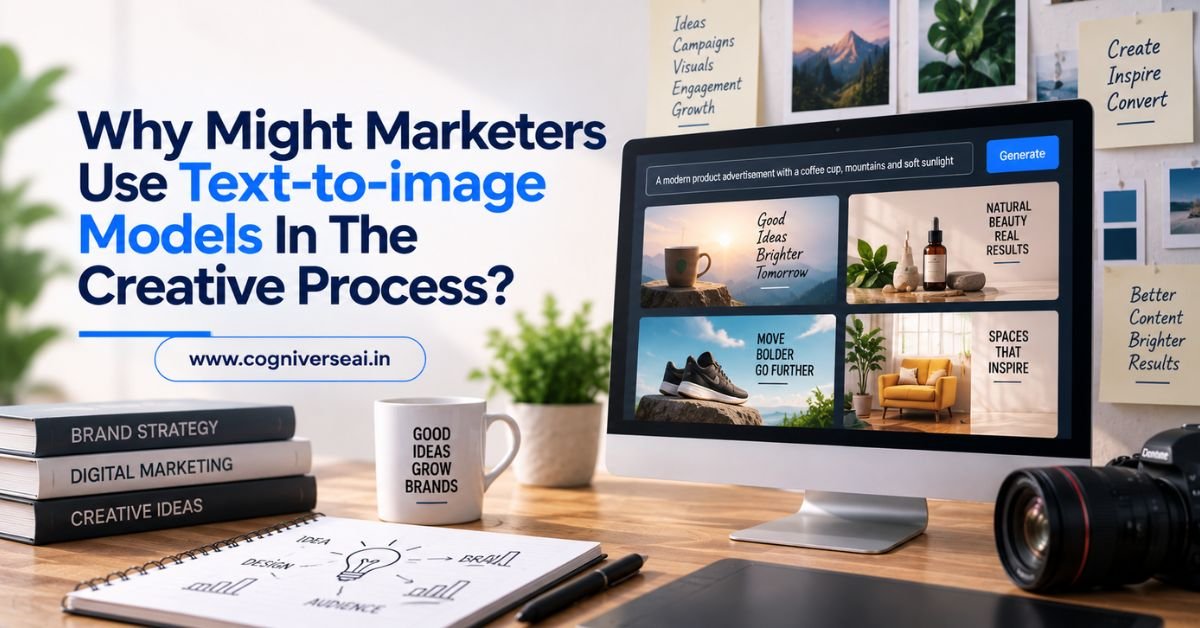
So, why might marketers use text-to-image models in the creative process? The main reason is that text-to-image models can help marketers quickly turn ideas into visual concepts, create multiple creative variations, experiment with different styles and settings, and produce supporting visual assets more efficiently.
The important point is that these tools are most useful as part of the creative process, not as an automatic replacement for marketers, designers, photographers, or brand strategy. Human judgment is still needed to decide whether an image is accurate, useful, on-brand, appropriate for the audience, and suitable for the campaign.
What Are Text-to-Image Models?
Text-to-image models are generative AI systems that create images from written instructions called prompts.
A marketer might enter a description such as:
“Create a clean lifestyle image of a reusable water bottle on a wooden desk near a window, with soft morning light and a modern office background.”
The system then generates one or more images based on the prompt.
The exact capabilities vary between tools, but modern image-generation systems can often help with concepts such as composition, background, lighting, style, objects, colors, and visual settings.
Marketing platforms are also increasingly integrating generative image features directly into advertising workflows. Google Ads, for example, provides tools that can generate new image assets, create variations, edit existing images, and adapt assets for different formats.
Also read: Why Is Controlling The Output Of Generative AI Systems Important?
Why Might Marketers Use Text-to-Image Models in the Creative Process?
The biggest reason is simple: they can reduce the time and effort required to explore visual ideas.
Marketing teams often need more than one image. A campaign may require different concepts for Instagram, search ads, display advertising, websites, email, presentations, and other channels.
Text-to-image models can help marketers move from a rough idea to several visual directions without having to produce every concept manually from the beginning.
Google’s advertising tools now explicitly position generative AI as a way to create more asset variety, overcome limited creative resources, and refine generated assets before publishing.
That makes text-to-image AI useful in several parts of the marketing workflow.
Faster Creative Ideation
One of the strongest uses of text-to-image models is creative brainstorming.
A marketer may have an idea but not yet know exactly what the final visual should look like.
Instead of describing the idea only with words in a meeting, the marketer can create several visual concepts.
For example, imagine a travel company promoting a winter destination.
The team could explore ideas involving:
- A snowy mountain landscape
- A cozy cabin with warm lighting
- Travelers standing near an icy lake
- A city street during snowfall
- A family preparing for a winter trip
These images do not necessarily need to become final advertisements. They can simply help the team decide which creative direction feels strongest.
This makes AI useful as a visual brainstorming tool.
Creating More Creative Variations
Marketers rarely create just one version of a campaign.
They may need different visual concepts for different audiences, platforms, seasons, messages, or product features.
Text-to-image models can help generate variations from a shared idea.
For example, a skincare brand could explore the same product concept in several settings:
- A clean bathroom
- A natural outdoor environment
- A minimalist studio
- A travel setting
- A morning skincare routine
The marketing team can compare the visual directions before deciding which one fits the campaign.
This ability to explore multiple options quickly can be valuable when a team wants creative variety without starting every concept from zero.
Saving Time in the Early Stages
Traditional creative production can involve several steps before a final image exists.
There may be a creative brief, mood boards, location decisions, photography, styling, image selection, editing, and approvals.
Text-to-image models can shorten some of the early exploration.
A marketer can use AI to create a rough visual direction before investing in a full production process.
For example, a company planning a seasonal product campaign could use AI images to test different moods and compositions during the planning stage.
Once the team has a clearer direction, it can decide whether to use photography, illustration, 3D work, AI-generated visuals, or a combination of methods.
This is an important distinction: AI can help decide what should be created before the team spends more time and money producing the final asset.
Supporting Visual Storytelling
Good marketing is not only about showing a product. It is often about showing the product in a meaningful situation.
A marketer may want customers to imagine how a product fits into their lives.
Text-to-image tools can help explore these situations.
For example, instead of showing only a coffee machine on a plain background, a campaign might show the product in a bright kitchen during a relaxed morning routine.
For a sports brand, the same product might be visualized in a training environment.
For a furniture company, a chair could be shown in a modern home office.
These concepts can help marketers think about the story surrounding a product rather than focusing only on the product itself.
Creating Images for Different Marketing Formats
Marketing campaigns often need different image dimensions and compositions.
A visual designed for a website banner may not work well as a vertical social media post. A landscape advertisement may need a different composition from a square product image.
AI-powered creative tools can help marketers generate or adapt assets for different formats.
Google Ads currently provides image-generation and image-editing capabilities that include aspect-ratio adjustments and different creative versions for advertising placements.
This can reduce some repetitive production work.
However, the marketer still needs to check whether the important part of the image remains visible and whether the composition works naturally in each format.
Personalizing Creative Ideas for Different Audiences
Different audiences may respond to different visual contexts.
A company may want one campaign to speak to students, professionals, families, or travelers. The core product can stay the same while the visual setting changes.
Text-to-image tools make it easier to explore these variations.
For example, a laptop brand might visualize the same product in:
- A student study space
- A home office
- A creative studio
- A business meeting
The purpose is not to assume that AI knows what every audience wants. Instead, marketers can use these visual concepts to test different creative directions and then make decisions using audience research and campaign results.
Helping Small Marketing Teams
Large companies may have designers, photographers, video teams, copywriters, and creative agencies.
Smaller businesses may have only one or two people handling marketing.
Text-to-image tools can give smaller teams another way to explore visual concepts when they have limited resources.
A small business could use AI to create early campaign concepts, background ideas, mood boards, or draft visuals before deciding which pieces need professional photography or design.
This can help the team spend its limited creative resources where they provide the most value.
Testing Ideas Before Full Production
This is one of the most practical reasons marketers may use text-to-image models.
Imagine a business is considering three campaign concepts. Producing three full photo shoots could be expensive and time-consuming.
Instead, marketers can first create rough AI-generated versions of each concept.
The team can then ask:
- Which concept communicates the message most clearly?
- Which composition fits the brand?
- Which image gives the product enough attention?
- Which idea works better for the target audience?
- Which concept is worth developing further?
The AI image does not need to be the final asset. It can simply help the team make a better creative decision.
Keeping the Human Creative Process at the Center
Text-to-image models can generate visuals, but they do not replace the broader marketing process.
A successful campaign still needs:
- A clear marketing objective
- Audience understanding
- Brand strategy
- Strong messaging
- Creative direction
- Appropriate design choices
- Review and approval
- Performance analysis
An AI model does not automatically know what a brand stands for or what a customer should feel when seeing an advertisement.
The marketer provides that context.
For this reason, text-to-image AI works best as a creative assistant rather than a complete creative director.
Why Brand Consistency Still Matters?
One of the biggest challenges with AI-generated images is consistency.
A company may have specific colors, visual styles, product proportions, packaging, photography standards, and brand rules.
An AI-generated image can look attractive while still being wrong for the brand.
Marketing teams should therefore check:
- Brand colors
- Product appearance
- Logo placement
- Typography
- Visual style
- Background choices
- Image quality
- Audience suitability
Google’s current advertising tools allow marketers to provide brand guidelines and product images to help generate assets that align more closely with a brand, while still offering manual editing and refinement.
AI can accelerate production, but brand quality still depends on human review.
Accuracy Matters When Products Are Shown
Marketers also need to be careful when AI generates or modifies images of real products.
An AI-created product may have incorrect proportions, materials, labels, packaging details, buttons, screens, or other features.
This can become a problem if the image makes a product look different from what customers will actually receive.
For product advertising, marketers should compare the generated visual with the real product and correct anything misleading.
A beautiful image is not a successful marketing asset if it creates false expectations.
Copyright, Policy, and Transparency Considerations
Using generative AI in marketing also brings legal and policy questions.
Companies should understand the rules that apply to their market, platform, and type of content. They should also review the terms governing the AI tool they use.
Transparency can matter as well.
For example, Google currently provides AI-related labeling and disclosure features for certain advertising assets and notes that some regulations, including requirements affecting India, may require disclosures for certain AI-generated or AI-edited advertising content.
Rules can vary by jurisdiction and change over time, so marketers should check current requirements rather than assuming that one rule applies everywhere.
When Text-to-Image AI May Not Be the Best Choice?
Text-to-image models are useful, but they are not always the right solution.
Professional photography may be better when:
- Exact product details must be shown
- A real person needs to be represented accurately
- Packaging must match the real item
- The campaign depends on authentic locations
- Real customer experiences are important
- Brand photography has a specific established style
For some campaigns, real photographs may create stronger trust and authenticity.
AI is most useful when it solves a real creative problem rather than being used simply because it is available.
How Marketers Can Use Text-to-Image Models Responsibly?
A practical workflow can make AI-generated visuals much more useful.
Start With the Marketing Goal
Define what the image needs to achieve before writing the prompt.
Give the Model Clear Context
Describe the audience, product, visual style, setting, mood, composition, and important brand requirements.
Generate Multiple Concepts
Do not assume that the first result is the best one. Create several directions and compare them.
Review Every Important Detail
Check products, people, text, logos, colors, proportions, and overall accuracy.
Refine With Human Editing
AI generation can be combined with traditional design tools and human creative decisions.
Check Platform and Legal Requirements
Before publishing, review advertising policies, disclosure requirements, usage rights, and brand guidelines.
This approach treats AI as part of a controlled creative workflow instead of an automatic publishing machine.
The Future of AI in Marketing Creativity
Text-to-image models are likely to become increasingly connected with broader marketing workflows.
Instead of using AI only to make one image, marketers may use it to explore concepts, adapt visuals, create variations, generate different formats, and refine campaign assets.
Advertising platforms are already moving in this direction. Google’s current tools, for example, combine prompt-based generation with editing, brand guidance, asset variation, and campaign workflows.
But the growing availability of AI also makes human judgment more important.
Marketing teams still need to decide what the brand should communicate, which visuals are truthful, what feels authentic, what is appropriate for the audience, and which creative ideas actually support the campaign goal.
Also read: National Winning Science Fair Projects
Conclusion
So, why might marketers use text-to-image models in the creative process? They may use them to generate visual ideas quickly, explore multiple concepts, create creative variations, test campaign directions, adapt visuals for different formats, and support faster content production.
The biggest value is not simply that AI can create pictures. Its real value is that it can help marketers move from an idea to a visual concept much faster.
That can make brainstorming more practical, help small teams explore more options, and allow larger teams to produce and test a wider range of creative ideas.
At the same time, AI-generated images require human review. Marketers need to protect brand consistency, check product accuracy, consider audience expectations, and follow applicable advertising and disclosure requirements.
The strongest creative process is therefore not AI instead of humans. It is AI supporting human creativity, strategy, judgment, and editing.
When marketers use text-to-image models thoughtfully, the technology can become a useful part of the creative process without replacing the human decisions that make marketing meaningful.
Frequently Asked Questions (FAQ)
1. Why do marketers use text-to-image AI?
They use it to brainstorm visual ideas, create variations, test concepts, and produce supporting creative assets more quickly.
2. Can text-to-image models replace graphic designers?
Not completely. Designers provide creative direction, brand judgment, editing skills, and quality control that AI does not reliably replace.
3. How can marketers use AI-generated images responsibly?
They should review accuracy, brand consistency, product details, audience suitability, platform policies, and applicable disclosure or legal requirements.
4. Are AI-generated images suitable for advertising?
They can be, but marketers should verify the image, follow advertising rules, and ensure the visual does not misrepresent the product or brand.
5. What is the biggest benefit of text-to-image models for marketers?
A major benefit is faster visual experimentation, allowing marketers to explore more creative directions before choosing what to develop further.
1 thought on “Why Might Marketers Use Text-to-image Models In The Creative Process?”